Asking for Directions in Spanish in Mexico City
To ask for directions in Spanish in Mexico City, start with disculpe, excuse me, then ask dónde está, where is, with the place: ¿Dónde está el metro? Asking is the easy part. The answer is harder, because it comes as a quick string of words like derecho, dos cuadras, y a la izquierda: straight ahead, two blocks, then left. Below are the question, the handful of words the answers are built from, the one-letter difference to watch for, and the habit that keeps you on track, with recordings from Habla’s getting-around unit.
How to stop someone and ask the way
In the course, Tom stops a stranger in the street. He opens with one word to get her attention, then asks his question:
Tom, a newcomer, asks
Disculpe, ¿dónde está el metro?
Excuse me, where’s the metro?
Disculpe is excuse me. The course notes that it is the polite way to get a stranger’s attention, and that to someone your own age you would say disculpa. With a stranger in the street, disculpe is the safe choice.
The question itself is dónde está, where is, plus the place:
You ask
¿Dónde está el metro?
Where’s the metro?
Disculpe first, to a stranger. ¿Dónde queda…? is the same question.
The course notes that ¿Dónde queda...? is the same question, so you may hear either one. Swap in any place you need. The course also uses this shape for the bathroom, with ¿Dónde está el baño?
Understanding the answer
Here is the answer Tom gets, in the course’s street scene:
Doña Lupe says
Derecho, dos cuadras, y a la izquierda.
Straight ahead, two blocks, then left.
It sounds like one long phrase, but it is three short pieces. Derecho is straight ahead. Dos cuadras is two blocks. A la izquierda is to the left. The course builds its directions from these pieces, so it is worth learning them one at a time:
You say
Derecho.
Straight ahead.
You’ll hear todo derecho and the diminutive derechito: keep going straight.
You say
Está a dos cuadras.
It’s two blocks away.
Una cuadra is a block. Está a… says how far something is.
You say
A la izquierda.
To the left.
The course notes that una cuadra is a block and that está a... says how far something is. You will also hear todo derecho and the diminutive derechito, both meaning keep going straight.
When Tom checks, the answer comes with a phrase worth knowing:
Doña Lupe says
Sí, a la izquierda. No tiene pierde.
Yes, left. You can’t miss it.
No tiene pierde is you can’t miss it. When you hear it, the directions are finished.
Right or straight ahead: the one-letter trap
This is the part to watch. The word for right and the word for straight ahead are one letter apart:
You say
A la derecha.
To the right.
Derecha with an a is right. Derecho with an o is straight ahead.
Derecha, with an a, is right. Derecho, with an o, is straight ahead. In a quick answer the last vowel is easy to miss, and getting it wrong sends you in a completely different direction.
Two habits help. First, listen for what comes in front: in the course’s lines, the turns come as a la derecha and a la izquierda, while straight ahead is derecho on its own, or sigue derecho, keep straight on. Second, if you are not sure which one you heard, ask. The next section shows the easiest way.
You will meet a la derecha indoors too. When Diego asks for the bathroom at Sofía’s café, this is the answer:
Sofía, the barista, says
Al fondo, a la derecha.
At the back, on the right.
Al fondo, a la derecha is at the back, on the right. Same word, same trap, just a shorter walk.
First, second, third street
Instead of blocks, some answers count streets. The course teaches these two lines for it:
You say
La segunda calle a la derecha.
The second street on the right.
Primera, segunda, tercera: first, second, third, agreeing with calle.
You say
La segunda calle a la izquierda.
The second street on the left.
La segunda calle a la derecha is the second street on the right, and a la izquierda swaps in the left. The course notes the order words: primera, segunda, tercera, first, second, third, agreeing with calle. On the course’s walk to the Zócalo, Tom shortens it to la segunda a la derecha.
Listen for the order word first, then the side. If you only catch one, catch the number: it tells you how far to go before you need to think about the side.
Say it back to be sure
The single best habit for directions is to repeat the key part back as a question. The course calls saying directions back the best way to be sure you got them. Tom does it in the street scene:
You ask
¿A la izquierda?
To the left?
Saying a direction back to check it.
Doña Lupe says
Sí, sí, a la izquierda.
Yes, yes, to the left.
¿A la izquierda?, to the left?, and the answer sí, sí, a la izquierda settles it. It costs you two seconds.
For a longer direction, repeat the whole thing:
You ask
¿La segunda calle a la derecha?
The second street on the right?
Saying directions back is the best way to be sure you got them.
If you got it wrong, this is when you find out, while the person who knows the way is still standing in front of you. If the answer came too fast to repeat at all, the course has lines for asking someone to slow down or say it again; see what to say when you don’t understand Spanish in Mexico.
Saying thank you and moving on
Once you have it, a warm thank you closes the exchange:
You say
Muchas gracias.
Thank you very much.
You’ll also hear mil gracias, a thousand thanks.
In the course, Doña Lupe answers Tom’s thanks with de nada, joven, you’re welcome, young man. A short muchas gracias and you are on your way.
Directions to a place that needs the metro, or to one that might be a long walk, bring their own questions. For those, see Spanish for the Mexico City metro and Metrobús and asking if a place is far.
Every line on this page is a recording from Habla’s course. In the app you hear a line, say it out loud, and see what it heard. The most useful drill here is the trap: play a la derecha and derecho until you can tell them apart without thinking, then practice saying each direction back as a question.
Every line on this page
The 15 lines above, in order, for one last listen before you go. Each one is the recording from the Habla course.
Disculpe, ¿dónde está el metro?Excuse me, where’s the metro?
¿Dónde está el metro?Where’s the metro?
Derecho, dos cuadras, y a la izquierda.Straight ahead, two blocks, then left.
Derecho.Straight ahead.
Está a dos cuadras.It’s two blocks away.
A la izquierda.To the left.
Sí, a la izquierda. No tiene pierde.Yes, left. You can’t miss it.
A la derecha.To the right.
Al fondo, a la derecha.At the back, on the right.
La segunda calle a la derecha.The second street on the right.
La segunda calle a la izquierda.The second street on the left.
¿A la izquierda?To the left?
Sí, sí, a la izquierda.Yes, yes, to the left.
¿La segunda calle a la derecha?The second street on the right?
Muchas gracias.Thank you very much.
Common questions
How do you ask “where is” in Spanish?
Use dónde está, where is, with the place, as in ¿Dónde está el metro? Start with disculpe to a stranger. The course notes that ¿Dónde queda...? is the same question.
What is the difference between derecha and derecho?
Derecha, with an a, is right, as in a la derecha. Derecho, with an o, is straight ahead. They are one letter apart, so say the direction back to check which one you heard.
What does no tiene pierde mean?
It means you can’t miss it. In the course it closes a set of directions to the metro: Sí, a la izquierda. No tiene pierde.
How do you say “block” in Spanish in Mexico?
The course uses cuadra: una cuadra is a block, and está a dos cuadras means it is two blocks away.
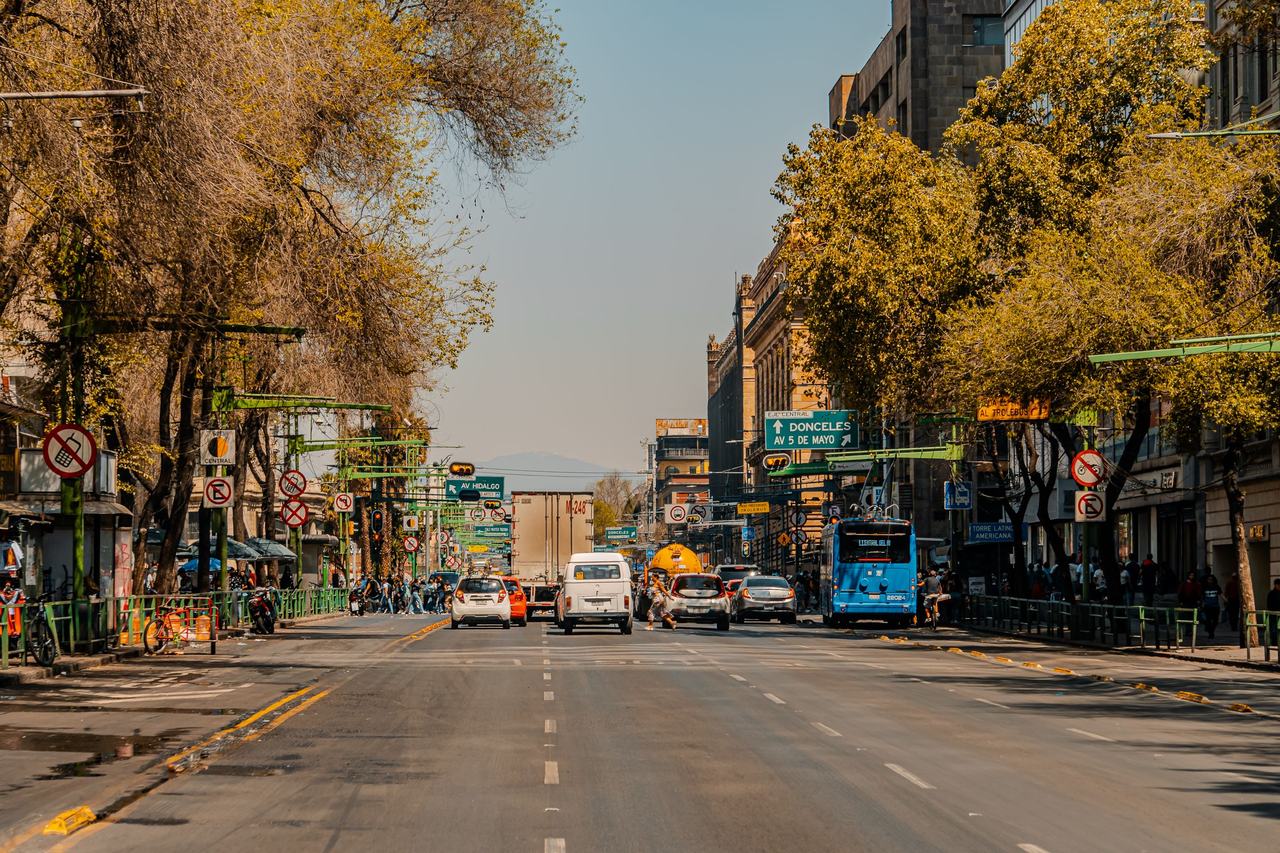
Opening photograph: Cars, vans and a blue city bus move down a wide, tree-lined avenue in Mexico City. Photograph by Jimmy Elizarraras on Pexels. Blog photo credits.