Spanish for the Mexico City Metro and Metrobús
The Spanish you need for the Mexico City metro comes down to four short questions. Ask how to get there with cómo llego a, how do I get to, plus the place, then which line, how many stations, and where to get off: ¿Cuál línea tomo? ¿Cuántas estaciones son? ¿Dónde me bajo? The answers come back in a few set words too: toma la línea, take line, te bajas en, you get off at, and directo, sin transbordo, direct, with no transfer. Below are the questions, the answers and the Metrobús version, with recordings from Habla’s getting-around unit.
The one question for any destination
Every route starts with the same question. In the course, Tom asks Mariana how to get to Coyoacán:
You ask
¿Cómo llego a Coyoacán?
How do I get to Coyoacán?
Literally: how do I arrive at…? The question for any place in the city.
Cómo llego a literally asks how do I arrive at. The course calls it the question for any place in the city, so you only need to change the name at the end. Here it is with another stop from the course, Chapultepec, which the course describes as the city’s great park, with the castle and the museums:
You ask
¿Cómo llego a Chapultepec?
How do I get to Chapultepec?
In the course’s role play, Mariana opens by offering help: ¿Te ayudo con algo?, need a hand with something? That is your opening to ask the route.
Which line: numbers and colors
Once you know you are taking the metro, the next thing to find out is the line. The course gives the question, with a note about how Mexicans phrase it:
You ask
¿Cuál línea tomo?
Which line do I take?
Metro lines have numbers and colors. Mexicans say ¿Cuál línea? where a textbook says ¿Qué línea?
That note is worth reading twice. A textbook may teach ¿Qué línea?, but in Mexico you will hear ¿Cuál línea? And because metro lines have numbers and colors, the answer you get will name a number:
Mariana, a coworker, says
En metro. Toma la línea tres y te bajas en Viveros.
By metro. Take line three and get off at Viveros.
Toma la línea tres is take line three, and te bajas en Viveros is get off at Viveros. That one sentence holds most of a route: the line, then the station where you leave it.
The color is the practical part. Each station on the network has its own small logo, linked to its name or the area around it, and the logo’s background is the color of the line it serves. So once you know your line’s number, look for its color on the station logos.
How many stations, and where to get off
Knowing how many stops to expect keeps you from watching every station name go past. Tom asks it like this:
You ask
¿Cuántas estaciones son?
How many stations is it?
Mariana, a coworker, says
Como seis. Y luego caminas diez minutos.
About six. Then you walk ten minutes.
Como seis is about six. The course explains that como before a number means about. Y luego caminas diez minutos adds the last part: then you walk ten minutes. This route ends with a walk from the station, so listen past the station name.
If the station did not come up, or you missed it, ask directly:
You ask
¿Dónde me bajo?
Where do I get off?
Bajarse is to get off. Te bajas en…: you get off at…
The course notes that bajarse is to get off and that the answer comes as te bajas en..., you get off at, plus the station. Listen for that exact sound. Whatever follows it is the name you need.

Direct, or with a transfer
The last thing to find out is whether you change lines. In the course, Mariana adds it without being asked:
Mariana, a coworker, says
Y es directo, sin transbordo.
And it’s direct, no transfer.
Directo is direct, and sin transbordo is with no transfer. A transbordo is a change from one line to another. If you hear the word without sin, ask which line you change to, with the same ¿Cuál línea tomo? as before.
Transfer stations are easy to recognize on the map. Their logos show the colors of every line that stops there as diagonal stripes, as at Salto del Agua. If your route has a transbordo, that striped logo is the station where you change.
The Metrobús
The Metrobús is the other way across the city. The course describes it as the red bus with its own lane, with lines numbered like the metro’s. The question is the same shape as the metro one:
You ask
¿Cuál Metrobús tomo?
Which Metrobús do I take?
The Metrobús is the red bus with its own lane; its lines are numbered like the metro’s.
The answer will name a line number, just as with the metro. Sometimes, though, the answer is that the metro is the better choice. That happens in the course when Tom asks about it:
Tom, a newcomer, asks
¿Y no hay Metrobús?
And isn’t there a Metrobús?
Mariana, a coworker, says
Sí, pero te deja lejos. Mejor el metro.
There is, but it leaves you far away. The metro’s better.
Te deja lejos is it leaves you far away. Mejor el metro is the metro’s better. The course notes elsewhere that mejor plus a suggestion is a gentle way to change a plan, and here it does just that: when you hear mejor plus a choice, that choice is the advice.
Finding the station in the first place
Before any of this, you may need to find the metro itself. The course line is short:
You ask
¿Dónde está el metro?
Where’s the metro?
Disculpe first, to a stranger. ¿Dónde queda…? is the same question.
Start with disculpe to a stranger, as the course notes. The answer in the course comes in blocks and turns. For decoding those, see asking for directions in Spanish in Mexico City.
Put together, a metro route is four questions, how do I get there, which line, how many stations and where do I get off, plus listening for directo, sin transbordo. The course’s own example of a full route, from asking to the walk at the end, is the trip to Coyoacán; it has its own walkthrough in getting to Coyoacán by metro.
Every line on this page is a recording from Habla’s course. In the app you hear a line, say it out loud, and it shows you what it heard. The answers are the part to rehearse most: play toma la línea tres y te bajas en Viveros until you can pull out the line number and the station name on the first hearing.
Every line on this page
The 12 lines above, in order, for one last listen before you go. Each one is the recording from the Habla course.
¿Cómo llego a Coyoacán?How do I get to Coyoacán?
¿Cómo llego a Chapultepec?How do I get to Chapultepec?
¿Cuál línea tomo?Which line do I take?
En metro. Toma la línea tres y te bajas en Viveros.By metro. Take line three and get off at Viveros.
¿Cuántas estaciones son?How many stations is it?
Como seis. Y luego caminas diez minutos.About six. Then you walk ten minutes.
¿Dónde me bajo?Where do I get off?
Y es directo, sin transbordo.And it’s direct, no transfer.
¿Cuál Metrobús tomo?Which Metrobús do I take?
¿Y no hay Metrobús?And isn’t there a Metrobús?
Sí, pero te deja lejos. Mejor el metro.There is, but it leaves you far away. The metro’s better.
¿Dónde está el metro?Where’s the metro?
Common questions
How do you ask which metro line to take in Spanish?
Say ¿Cuál línea tomo? The course notes that Mexicans say ¿Cuál línea? where a textbook says ¿Qué línea?, and that the lines have numbers and colors.
What does sin transbordo mean?
It means with no transfer: you stay on one line the whole way. A transbordo is a change of line. Directo, sin transbordo is the answer you hope for.
What is the Metrobús in Mexico City?
The course describes it as the red bus with its own lane, with lines numbered like the metro’s. You ask for it with ¿Cuál Metrobús tomo?
How do I ask where to get off in Spanish?
Ask ¿Dónde me bajo? The answer starts with te bajas en, you get off at, followed by the station name.
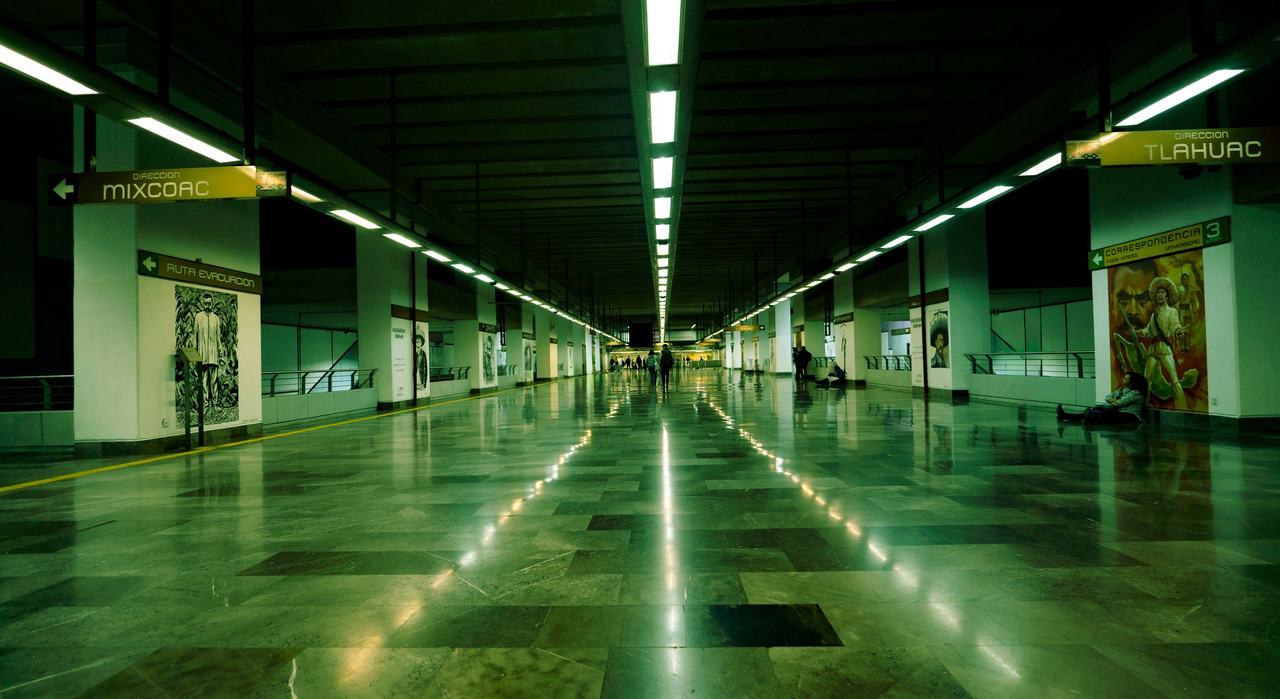
Opening photograph: A long, nearly empty metro platform in Mexico City under rows of fluorescent lights. Photograph by Vintage Lenses on Pexels. Blog photo credits.