Is It Far? Walking Directions in Spanish in Mexico City
To ask if a place is far in Spanish, say ¿Está lejos?, is it far?, or name the place first: Voy al Zócalo. ¿Está lejos? If it sounds close, follow up with ¿Puedo ir caminando? The answers use a few words you can learn in a minute: lejos is far, cerca is close, cerquita is really close, and a diez minutos caminando is ten minutes on foot. Below are the questions, the answers and the short walk that follows, from Habla’s getting-around unit, where Tom asks his friend Diego about the walk to the Zócalo.
Asking if it is far
The shortest version is two words:
You ask
¿Está lejos?
Is it far?
Lejos is far, cerca is close. You’ll also hear ¿Está retirado?
¿Está lejos? asks is it far. The course notes that lejos is far and cerca is close, and that you will also hear ¿Está retirado? for the same question. Hearing either one tells you someone is asking about distance.
If you are asking someone who does not know where you are going, say the place first:
You ask
Voy al Zócalo. ¿Está lejos?
I’m going to the Zócalo. Is it far?
The Zócalo is the city’s main square. Voy a…: I’m going to…
Voy al Zócalo is I’m going to the Zócalo, which the course describes as the city’s main square. The course notes that voy a... is I’m going to, so you can put any destination in that slot and keep ¿Está lejos? after it.
Sometimes the question comes the other way. In the course’s role play, Diego sees Tom and asks where he is headed:
Diego, a friend, asks
¿Qué onda? ¿A dónde vas?
What’s up? Where are you off to?
¿Qué onda? is what’s up, and ¿A dónde vas? is where are you off to. It is a friendly opening, and your answer is the same: voy al Zócalo, or wherever you are going.
Close, really close, or far
Here is the answer Tom gets:
Diego, a friend, says
No, está cerca.
No, it’s close.
Diego, a friend, says
Está cerquita.
It’s really close.
No, está cerca is no, it’s close. Está cerquita is it’s really close. That small ending makes a difference. It is the same kind of diminutive the course shows in derechito and poquito, and the course notes that Mexicans love the diminutive. Here it turns close into really close. For more words like it, see Mexican diminutives explained.
The opposite answer is lejos. In the course you hear it about the Metrobús to Coyoacán: te deja lejos, it leaves you far away. If the answer to ¿Está lejos? is a sí, it is time to ask about the metro or a taxi instead.
Can I walk there?
Close is not always walking distance. If you want to be sure, ask:
You ask
¿Puedo ir caminando?
Can I walk there?
Literally: can I go walking? A pie also means on foot.
¿Puedo ir caminando? literally asks can I go walking. The course notes that a pie also means on foot, so you may hear that in the answer.
In the course, Diego answers with the time and the route in one breath:
Diego, a friend, says
Sí, son como diez minutos. Toma la segunda calle a la derecha y sigue derecho.
Yes, it’s about ten minutes. Take the second street on the right and keep straight on.
Sí, son como diez minutos is yes, it’s about ten minutes. The rest is the route: take the second street on the right and keep straight on. A yes with a number of minutes is the answer you want when you are deciding whether to walk.
Distances in minutes and blocks
In the course, distance comes back as time. There are two ways to say it:
Diego, a friend, says
Está como a diez minutos.
It’s about ten minutes away.
You say
Está cerca, a diez minutos caminando.
It’s close, ten minutes on foot.
Está como a diez minutos is it’s about ten minutes away, and está cerca, a diez minutos caminando is it’s close, ten minutes on foot. Notice the pattern está a plus the distance. The course notes that está a... says how far something is, and the same shape works with blocks: está a dos cuadras, it’s two blocks away.
Notice como too. The course explains that como before a number means about, so como diez minutos is a rough guide, not a promise.
Following the walk once you set off
In the course, the walking directions are short. In the role play, Diego adds one more step after the turn:
Diego, a friend, says
Y luego sigues derecho.
Then you keep straight on.
Y luego sigues derecho is then you keep straight on. Derecho is straight ahead.
If the turn is the only tricky part, check it before you go. Tom says the key part back as a question:
Tom, a newcomer, asks
¿La segunda a la derecha?
The second on the right?
Diego, a friend, says
Sí, la segunda. Ahí lo ves luego luego.
Yes, the second. You’ll see it right away.
¿La segunda a la derecha? is the second on the right?, and Diego confirms: sí, la segunda. Then he adds ahí lo ves luego luego, you’ll see it right away. Luego luego means right away, and here it tells you the Zócalo will be in sight as soon as you make the turn.
For the full set of turns, blocks and the one-letter difference between right and straight, see asking for directions in Spanish in Mexico City.
Walk or ride: putting it together
The decision takes two questions. First ¿Está lejos?, then, if it sounds close, ¿Puedo ir caminando? Listen for these answers:
- Cerca or cerquita: close, probably walkable.
- Como a diez minutos: a short walk, about ten minutes.
- Lejos: far, so ask about the metro or a taxi.
If the answer is far, the next question is how to get there, with cómo llego a, how do I get to, which leads into lines, stations and where to get off. That has its own page: Spanish for the Mexico City metro and Metrobús.
Every line on this page is a recording from Habla’s course. In the app you hear a line, say it out loud, and it shows you what it heard. A good drill is to play Diego’s answers and say, for each one, walk or ride.
Every line on this page
The 12 lines above, in order, for one last listen before you go. Each one is the recording from the Habla course.
¿Está lejos?Is it far?
Voy al Zócalo. ¿Está lejos?I’m going to the Zócalo. Is it far?
¿Qué onda? ¿A dónde vas?What’s up? Where are you off to?
No, está cerca.No, it’s close.
Está cerquita.It’s really close.
¿Puedo ir caminando?Can I walk there?
Sí, son como diez minutos. Toma la segunda calle a la derecha y sigue derecho.Yes, it’s about ten minutes. Take the second street on the right and keep straight on.
Está como a diez minutos.It’s about ten minutes away.
Está cerca, a diez minutos caminando.It’s close, ten minutes on foot.
Y luego sigues derecho.Then you keep straight on.
¿La segunda a la derecha?The second on the right?
Sí, la segunda. Ahí lo ves luego luego.Yes, the second. You’ll see it right away.
Common questions
How do you ask “is it far” in Spanish?
Say ¿Está lejos? To add the place, say voy a plus the place first, as in Voy al Zócalo. ¿Está lejos? The course notes you may also hear ¿Está retirado?
What does cerquita mean?
It means really close. Cerca is close, and cerquita adds the diminutive ending the course also shows in poquito and derechito. In the course, Diego says está cerquita about the walk to the Zócalo.
How do I ask if I can walk somewhere in Spanish?
Ask ¿Puedo ir caminando? It literally means can I go walking. The course notes that a pie also means on foot.
What does luego luego mean in Mexico?
It means right away. In the course, Diego says ahí lo ves luego luego, you’ll see it right away, at the end of his directions.
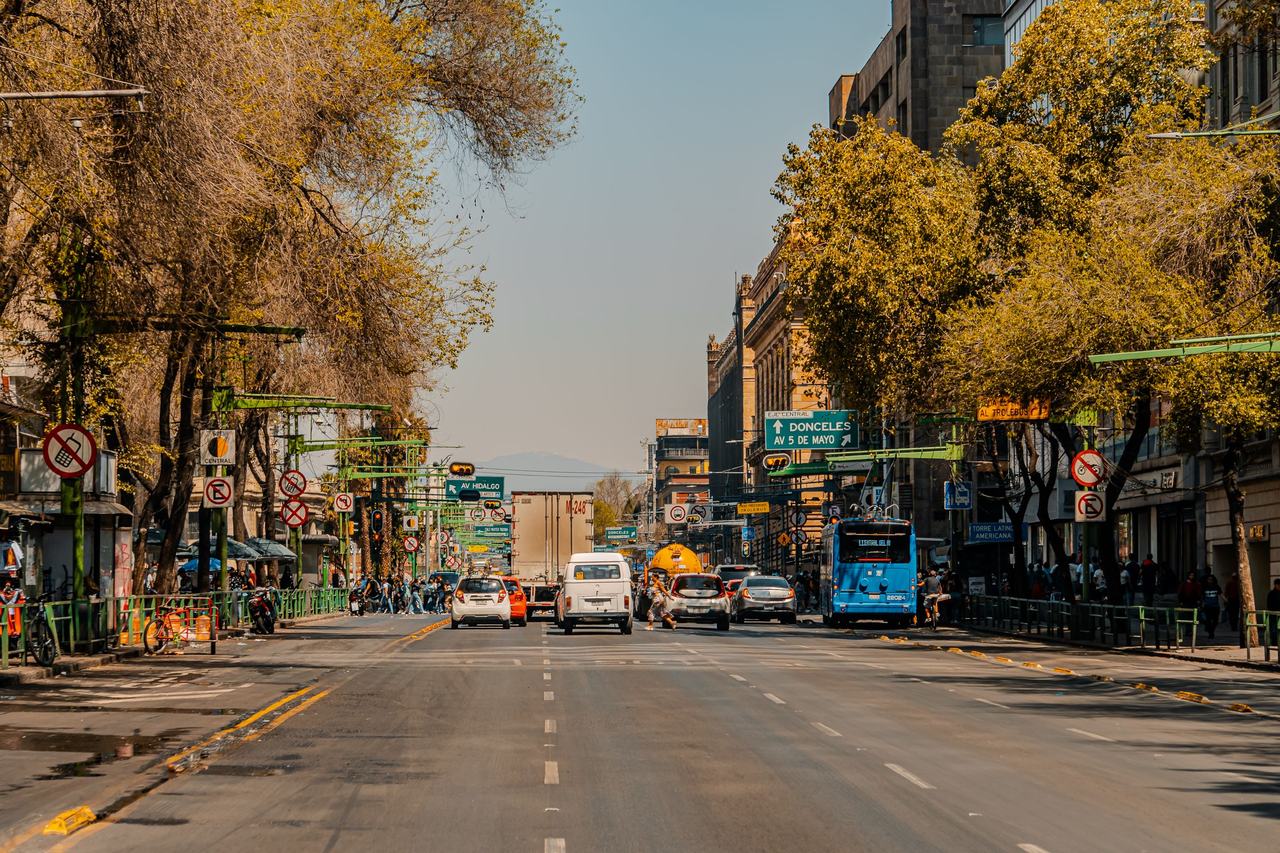
Opening photograph: Cars, vans and a blue city bus move down a wide, tree-lined avenue in Mexico City. Photograph by Jimmy Elizarraras on Pexels. Blog photo credits.