Breaking a Big Bill in Mexico: Asking for Change in Spanish
To ask for change in Spanish, say ¿Tiene cambio?, do you have change? Ask before you hand over a big bill, and name the bill if you can: ¿Tiene cambio de quinientos?, do you have change for $500? The course notes that taxis and small stores are often short of change for big bills, so the question saves an awkward moment. The answer you hope for is sí, cómo no, yes, of course, and then aquí está su cambio, here’s your change. Below are the questions, the replies and the slang word you may hear, from Habla’s numbers and corner store units.
Ask before you hand over the bill
The basic question is two words:
You ask
¿Tiene cambio?
Do you have change?
Ask before you hand over a big bill. You’ll also hear feria, slang for coins: ¿No tiene feria?
¿Tiene cambio? is do you have change? The course note gives the timing: ask before you hand over a big bill. That way, if the answer is no, you still have your bill and time to find a smaller one.
The note also gives a word you may hear in place of cambio: feria, slang for coins. The course’s example is ¿No tiene feria? So if you hear feria at a counter, the talk is about coins and change.
Naming the bill
If you know you only have a large bill, say which one. The course gives two of them:
You ask
¿Tiene cambio de quinientos?
Do you have change for $500?
Taxis and small stores are often short of change for big bills.
You ask
¿Tiene cambio de doscientos?
Do you have change for $200?
¿Tiene cambio de quinientos? is do you have change for $500, and ¿Tiene cambio de doscientos? is for $200. The bill goes after de, said as the number: quinientos is 500 and doscientos is 200. The course notes that the hundreds are one word each.
In the course, Mariana asks this at the end of a taxi ride, and Don Toño answers:
Don Toño, the taxi driver, says
Sí, cómo no, señorita.
Yes, of course, miss.
Sí, cómo no, señorita is yes, of course, miss. Cómo no is worth knowing on its own. You hear it again from Doña Chelo at the corner store, and in both scenes it is a friendly yes.
The friend’s version: do you have change on you?
Between friends, the question sounds a little different. In the course, Mariana is heading to the corner store and checks with Diego first:
Mariana, a coworker, says
Va. ¿Traes cambio? Nada más tengo un billete de quinientos.
Sure. Do you have change? I only have a $500 bill.
Diego, a friend, says
No, pero Doña Chelo siempre tiene.
No, but Doña Chelo always has some.
¿Traes cambio? is do you have change on you? Nada más tengo un billete de quinientos is I only have a $500 bill. Billete is the bill itself. The course notes elsewhere that traer, literally to bring, is the everyday Mexican verb for having something with you. In the course, ¿Traes cambio? is what one friend asks another, while the driver and the shopkeeper are asked ¿Tiene cambio?
Diego’s answer has a useful idea in it: Doña Chelo siempre tiene, Doña Chelo always has some.
What you hear back at the counter
At Doña Chelo’s corner store, the exchange runs like this. First the price, then your question, then her answer:
Doña Chelo, at the corner store, says
Son treinta y ocho pesos.
That’s $38.
You ask
¿Tiene cambio?
Do you have change?
Doña Chelo, at the corner store, says
Sí, sí tengo.
Yes, I do.
Son treinta y ocho pesos is that’s $38. Sí, sí tengo is yes, I do. Then she hands it over:
Doña Chelo, at the corner store, says
Aquí tiene su cambio.
Here’s your change.
Aquí tiene su cambio is here’s your change. You will also hear it as aquí está su cambio, the version Doña Chelo uses in another scene:
Doña Chelo, at the corner store, says
Aquí está su cambio.
Here’s your change.
Both mean the same thing. When you hear either one, check the change in your hand before you walk away, and if the amount is not what you expected, say the price back as a question. The course calls saying the price back the way to check it.
When the answer is no
If the driver or the shop cannot break your bill, you have found out at the right moment, before handing it over. Now you have two choices: find a smaller bill, or get change somewhere else and come back.
Diego’s answer to Mariana points to the other fix: go to a place that has change, the way Doña Chelo always does in the course.
Keeping the change
Sometimes the change is small enough to leave. In a taxi especially, it can be simpler than waiting for coins:
You say
Quédese con el cambio.
Keep the change.
Quédese con el cambio is keep the change. For the rest of a taxi ride, from where to the fare, see how to take a taxi in Mexico City.
Getting ready with smaller bills
The course’s note is the best advice on this topic: taxis and small stores are often short of change for big bills. So the more small bills and coins you carry, the less you need these questions at all. When you do need them, the order is simple:
- Before paying, ask ¿Tiene cambio?, or name the bill: ¿Tiene cambio de quinientos?
- Listen for sí, cómo no or sí, sí tengo.
- Hand over the bill with aquí tiene, here you go.
- Take aquí tiene su cambio, or say quédese con el cambio.
For the other side of paying, whether a place takes cards at all, see cash or card in Mexico, and for catching the amounts, understanding prices in pesos.
Every line on this page is a recording from Habla’s course. In the app you hear a line, say it out loud, and see what it heard, so ¿Tiene cambio de quinientos? comes out smoothly the first time you need it.
Every line on this page
The 11 lines above, in order, for one last listen before you go. Each one is the recording from the Habla course.
¿Tiene cambio?Do you have change?
¿Tiene cambio de quinientos?Do you have change for $500?
¿Tiene cambio de doscientos?Do you have change for $200?
Sí, cómo no, señorita.Yes, of course, miss.
Va. ¿Traes cambio? Nada más tengo un billete de quinientos.Sure. Do you have change? I only have a $500 bill.
No, pero Doña Chelo siempre tiene.No, but Doña Chelo always has some.
Son treinta y ocho pesos.That’s $38.
Sí, sí tengo.Yes, I do.
Aquí tiene su cambio.Here’s your change.
Aquí está su cambio.Here’s your change.
Quédese con el cambio.Keep the change.
Common questions
How do you ask for change in Spanish?
Say ¿Tiene cambio? For a specific bill, name it: ¿Tiene cambio de quinientos? The course notes that you should ask before you hand over a big bill.
What does feria mean in Mexico?
The course notes that feria is slang for coins. You may hear ¿No tiene feria? when someone is asking if you have change.
How do you say “keep the change” in Spanish?
Say Quédese con el cambio.
Do taxis in Mexico have change for big bills?
Not always. The course notes that taxis and small stores are often short of change for big bills, so ask ¿Tiene cambio de quinientos? before you hand one over.
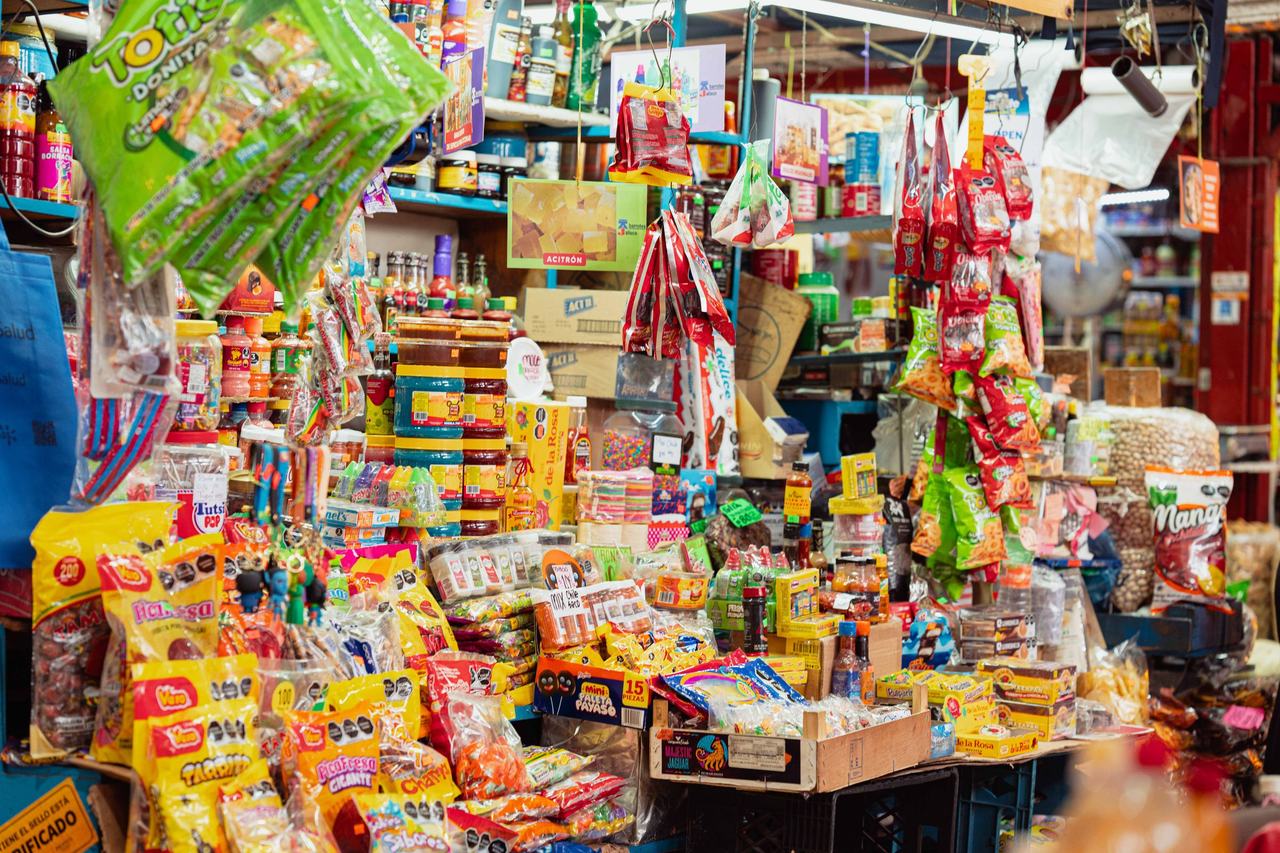
Opening photograph: A stall in Mexico City piled high with bags of Mexican candies and snacks. Photograph by Viridiana Rivera on Pexels. Blog photo credits.