Shopping at a Tianguis in Mexico City: A Spanish Guide
A tianguis is a street market in Mexico City that sets up on particular days, unlike a covered market, which has its own building and opens every day. The word comes from the Nahuatl “tianquiztli,” marketplace. To shop one, you need only a few lines: point at something and ask ¿Cuánto cuesta esta playera? (how much is this T-shirt?), then ¿Lo tiene en otro color? if you want it in a different color. Below is a full stall exchange from Habla’s shopping unit, with Paty the clothes vendor, plus what to know about paying.
What a tianguis is, and how it differs from a market
A tianguis is a market that comes to the street rather than living in a building. That is the whole difference from a covered market hall: the hall is there every day, while a tianguis sets up on its own days. The Spanish you need at a stall is the same either way, and it is short and practical.
The course brings it up in a small, real way. Mariana is showing off a new T-shirt, and she tells Diego what it cost and where she bought it:
Mariana, a coworker, says
Esta playera me costó ochenta pesos.
This T-shirt cost me $80.
Mariana, a coworker, says
En el tianguis.
At the street market.
Me costó, as the course explains, means it cost me, and ochenta pesos is 80 pesos. In the same scene, Diego says he paid 350 pesos for his. Two T-shirts, two very different prices, and the street-market one is the cheap one.
Asking the price at a clothes stall
Vendors often speak first. Paty greets you with ¿Le ayudo en algo?, can I help you with anything. You can answer by pointing at what you like and asking the price.
Paty, the clothes vendor, asks
Buenas tardes. ¿Le ayudo en algo?
Good afternoon. Can I help you with anything?
You ask
¿Cuánto cuesta esta playera?
How much is this T-shirt?
Playera is the Mexican word for a T-shirt. Esta playera: this T-shirt.
Paty, the clothes vendor, says
Ciento veinte pesos.
$120.
The course notes that playera is the Mexican word for a T-shirt, and that esta playera means this T-shirt. If you do not know the word for the thing in your hand, you do not need it. Point and ask ¿Cuánto cuesta esto? The course notes that ¿Cuánto vale? means the same.
Listen for an offer after the price. Paty adds one in the course:
Paty, the clothes vendor, says
Y le dejo dos en doscientos.
And I’ll let you have two for $200.
Dos en doscientos is two for 200 pesos, against 120 for one. You can take it, or simply buy the one you came for.
Asking for another color
The next question at any clothes stall is about color. Diego asks it in the course, and Paty answers with what she has:
Diego, a friend, asks
¿La tiene en otro color?
Do you have it in another color?
Paty, the clothes vendor, says
Sí, en azul y en negro.
Yes, in blue and in black.
You say it almost the same way. The course’s own version uses lo, and its note explains the small change: lo for an el thing, la for a la thing, so for la playera you ask ¿La tiene…?
You ask
¿Lo tiene en otro color?
Do you have it in another color?
Lo for an el thing, la for a la thing: ¿La tiene…? for la playera.
Then Paty asks which one you like, and you answer with the color and por favor:
Paty, the clothes vendor, asks
¿Cuál le gusta?
Which one do you like?
You say
En negro, por favor.
In black, please.
You say
En azul, por favor.
In blue, please.
Notice that Paty does not repeat your whole sentence back. She hands over the shirt and says Aquí tiene, en negro: here you go, in black. You will not need long sentences here either.
Trying it on when there is no fitting room
Trying clothes on at a street market is not always possible, and the course is honest about this. Its note on the fitting room says that at a tianguis there may be only a curtain, or none at all, and suggests you ask ¿Tiene probador? first.
You ask
¿Dónde está el probador?
Where’s the fitting room?
Also el vestidor. At a tianguis there may be only a curtain, or none at all: ask ¿Tiene probador?
If there is somewhere to try it, the rest of the conversation is about size and fit: too big, a medium, it fits. That has its own guide: trying on clothes in Spanish in Mexico.
Paying in cash, and walking away politely
Before you count out money, ask about cards. In the course, Paty’s answer is the one to expect at a stall:
You ask
¿Aceptan tarjeta?
Do you take cards?
Many small places take cash only.
Paty, the clothes vendor, says
No, nada más efectivo.
No, cash only.
Nada más efectivo means cash only. The course’s note on the question is short: many small places take cash only. So carry small bills when you go to a tianguis, and do not count on a card machine.
If you looked and decided not to buy, you do not need an excuse. The course gives a polite no that works at any stall:
You say
Lo voy a pensar, gracias.
I’ll think about it, thanks.
The polite no. Ahorita regreso, I’ll be right back, is the classic version.
And if you do want it, the line to close the sale is short: Me lo llevo, I’ll take it. The course notes it becomes Me la llevo for a la thing, like la playera.
Asking for a lower price is part of market shopping too. The course notes that at a market stall, asking for a discount is normal and expected, though not in a chain store. The full back and forth is in how to bargain at a Mexican market.
One stall, start to finish
Here is the whole visit the way it tends to run. Paty asks ¿Le ayudo en algo? You point at a T-shirt and ask ¿Cuánto cuesta esta playera? She says the price, maybe with an offer for two. You ask ¿Lo tiene en otro color? and she tells you the colors she has. She asks ¿Cuál le gusta? and you say En negro, por favor or En azul, por favor. You ask ¿Aceptan tarjeta? and hear nada más efectivo. You pay, she says aquí tiene, and you say thanks.
None of that needs grammar you have to work out on the spot. What makes it hard is speed, and a voice you have never heard. Every line on this page is a recording from Habla’s course, and the app has you hear each one, say it out loud, and see what it heard, so the price and the color question are in your mouth before you reach the stall.
Every line on this page
The 16 lines above, in order, for one last listen before you go. Each one is the recording from the Habla course.
Esta playera me costó ochenta pesos.This T-shirt cost me $80.
En el tianguis.At the street market.
Buenas tardes. ¿Le ayudo en algo?Good afternoon. Can I help you with anything?
¿Cuánto cuesta esta playera?How much is this T-shirt?
Ciento veinte pesos.$120.
Y le dejo dos en doscientos.And I’ll let you have two for $200.
¿La tiene en otro color?Do you have it in another color?
Sí, en azul y en negro.Yes, in blue and in black.
¿Lo tiene en otro color?Do you have it in another color?
¿Cuál le gusta?Which one do you like?
En negro, por favor.In black, please.
En azul, por favor.In blue, please.
¿Dónde está el probador?Where’s the fitting room?
¿Aceptan tarjeta?Do you take cards?
No, nada más efectivo.No, cash only.
Lo voy a pensar, gracias.I’ll think about it, thanks.
Common questions
What does tianguis mean?
It is a street market that sets up on particular days. The word comes from the Nahuatl “tianquiztli,” which means marketplace, and it is still the everyday word in Mexico City.
Is a tianguis the same as a covered market?
No. A covered market has its own building and opens daily. A tianguis sets up in the street on its own days. The Spanish you use at a stall is the same in both.
Do tianguis stalls take cards?
Do not count on it. In the course, the clothes vendor answers nada más efectivo, cash only, and the course notes that many small places take cash only. Ask ¿Aceptan tarjeta? before you choose, and bring small bills.
How do I ask the price of something at a tianguis?
Point and say ¿Cuánto cuesta esto? For a T-shirt, the course line is ¿Cuánto cuesta esta playera? The course notes that ¿Cuánto vale? means the same.
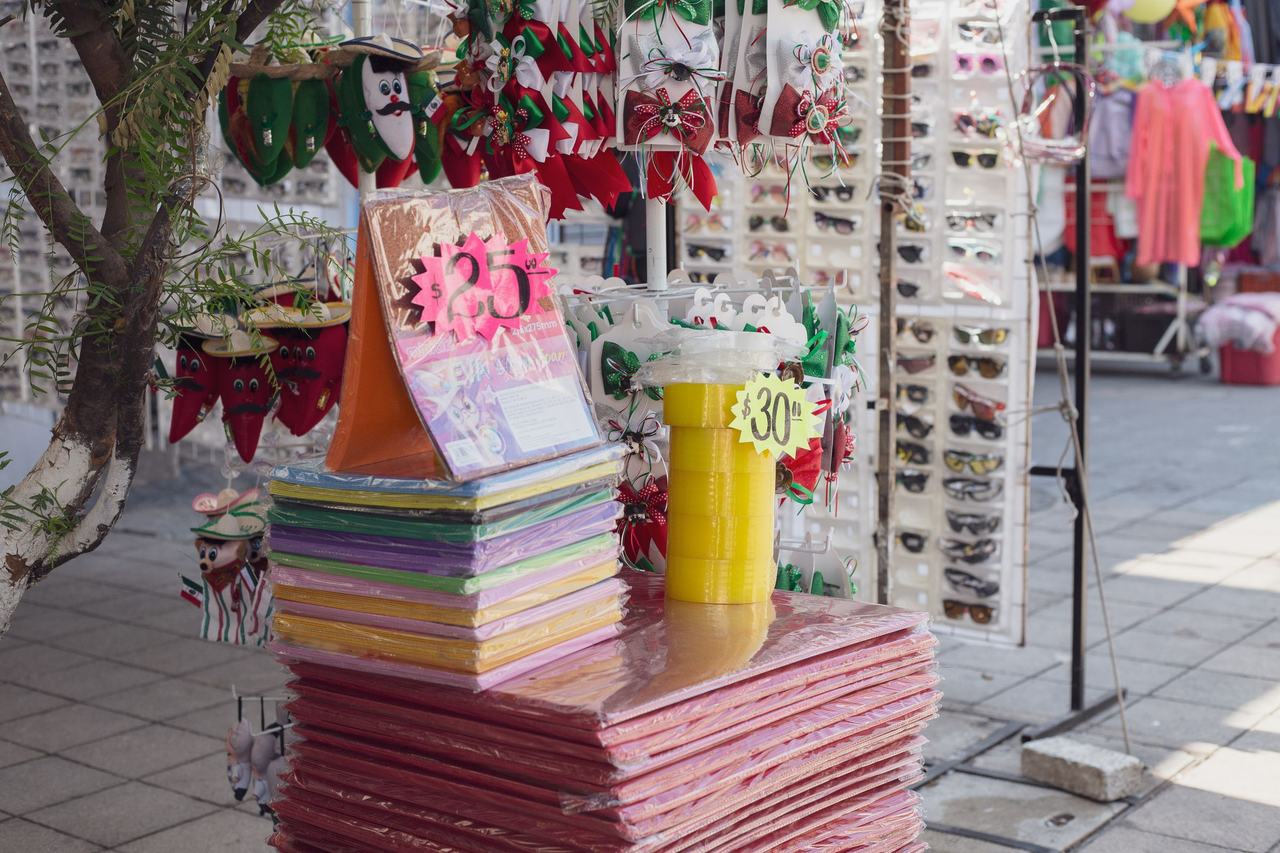
Opening photograph: A street market stall in Mexico City selling colored paper, sunglasses and festive decorations. Photograph by Noemí Jiménez on Pexels. Blog photo credits.