Understanding Prices in Pesos: Spanish Numbers for Mexico
Prices in Mexico are said as son, then the number, then pesos: Son cuarenta y cinco pesos, it’s $45. Once you know that frame, catching a price comes down to a few patterns: the teens and twenties are one word, y joins the tens and the ones from 31 to 99, exactly 100 is cien but 120 is ciento veinte, and the hundreds are one word each, like doscientos and quinientos. Below are those patterns with prices from Habla’s numbers unit and the corner store, each one recorded, plus the easiest way to check you heard right.
How a price sounds out loud
Almost every price in the course comes in the same frame. The course note explains why:
You say
Son cuarenta y cinco pesos.
It’s $45.
Prices take son: literally, they are 45 pesos. From 31 to 99, y joins the tens and the ones.
Son cuarenta y cinco pesos is it’s $45. The course notes that prices take son, literally they are 45 pesos. So when you hear son, get ready: the number comes next, and pesos closes it.
Here is the same frame at Sofía’s café and at Doña Chelo’s corner store:
Sofía, the barista, says
Son ochenta y cinco pesos.
It’s $85.
Doña Chelo, at the corner store, says
Son quince pesos.
That’s $15.
Son ochenta y cinco pesos is $85, and son quince pesos is $15. Sometimes the son is left out and the price comes on its own, as when Paty answers ciento veinte pesos at her clothes stall. The number and pesos are still there.
On paper, the price uses the $ sign. The Mexican peso uses the same $ symbol as the US dollar, and the course writes peso prices that way in its translations. So a $45 price tag in Mexico City is 45 pesos.
The teens and twenties are one word
From 16 to 29, the number is a single word:
You say
Son dieciséis pesos.
It’s $16.
From 16 to 29 the number is one word: dieciséis, veintidós.
You say
Son veinte pesos.
It’s $20.
Dieciséis is 16, and the course gives veintidós, 22, as another example. The course explanations add dieciocho, eighteen, and veinticinco, twenty-five. Each sounds like one long word because it is one word. Veinte on its own is 20.
This matters because these numbers come fast. If you are listening for two separate words, you may miss them. Listen for how each one starts instead: dieciséis and dieciocho begin the same way, and so do veintidós and veinticinco.
From 31 to 99: two parts joined by and
From 31 to 99, the number comes in two parts joined by y, and. The course note on the first price above says it directly: from 31 to 99, y joins the tens and the ones.
You say
Son cincuenta y cinco pesos.
It’s $55.
Cincuenta y cinco is 55: cincuenta, fifty, and cinco, five. The course breaks down the café price the same way: ochenta is 80, and y cinco adds 5. When you hear y, you know a small number is coming to add to the one before it.
The tens that come up in the course’s prices are treinta (30), cuarenta (40), cincuenta (50), sesenta (60), setenta (70) and ochenta (80). The course also gives noventa y ocho, ninety-eight.
The number 100, and the prices just above it
This one is worth getting straight, and the course note handles it in two sentences:
You say
Son cien pesos.
It’s $100.
Exactly 100 is cien. From 101 to 199 it’s ciento: ciento veinte.
You say
Son ciento cincuenta pesos.
It’s $150.
Exactly 100 is cien. From 101 to 199, it becomes ciento: ciento veinte is 120 and ciento cincuenta is 150. So if you hear ciento, the price is over 100, and another number follows. If you hear cien and then pesos, it is exactly 100.
A taxi fare in the course shows the pattern with three parts:
Don Toño, the taxi driver, says
Son ciento sesenta pesos.
It’s $160.
Ciento sesenta pesos is $160: ciento, a hundred, and sesenta, sixty. The course gives another taxi fare, ciento treinta, and explains it the same way: ciento is a hundred and treinta is thirty.
The hundreds: one word each
From 200 up, each hundred is its own word:
You say
Son doscientos cincuenta pesos.
It’s $250.
The hundreds are one word each: doscientos, trescientos, quinientos.
Doscientos cincuenta is 250. The course notes that the hundreds are one word each: doscientos, trescientos, quinientos. Quinientos, 500, is worth learning by ear, because it comes up in the course as a bill: ¿Tiene cambio de quinientos?, do you have change for $500?
You hear trescientos in a conversation about a T-shirt:
Diego, a friend, says
Yo pagué trescientos cincuenta pesos por la mía.
I paid $350 for mine.
Trescientos cincuenta pesos is $350.
What it cost you, and checking a price back
When people talk about what they paid, the frame changes from son to me costó, it cost me:
Mariana, a coworker, says
Esta playera me costó ochenta pesos.
This T-shirt cost me $80.
You say
Me costó ciento veinte pesos.
It cost me $120.
Me costó: it cost me.
Esta playera me costó ochenta pesos is this T-shirt cost me $80, said by Mariana about a T-shirt from the tianguis, the street market. Me costó ciento veinte pesos is it cost me $120.
The single best trick for prices is to say the number back as a question:
You ask
¿Ciento sesenta pesos?
$160?
Saying the price back to check it.
¿Ciento sesenta pesos? checks $160. The course calls this saying the price back to check it. If you heard right, you get a yes. If not, you hear the price again, and this time you are ready for it. For the questions that bring these answers, see how to ask how much in Spanish, and for using these numbers to pay, cash or card in Mexico.
Every line on this page is a recording from Habla’s course. In the app you hear a line, say it out loud, and see what it heard. Numbers are a good thing to drill this way: play the prices here, say each one back, and keep going until ciento and cien sound different on the first try.
Every line on this page
The 14 lines above, in order, for one last listen before you go. Each one is the recording from the Habla course.
Son cuarenta y cinco pesos.It’s $45.
Son ochenta y cinco pesos.It’s $85.
Son quince pesos.That’s $15.
Son dieciséis pesos.It’s $16.
Son veinte pesos.It’s $20.
Son cincuenta y cinco pesos.It’s $55.
Son cien pesos.It’s $100.
Son ciento cincuenta pesos.It’s $150.
Son ciento sesenta pesos.It’s $160.
Son doscientos cincuenta pesos.It’s $250.
Yo pagué trescientos cincuenta pesos por la mía.I paid $350 for mine.
Esta playera me costó ochenta pesos.This T-shirt cost me $80.
Me costó ciento veinte pesos.It cost me $120.
¿Ciento sesenta pesos?$160?
Common questions
What does the $ sign mean on prices in Mexico?
It means pesos. The Mexican peso uses the same $ symbol as the US dollar, so a price written $45 in Mexico is 45 pesos, and it is said Son cuarenta y cinco pesos.
Is 100 cien or ciento in Spanish?
Both, depending on the number. Exactly 100 is cien, as in Son cien pesos. From 101 to 199 it is ciento, as in ciento veinte, 120.
How do you say a price in Spanish?
Use son, then the number, then pesos. The course notes that prices take son, literally they are 45 pesos.
How can I check that I heard a price correctly?
Say it back as a question, as in ¿Ciento sesenta pesos? The course calls this saying the price back to check it.
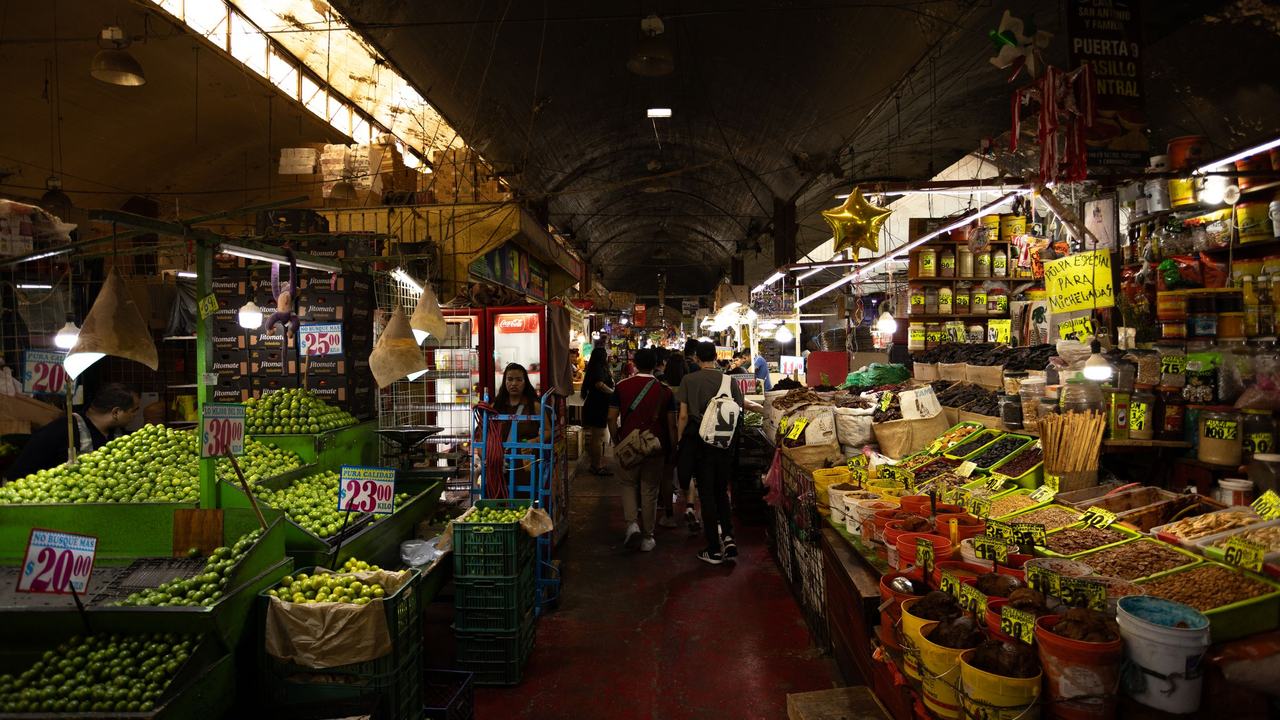
Opening photograph: Shoppers walk an aisle between stalls of limes, chiles and dried goods in a covered Mexico City market. Photograph by David Hernandez on Pexels. Blog photo credits.