Trying On Clothes in Spanish: Sizes and Fit in Mexico
To ask to try clothes on in Spanish in Mexico, say ¿Me lo puedo medir?, can I try it on? The course notes that Mexicans use medirse, literally to measure oneself, for trying clothes on, though probarse is understood too. Then ask for the fitting room with ¿Dónde está el probador? and say how it fits with me queda: Me queda grande or Me queda bien. Below is the whole exchange at Paty’s clothes stall from Habla’s shopping unit, with the sizes, the vendor’s questions and every line recorded.
Asking to try it on
In the course, Tom spots a shirt he likes at Paty’s stall and asks to try it:
Tom, a newcomer, asks
Me gusta esta camisa. ¿Me la puedo medir?
I like this shirt. Can I try it on?
Me gusta esta camisa is I like this shirt. ¿Me la puedo medir? is can I try it on? Here is the line you say, with the course note that explains the verb:
You ask
¿Me lo puedo medir?
Can I try it on?
Mexicans say medirse, to measure oneself, for trying clothes on. Probarse is understood too. Me la for a la thing.
¿Me lo puedo medir? is the version for an el thing, and me la is for a la thing, as with the shirt in Tom’s line. The course notes that Mexicans say medirse for trying clothes on, and that probarse is understood too. If you learned probarse somewhere else, it will still work. Medirse is simply what you will hear at the stall.
The vendor may speak first. In the role play, Paty opens with a compliment:
Paty, the clothes vendor, says
Esa camisa está muy bonita.
That shirt is really nice.
Esa camisa está muy bonita is that shirt is really nice. It is your cue to ask to try it.
Finding the fitting room
Paty’s answer tells Tom where to go. In the role play she adds which side:
Paty, the clothes vendor, says
Claro. El probador está al fondo, a la derecha.
Of course. The fitting room is at the back, on the right.
El probador está al fondo, a la derecha is the fitting room is at the back, on the right. El probador is the fitting room. If no one tells you, ask:
You ask
¿Dónde está el probador?
Where’s the fitting room?
Also el vestidor. At a tianguis there may be only a curtain, or none at all: ask ¿Tiene probador?
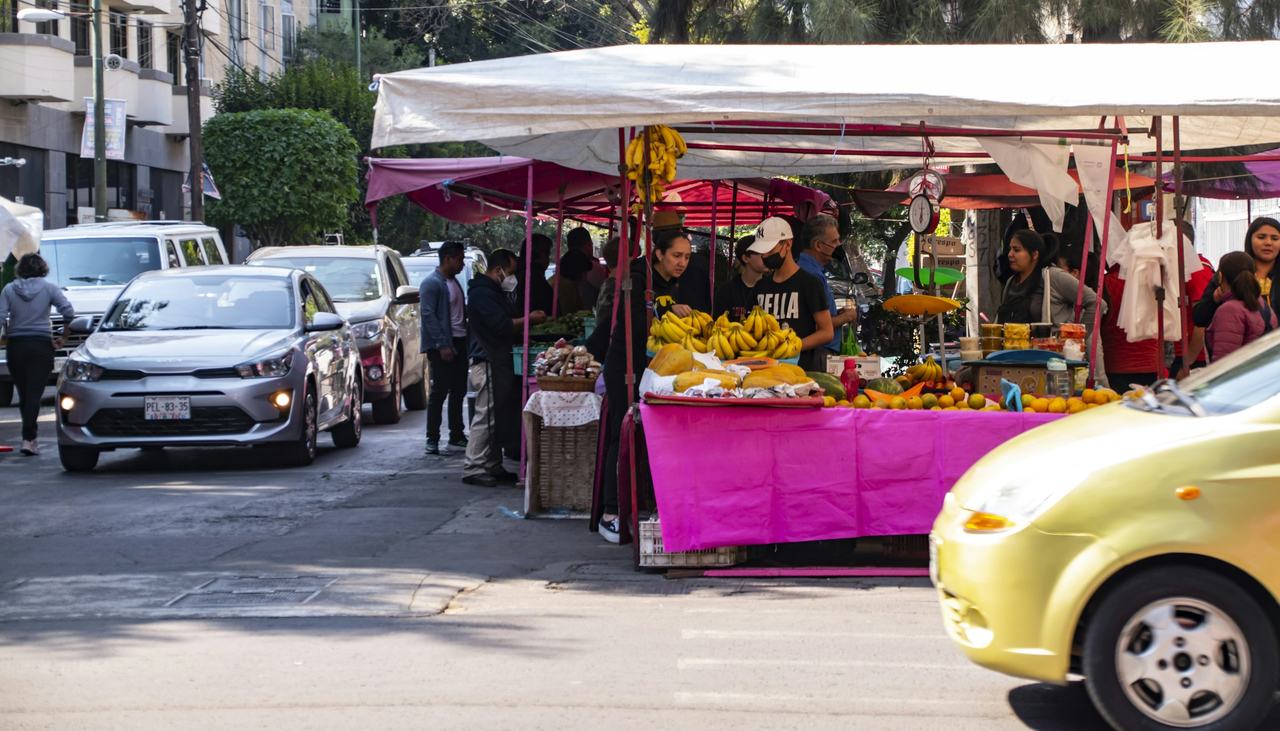
The course notes that you may also hear el vestidor, and gives a practical warning: at a tianguis, the street market, there may be only a curtain, or none at all. Ask ¿Tiene probador?, do you have a fitting room?, before you pick out a pile of clothes. For more on street-market shopping, see shopping at a tianguis in Mexico City.
How does it fit?
When you come out, the vendor will ask:
Paty, the clothes vendor, asks
¿Cómo le queda?
How does it fit?
¿Cómo le queda? is how does it fit? The answer is built on the same verb, me queda, it fits me. The course note gives the pieces:
You say
Me queda grande.
It’s too big on me.
Me queda…: it fits me… Me queda chico: it’s too small. Chilangos also say me queda guango: it’s baggy.
You say
Me queda bien.
It fits.
Me queda grande is it’s too big on me. Me queda chico is it’s too small. Me queda bien is it fits. So you only need me queda plus one word: grande, chico or bien.
The course also gives a piece of Mexico City slang for the same idea: chilangos say me queda guango, it’s baggy. It is worth knowing so that you recognize it if you hear it.
Asking for another size
If it does not fit, ask for a different size. The course note lists the sizes:
You ask
¿Lo tiene en mediana?
Do you have it in medium?
Sizes are chica, mediana, grande and extra grande, agreeing with talla.
The sizes are chica, mediana, grande and extra grande, agreeing with talla, size, as the course notes. ¿Lo tiene en mediana? is do you have it in medium? In the course, Tom puts the two lines together in one go:
You ask
Me queda grande. ¿La tiene en mediana?
It’s too big. Do you have it in medium?
Paty, the clothes vendor, says
Sí, claro. Aquí tiene la mediana.
Yes, of course. Here’s the medium.
Me queda grande. ¿La tiene en mediana? is it’s too big, do you have it in medium? Paty’s answer is sí, claro, yes, of course, and then aquí tiene la mediana, here’s the medium.
After the second try, the vendor asks again, this time about the new one:
Paty, the clothes vendor, asks
¿Y esa cómo le queda?
And how does that one fit?
¿Y esa cómo le queda? is and how does that one fit? In the course, Tom’s answer is the one you hope to give:
Tom, a newcomer, says
Perfecto, me queda bien.
Perfect, it fits.
Perfecto, me queda bien is perfect, it fits.
Another color, and taking it
Sometimes the fit is right but the color is not. The course has a line for that too:
You ask
¿Lo tiene en otro color?
Do you have it in another color?
Lo for an el thing, la for a la thing: ¿La tiene…? for la playera.
¿Lo tiene en otro color? is do you have it in another color? The course notes that you use lo for an el thing and la for a la thing, so for la playera, the T-shirt, it is ¿La tiene...? The answer will name colors, like en azul y en negro, in blue and in black, and you pick one with en negro, por favor.
When you are happy with it, close the deal:
You say
Me lo llevo.
I’ll take it.
Literally: I take it with me. Me la llevo for a la thing.
Me lo llevo is I’ll take it, and me la llevo is for a la thing. At a market stall you can also ask for a discount before you pay; for that, see how to bargain at a Mexican market. And bring cash: many small places take cash only, as the course notes, and Paty’s stall is one of them. For that exchange, see cash or card in Mexico.
The fitting in four steps
Here is the whole thing in order:
- Ask to try it: ¿Me lo puedo medir?, or ¿Me la puedo medir? for a la thing.
- Find the fitting room: ¿Dónde está el probador?
- Say how it fits: me queda grande, me queda chico or me queda bien.
- Ask for another size: ¿Lo tiene en mediana?
Every line on this page is a recording from Habla’s course. In the app you hear a line, say it out loud, and see what it heard, so ¿Me lo puedo medir? is ready before you reach the stall.
Every line on this page
The 15 lines above, in order, for one last listen before you go. Each one is the recording from the Habla course.
Me gusta esta camisa. ¿Me la puedo medir?I like this shirt. Can I try it on?
¿Me lo puedo medir?Can I try it on?
Esa camisa está muy bonita.That shirt is really nice.
Claro. El probador está al fondo, a la derecha.Of course. The fitting room is at the back, on the right.
¿Dónde está el probador?Where’s the fitting room?
¿Cómo le queda?How does it fit?
Me queda grande.It’s too big on me.
Me queda bien.It fits.
¿Lo tiene en mediana?Do you have it in medium?
Me queda grande. ¿La tiene en mediana?It’s too big. Do you have it in medium?
Sí, claro. Aquí tiene la mediana.Yes, of course. Here’s the medium.
¿Y esa cómo le queda?And how does that one fit?
Perfecto, me queda bien.Perfect, it fits.
¿Lo tiene en otro color?Do you have it in another color?
Me lo llevo.I’ll take it.
Common questions
How do you ask “can I try it on” in Spanish in Mexico?
Say ¿Me lo puedo medir? The course notes that Mexicans say medirse for trying clothes on, and that probarse is understood too. For a la thing, it is ¿Me la puedo medir?
What are clothing sizes in Spanish?
The course gives chica, mediana, grande and extra grande, agreeing with talla, size. To ask for one, say ¿Lo tiene en mediana?
How do you say “it’s too big” in Spanish?
Say Me queda grande. The course notes that me queda chico is it’s too small, and that chilangos also say me queda guango, it’s baggy.
How do I ask where the fitting room is in Spanish?
Ask ¿Dónde está el probador? The course notes that you may also hear el vestidor, and that at a tianguis there may be only a curtain, so you can ask ¿Tiene probador?
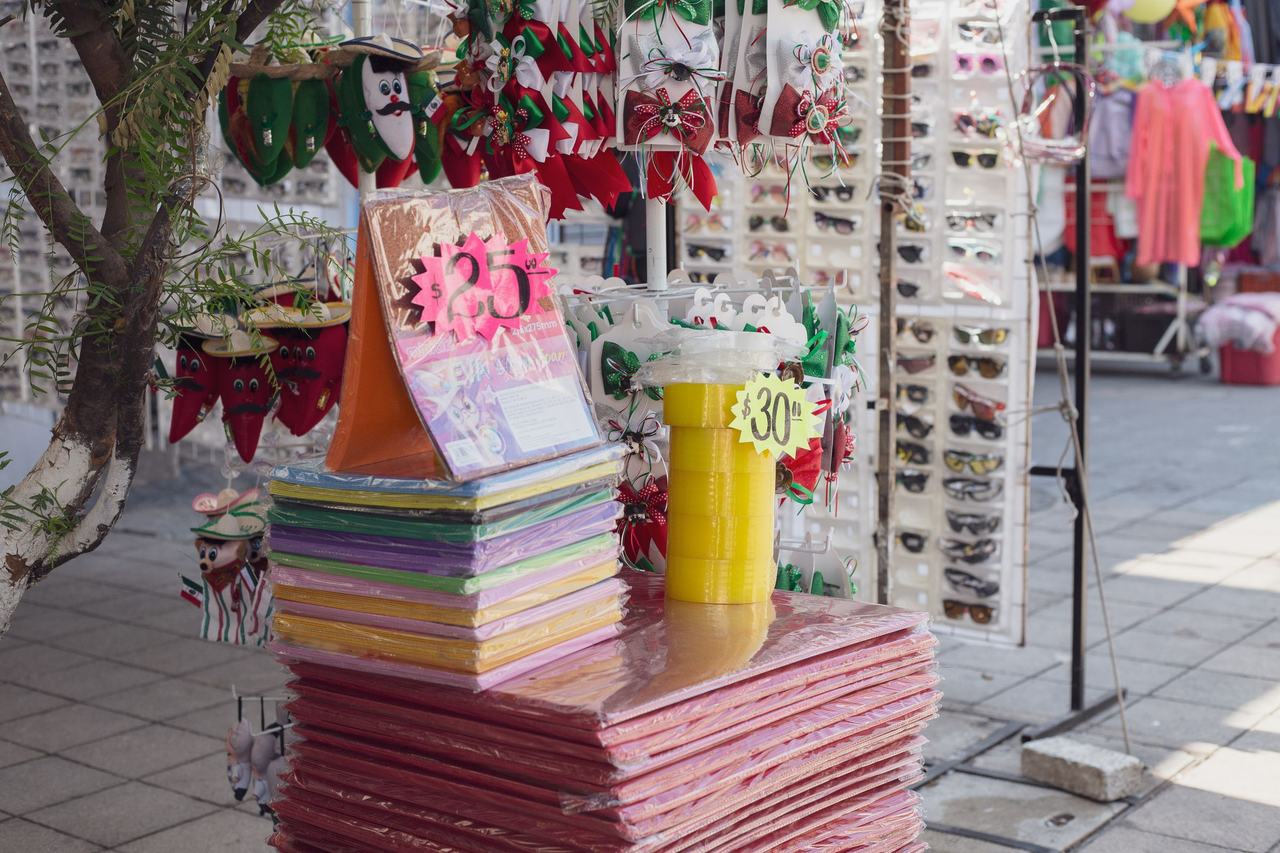
Opening photograph: A street market stall in Mexico City selling colored paper, sunglasses and festive decorations. Photograph by Noemí Jiménez on Pexels. Blog photo credits.