How to Order Yakitori in Tokyo: Shio or Tare
To order yakitori, choose your skewers, and when the cook asks 塩とタレ、どちらにしますか? (salt or sauce?), answer 塩でお願いします (salt, please) or タレでお願いします (the sweet sauce, please). That one question is the heart of a yakitori counter. Around it you need a drink order, a way to ask what is good, and the two questions about time that matter late in the evening: how late they are open, and when last order is. Below is each line with a real recording, from the yakitori counter under the train tracks in Yurakucho that sets the scene for Koe’s time unit.
Salt or sauce: the question you will hear
Each order comes with one choice. The course notes explain it: skewers come seasoned with salt, or brushed with tare, a sweet soy sauce, and you pick one when you order. Sakai-san, the cook in the course, asks it like this:
Sakai-san, the yakitori cook, asks
塩とタレ、どちらにしますか?
Shio to tare, dochira ni shimasu ka?
Salt or sauce?
You say
塩でお願いします。
Shio de onegai shimasu.
Salt, please.
Skewers come seasoned with salt, or brushed with タレ, a sweet soy sauce. You pick one when you order.
You say
タレでお願いします。
Tare de onegai shimasu.
The sweet sauce, please.
Listen for the two words, shio and tare, and then dochira, which one. Your answer is just the word you want with de onegai shimasu after it. Neither answer is wrong, and if you cannot decide, try one on this round and the other on the next.
How yakitori is ordered
A yakitori order is not always one skewer. A Tokyo guide to yakitori explains that at an izakaya one order is usually a few skewers, while some old-style places take orders skewer by skewer, by the cut of meat. If you are not sure which kind of place you are in, look at what the people beside you have in front of them, or just ask for a recommendation:
You ask
おすすめは何ですか?
Osusume wa nan desu ka?
What do you recommend?
Whatever the cook names, order it with じゃあ、それをお願いします, I’ll have that, then. If there is a menu with pictures, point and say じゃあ、これをください. The salt-or-sauce question may follow, so have your answer ready.
Drinks at the counter
The drink order is short. For two people:
You say
生ビールをふたつお願いします。
Namabīru o futatsu onegai shimasu.
Two draft beers, please.
Namabīru is draft beer, and the counting word futatsu makes it two. If you are not drinking, the course’s line for oolong tea, ウーロン茶をひとつください, works at a yakitori counter just as it does at an izakaya. When a glass is empty, one more:
You say
もう1杯お願いします。
Mō ippai onegai shimasu.
One more, please.
How late is the counter open
The course’s yakitori counter is an after-work stop, and the scene is set at nine at night. Your coworker notices the time, and you ask how late the cook is open:
Mori-san, a coworker, says
あ、もう9時ですね。
A, mō kuji desu ne.
Oh, it’s already nine.
You ask
何時までやってますか?
Nanji made yattemasu ka?
How late are you open?
やってます is the everyday way to say a place is open.
Sakai-san, the yakitori cook, says
11時までです。
Jūichiji made desu.
Until eleven.
Yattemasu is, in the course’s words, the everyday way to say a place is open. The answer comes back with made, until: jūichiji made desu, until eleven. The time just before made is the one to catch.
Mori-san’s line is a small lesson in hearing the hour, too. She says kuji, nine o’clock, and the course notes point out that nine o’clock is only ever kuji. When the cook gives a closing time, the hour comes first and made comes after, so catch the hour and the rest falls into place.
Last order before the grill closes
Closing time is not the same as the last chance to order. The course notes explain that restaurants and bars stop taking orders a little before they close. That cutoff is called rasuto ōdā, last order, and it is worth asking about if you arrive late:
You ask
ラストオーダーは何時ですか?
Rasuto ōdā wa nanji desu ka?
When is last order?
Restaurants and bars stop taking orders a little before they close: last call.
Sakai-san, the yakitori cook, says
ラストオーダーは10時半です。
Rasuto ōdā wa jūjihan desu.
Last order is at ten thirty.
In the course, the counter is open until eleven, but last order is at ten thirty. Han after the hour is half past, so jūjihan is ten thirty. If you want one more round of skewers, order before then. And if you hear rasuto ōdā from the staff without asking, that is your cue: anything you still want, order it now. If you are also watching for the last train, the same kind of question works for that: the last train guide covers it.
Paying and leaving
When you are done, call the cook or the staff with the course’s standard line for the check:
You say
すみません、お会計お願いします。
Sumimasen, okaikei onegai shimasu.
Excuse me, the check, please.
On your way out, thank the person who grilled your dinner. The course notes say this is said as you leave, to whoever cooked or served:
You say
ごちそうさまでした。
Gochisōsama deshita.
Thank you for the meal.
So the evening at the counter runs like this: a drink, a question about what is good, shio or tare for each order, a check on last order if it is getting late, and the check. Each step is one short line, and the salt-or-sauce question is the one to have ready.
Every line on this page is a recording from Koe’s course. The cook’s question comes fast, so it is the line to hear most. In the app you hear it, answer out loud, and see what it heard. For more on telling and asking the time, see the guide to opening hours and the time.
Every line on this page
The 13 lines above, in order, for one last listen before you go. Each one is the recording from the Koe course.
塩とタレ、どちらにしますか?Shio to tare, dochira ni shimasu ka?Salt or sauce?
塩でお願いします。Shio de onegai shimasu.Salt, please.
タレでお願いします。Tare de onegai shimasu.The sweet sauce, please.
おすすめは何ですか?Osusume wa nan desu ka?What do you recommend?
生ビールをふたつお願いします。Namabīru o futatsu onegai shimasu.Two draft beers, please.
もう1杯お願いします。Mō ippai onegai shimasu.One more, please.
あ、もう9時ですね。A, mō kuji desu ne.Oh, it’s already nine.
何時までやってますか?Nanji made yattemasu ka?How late are you open?
11時までです。Jūichiji made desu.Until eleven.
ラストオーダーは何時ですか?Rasuto ōdā wa nanji desu ka?When is last order?
ラストオーダーは10時半です。Rasuto ōdā wa jūjihan desu.Last order is at ten thirty.
すみません、お会計お願いします。Sumimasen, okaikei onegai shimasu.Excuse me, the check, please.
ごちそうさまでした。Gochisōsama deshita.Thank you for the meal.
Common questions
What does shio or tare mean at a yakitori restaurant?
Shio is salt, and tare is a sweet soy sauce brushed on the skewers. The cook asks which you want, and you answer 塩でお願いします or タレでお願いします.
How many skewers is one order of yakitori?
It depends on the place. A Tokyo yakitori guide explains that at an izakaya one order is usually a few skewers, while some old-style places take orders skewer by skewer, by the cut of meat.
What does last order mean in Japan?
Rasuto ōdā is the time a restaurant or bar stops taking orders, a little before it closes. Ask for it with ラストオーダーは何時ですか?.
How do you ask how late a restaurant is open in Japanese?
Say 何時までやってますか?. Yattemasu is the everyday way to say a place is open, and the answer ends with made, until.
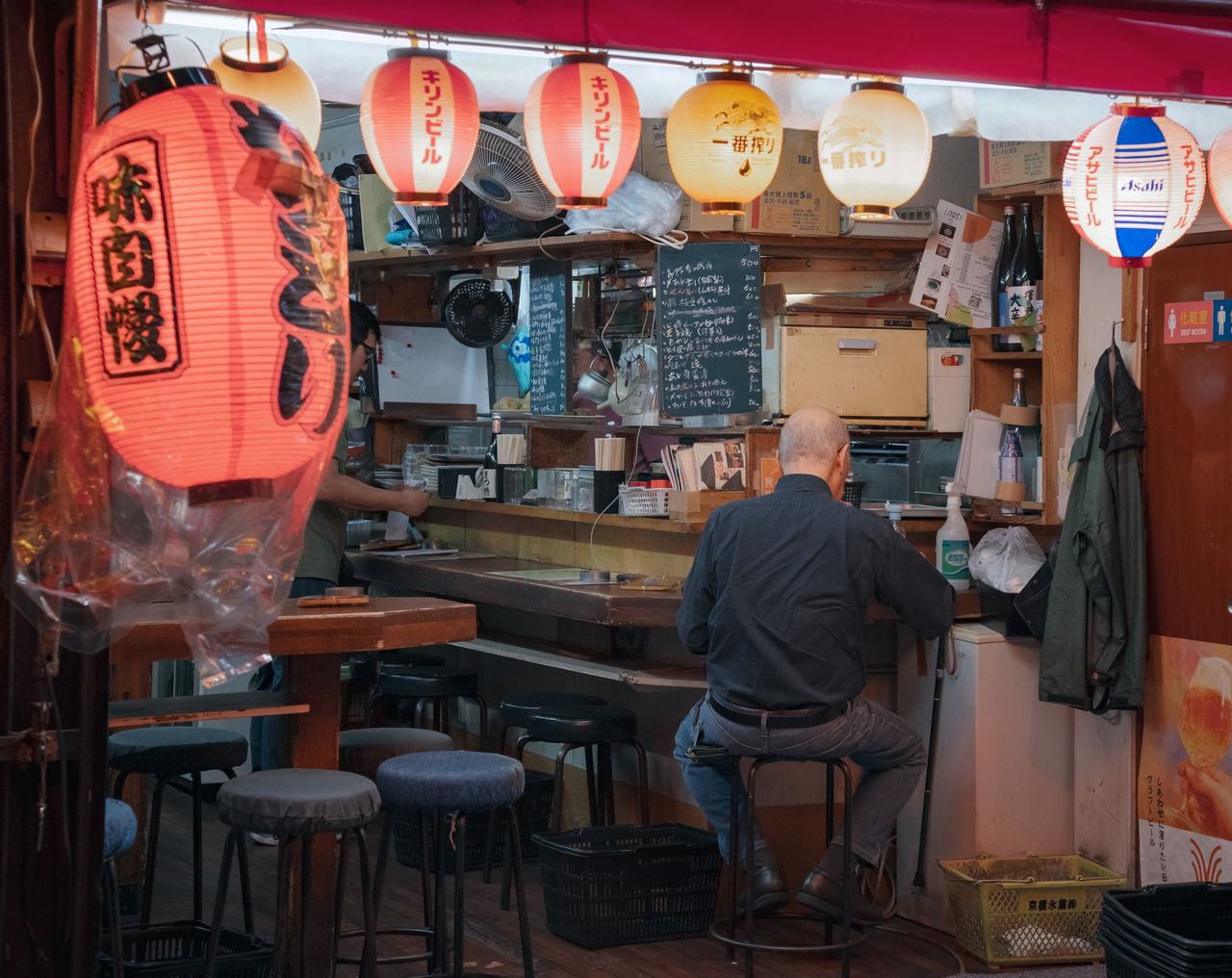
Opening photograph: A lone customer sits at the counter of a small izakaya under rows of paper lanterns in Tokyo. Photograph by Iban Lopez Luna on Pexels. Blog photo credits.