How to Order Coffee in Japanese at a Tokyo Cafe
To order coffee in Japanese, name it, add the number and say please: ホットコーヒーをひとつください, one hot coffee, please. At an old-style coffee shop, the course notes that regulars say just hotto, which alone means hot coffee: ホットをひとつお願いします. Then expect two short questions: for here or to go, and milk and sugar. Answer the second with ミルクだけお願いします, just milk, or 砂糖は大丈夫です, no sugar, thank you.
What you hear when you reach the counter
The course teaches coffee at a small kissaten in Jimbocho, among the secondhand bookstores. You will hear irasshaimase, welcome, as you come in. The course’s note is clear that you don’t say it back. Then, at the counter, Haruka, the café owner, asks for your order:
Haruka, the café owner, says
ご注文、お伺いします。
Gochūmon, oukagai shimasu.
What can I get you?
That is your cue. You do not need a greeting first. Just order. In fact, the very first line the course teaches is a coffee order, with no number at all:
You say
ホットコーヒーをください。
Hotto kōhī o kudasai.
A hot coffee, please.
Staff say いらっしゃいませ to everyone when you come in. You don’t say it back.
That one line gets you a coffee. The rest of this page adds the details: how many, which kind, and how you take it.
Ordering a hot or iced coffee
The full order puts the drink first, then the number, then kudasai. The course’s note on this line adds that ひとつ is one, for things you count:
You say
ホットコーヒーをひとつください。
Hotto kōhī o hitotsu kudasai.
One hot coffee, please.
ひとつ is one, for things you count. Staff answer an order with かしこまりました, certainly: that’s their word. Yours is はい or お願いします.
In a kissaten, there is a shortcut. The course notes that ホット alone means hot coffee, and アイス means iced coffee, and that regulars order with that one word:
You say
ホットをひとつお願いします。
Hotto o hitotsu onegai shimasu.
One hot coffee, please (just “hot”).
In a kissaten, ホット alone means hot coffee, and アイス means iced coffee. Regulars order with that one word.
For two iced coffees, change the drink and the number. The course uses the full word here, which works anywhere:
You say
アイスコーヒーをふたつください。
Aisu kōhī o futatsu kudasai.
Two iced coffees, please.
For two different drinks, name both and add hitotsu zutsu, one of each. The course’s example orders a pudding and a hot coffee together: プリンとホットをひとつずつください.
If you need more numbers than one and two, the course’s counting set runs hitotsu, futatsu, mittsu and on to ten. There is more in Japanese counters for ordering.
The house blend, tea or a cafe au lait
A kissaten’s everyday coffee has its own name. The course’s note says ブレンド is the house blend, the kissaten’s everyday coffee:
You say
ブレンドをください。
Burendo o kudasai.
The house blend, please.
ブレンド is the house blend, the kissaten’s everyday coffee.
If you are not sure what to order at a kissaten, the house blend is the safe choice. It also works with the short style, burendo plus kudasai, no number needed for one cup.
If you would rather have tea, the course’s note says 紅茶 is black tea, served with milk or lemon:
You say
紅茶をひとつお願いします。
Kōcha o hitotsu onegai shimasu.
One tea, please.
紅茶 is black tea, served with milk or lemon.
And for a café au lait, the course uses the quickest order of all. Its note explains that in a quick order the small word を is often left out, but you keep ください or お願いします, because a bare コーヒーをくれ is a rough command nobody says to staff:
You say
カフェオレください。
Kafeore kudasai.
A café au lait, please.
In a quick order を often drops out. Keep ください or お願いします, though: a bare コーヒーをくれ is a rough command nobody says to staff.
When the staff repeat your order
After you order, staff say it back to check. The course’s explanation notes that staff repeat an order back, and かしこまりました, certainly, closes it:
Haruka, the café owner, says
ホットおひとつですね。
Hotto ohitotsu desu ne.
One hot coffee, then.
You do not repeat their kashikomarimashita. The course’s note on ordering is direct: that’s their word, and yours is はい or お願いします. A simple hai is all it takes.
Next comes the question of whether you are staying. It is one long, polite question, and you only need a two-word answer. That exchange has its own page: for here or to go in Japanese.
Milk, sugar, syrup and ice
Then the last question, about how you take it. Haruka asks:
Haruka, the café owner, asks
ミルクとお砂糖はお付けしますか?
Miruku to osatō wa otsuke shimasu ka?
Would you like milk and sugar?
Two parts of that question are worth knowing. Miruku to osatō is milk and sugar, and the course notes that staff say お砂糖 while you can say either form. Otsuke shimasu ka asks whether to add them, and the course’s konbini note explains that お付けします is the clerk’s humble form for what the clerk does, so you never say it back.
There are four easy answers. Just milk uses dake, which the course notes means just, or only. No sugar uses daijōbu desu, which the course notes turns down an offer politely. And if you want neither, the course has ブラックで大丈夫です, black is fine. If you want both, it is 両方お願いします.
You say
ミルクだけお願いします。
Miruku dake onegai shimasu.
Just milk, please.
だけ means just, or only.
You say
砂糖は大丈夫です。
Satō wa daijōbu desu.
No sugar, thank you.
大丈夫です turns down an offer politely. The staff say お砂糖, and you can say either.
You may be asked about syrup as well. The course’s line for it:
Haruka, the café owner, asks
ガムシロップはお使いですか?
Gamushiroppu wa otsukai desu ka?
Will you want syrup?
You can answer it with the same daijōbu desu for no, or onegai shimasu for yes. And if you want less ice, the course has a line for that too:
You say
氷少なめでお願いします。
Kōri sukuname de onegai shimasu.
Light ice, please.
When the coffee arrives, you hear the set line staff use for bringing an order:
Haruka, the café owner, says
お待たせしました。ホットコーヒーです。
Omatase shimashita. Hotto kōhī desu.
Here you are, a hot coffee.
You can answer with a quick どうも, thanks, which the course notes is quick and light.
The whole order in one go
Here is the course’s counter exchange, in order:
- Staff ask what you would like: Gochūmon, oukagai shimasu.
- You order: Hotto o hitotsu onegai shimasu.
- Staff repeat it and close with kashikomarimashita. You say hai.
- Staff ask about milk and sugar. You say Miruku dake onegai shimasu, or Burakku de daijōbu desu.
- The coffee comes with omatase shimashita.
Every line on this page is a recording from Koe’s course. In the app you hear Haruka’s questions, answer out loud, and see what it heard, so the order comes out smoothly even when the line behind you is long.
Every line on this page
The 15 lines above, in order, for one last listen before you go. Each one is the recording from the Koe course.
ご注文、お伺いします。Gochūmon, oukagai shimasu.What can I get you?
ホットコーヒーをください。Hotto kōhī o kudasai.A hot coffee, please.
ホットコーヒーをひとつください。Hotto kōhī o hitotsu kudasai.One hot coffee, please.
ホットをひとつお願いします。Hotto o hitotsu onegai shimasu.One hot coffee, please (just “hot”).
アイスコーヒーをふたつください。Aisu kōhī o futatsu kudasai.Two iced coffees, please.
ブレンドをください。Burendo o kudasai.The house blend, please.
紅茶をひとつお願いします。Kōcha o hitotsu onegai shimasu.One tea, please.
カフェオレください。Kafeore kudasai.A café au lait, please.
ホットおひとつですね。Hotto ohitotsu desu ne.One hot coffee, then.
ミルクとお砂糖はお付けしますか?Miruku to osatō wa otsuke shimasu ka?Would you like milk and sugar?
ミルクだけお願いします。Miruku dake onegai shimasu.Just milk, please.
砂糖は大丈夫です。Satō wa daijōbu desu.No sugar, thank you.
ガムシロップはお使いですか?Gamushiroppu wa otsukai desu ka?Will you want syrup?
氷少なめでお願いします。Kōri sukuname de onegai shimasu.Light ice, please.
お待たせしました。ホットコーヒーです。Omatase shimashita. Hotto kōhī desu.Here you are, a hot coffee.
Common questions
How do you order a coffee in Japanese?
Say ホットコーヒーをひとつください, one hot coffee, please. In a kissaten, ホットをひとつお願いします works too: the course notes that hotto alone means hot coffee there.
What does burendo mean in a Japanese coffee shop?
It is the house blend. The course notes that ブレンド is the kissaten’s everyday coffee. Order it with ブレンドをください.
How do you say no sugar in Japanese?
Say 砂糖は大丈夫です, no sugar, thank you. The course notes that 大丈夫です turns down an offer politely. For no milk and no sugar, ブラックで大丈夫です.
How do you say iced coffee in Japanese?
Aisu kōhī, as in アイスコーヒーをふたつください, two iced coffees, please. In a kissaten, the course notes that アイス alone means iced coffee.
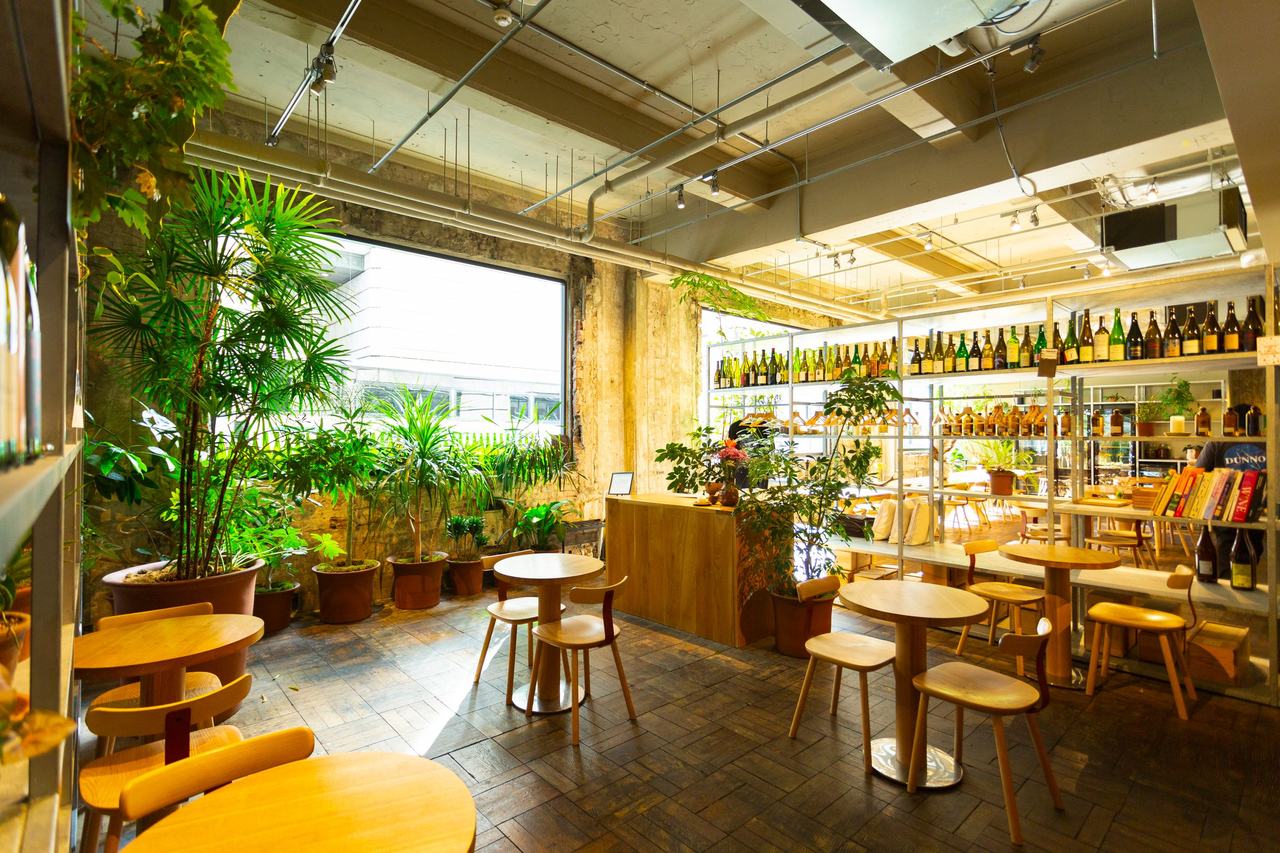
Opening photograph: Empty wooden tables and potted palms fill a sunlit cafe lined with shelves of bottles in Tokyo. Photograph by Gu Ko on Pexels. Blog photo credits.