Kissaten Guide: How to Order at a Retro Tokyo Coffee Shop
At a kissaten, order the house blend with ブレンドをください, or a classic lunch like ナポリタンをひとつください, Napolitan spaghetti. When asked if that is all, say 以上です. When asked whether your drink should come with the meal or after, say 食後でお願いします if you want it after. If the counter is full, ask about an empty seat with ここ、いいですか?, and leave with gochisōsama deshita. The course sets all of this in a small kissaten in Jimbocho, among the secondhand bookstores.
The kissaten in the course
A kissaten is a traditional Japanese coffee shop, and the course’s whole cafe unit takes place in one: ordering, paying and finding a seat in Jimbocho, run by Haruka, the café owner. It has a counter by the door with a morning line, a shared table, and a lunch menu of what the course calls the kissaten classics: Napolitan spaghetti, curry, a thick hotcake, custard pudding.
Kissaten coffee has its own short vocabulary. The course notes that ホット alone means hot coffee and アイス means iced coffee, and that regulars order with that one word. ブレンド is the house blend, the kissaten’s everyday coffee. For the full coffee exchange, including milk and sugar, see how to order coffee in Japanese.
Ordering the classics: Napolitan, hotcakes and pudding
At lunch, the course starts with Napolitan. Its note describes it plainly: spaghetti in a ketchup sauce, a kissaten classic.
You say
ナポリタンをひとつください。
Naporitan o hitotsu kudasai.
One Napolitan, please.
Spaghetti in a ketchup sauce, a kissaten classic.
To add something, use mo, which the course notes means too, or also:
You say
ホットケーキもお願いします。
Hottokēki mo onegai shimasu.
A hotcake too, please.
も means too, or also.
For something sweet, the course pairs a custard pudding with a hot coffee in one order. Its note says ひとつずつ is one of each, so you name both and count once:
You say
プリンとホットをひとつずつください。
Purin to hotto o hitotsu zutsu kudasai.
One pudding and one hot coffee, please.
ひとつずつ is one of each.
If something on the menu or in the display is a mystery, point at it and ask これは何ですか?, what’s this? The course teaches it at a ramen ticket machine, and it works just as well over a kissaten menu.
Will that be all?
Once you have ordered, Haruka repeats it back, as staff do throughout the course, and then checks that you are done:
Haruka, the café owner, asks
ご注文は以上でよろしいですか?
Gochūmon wa ijō de yoroshii desu ka?
Will that be all?
If you are finished, the course’s answer is two words:
You say
以上です。
Ijō desu.
That’s all.
If you are not, just add the next item with mo, as above, and answer ijō desu when you really are done.
Your drink before or after the meal
When you order food with a drink, Haruka has one more question: when to bring the drink.
Haruka, the café owner, asks
お飲み物は食後にお持ちしますか?
Onomimono wa shokugo ni omochi shimasu ka?
Shall I bring your drink after the meal?
If you want your coffee after you eat, the course’s answer is short, and its note is shorter still: when to bring the drink.
You say
食後でお願いします。
Shokugo de onegai shimasu.
After the meal, please.
When to bring the drink.
The word to listen for is shokugo, after the meal. Once you recognize it, the question is easy, and your answer simply repeats the word with de onegai shimasu.
Finding a seat at a shared table
The course’s scene has a full counter at a busy moment, so you ask a man at the shared table about the empty seat beside him. The course’s note says the line literally means “is here okay?”, said with a glance at the empty seat:
You ask
ここ、いいですか?
Koko, ii desu ka?
Is this seat free?
Literally, is here okay? Said with a glance at the empty seat.
A customer says
あ、どうぞ。
A, dōzo.
Oh, go ahead.
That is the whole exchange. Dōzo, go ahead, is the answer you hope for, and then you sit. Two short lines, and nobody has to explain anything.
Paying at the counter
In the course’s lunch scene, you pay at the counter and the food comes to your seat. If you came with someone, Haruka may ask whether you are paying together, as she does in the course’s coffee scene, and you can answer 別々でお願いします, separately, please:
Haruka, the café owner, asks
お会計はご一緒でよろしいですか?
Okaikei wa goissho de yoroshii desu ka?
Will you be paying together?
Haruka, the café owner, says
580円です。
Gohyakuhachijūen desu.
That’s ¥580.
If you want to use a card, ask first. The course’s note on this line is about the shopping streets, but the question works at any counter:
You ask
カードは使えますか?
Kādo wa tsukaemasu ka?
Can I pay by card?
Literally, can I use a card? Many small stores on a shotengai take cash only.
Once you have paid, Haruka tells you she will bring the order to your seat, so there is no need to wait at the counter.
Water, the restroom and leaving
Water at this kissaten is self-service. Haruka points it out:
Haruka, the café owner, says
お水はあちらにございます。ご自由にどうぞ。
Omizu wa achira ni gozaimasu. Gojiyū ni dōzo.
The water is over there. Please help yourself.
If you cannot see it, or would like a glass brought, the course has a polite question for it:
You ask
お水、もらえますか?
Omizu, moraemasu ka?
Could I have some water?
If you need the restroom, ask, and Haruka’s answer uses the polite word for it:
You ask
トイレはどこですか?
Toire wa doko desu ka?
Where’s the restroom?
お手洗い is the more polite word, and トイレ is fine too.
Haruka, the café owner, says
お手洗いは奥の右です。
Otearai wa oku no migi desu.
The restroom is at the back, on the right.
When you leave, thank whoever cooked or served. The course’s note says this is said as you leave, and that everyone says it when they finish eating, too:
You say
ごちそうさまでした。
Gochisōsama deshita.
Thank you for the meal.
Said as you leave, to whoever cooked or served. Everyone says it when they finish eating, too.
Haruka answers with ありがとうございました, thank you, and that is the visit done.
Here is the whole lunch in order, so you can see how little you need to say:
- Order at the counter: a Napolitan, and mo for anything extra.
- “Will that be all?” Answer ijō desu.
- “Drink after the meal?” Answer shokugo de onegai shimasu.
- Pay at the counter, separately if you need to.
- Find a seat, with koko, ii desu ka at a shared table.
- Help yourself to water while the food comes to you.
- Leave with gochisōsama deshita.
Every line on this page is a recording from Koe’s course. In the app you hear Haruka’s questions, answer out loud, and see what it heard, so you can walk into a kissaten and order without pointing at the menu.
Every line on this page
The 17 lines above, in order, for one last listen before you go. Each one is the recording from the Koe course.
ナポリタンをひとつください。Naporitan o hitotsu kudasai.One Napolitan, please.
ホットケーキもお願いします。Hottokēki mo onegai shimasu.A hotcake too, please.
プリンとホットをひとつずつください。Purin to hotto o hitotsu zutsu kudasai.One pudding and one hot coffee, please.
ご注文は以上でよろしいですか?Gochūmon wa ijō de yoroshii desu ka?Will that be all?
以上です。Ijō desu.That’s all.
お飲み物は食後にお持ちしますか?Onomimono wa shokugo ni omochi shimasu ka?Shall I bring your drink after the meal?
食後でお願いします。Shokugo de onegai shimasu.After the meal, please.
ここ、いいですか?Koko, ii desu ka?Is this seat free?
あ、どうぞ。A, dōzo.Oh, go ahead.
お会計はご一緒でよろしいですか?Okaikei wa goissho de yoroshii desu ka?Will you be paying together?
580円です。Gohyakuhachijūen desu.That’s ¥580.
カードは使えますか?Kādo wa tsukaemasu ka?Can I pay by card?
お水はあちらにございます。ご自由にどうぞ。Omizu wa achira ni gozaimasu. Gojiyū ni dōzo.The water is over there. Please help yourself.
お水、もらえますか?Omizu, moraemasu ka?Could I have some water?
トイレはどこですか?Toire wa doko desu ka?Where’s the restroom?
お手洗いは奥の右です。Otearai wa oku no migi desu.The restroom is at the back, on the right.
ごちそうさまでした。Gochisōsama deshita.Thank you for the meal.
Common questions
What is a kissaten?
An old-style Japanese coffee shop. The course’s kissaten in Jimbocho serves a house blend, ブレンド, and lunch classics like Napolitan spaghetti, curry, a thick hotcake and custard pudding.
What should I order at a kissaten?
The house blend, ブレンドをください, and if it is lunchtime, a Napolitan, ナポリタンをひとつください. For something sweet, the course orders a pudding with a hot coffee: プリンとホットをひとつずつください.
Do you get your own water at a kissaten?
At the course’s kissaten, yes. Haruka says the water is over there and to help yourself. If you would like some brought, ask お水、もらえますか?.
How do you ask to share a table in Japanese?
Look at the empty seat and say ここ、いいですか?, is this seat free? The course notes it literally means is here okay. In the course, the answer is A, dōzo, oh, go ahead.
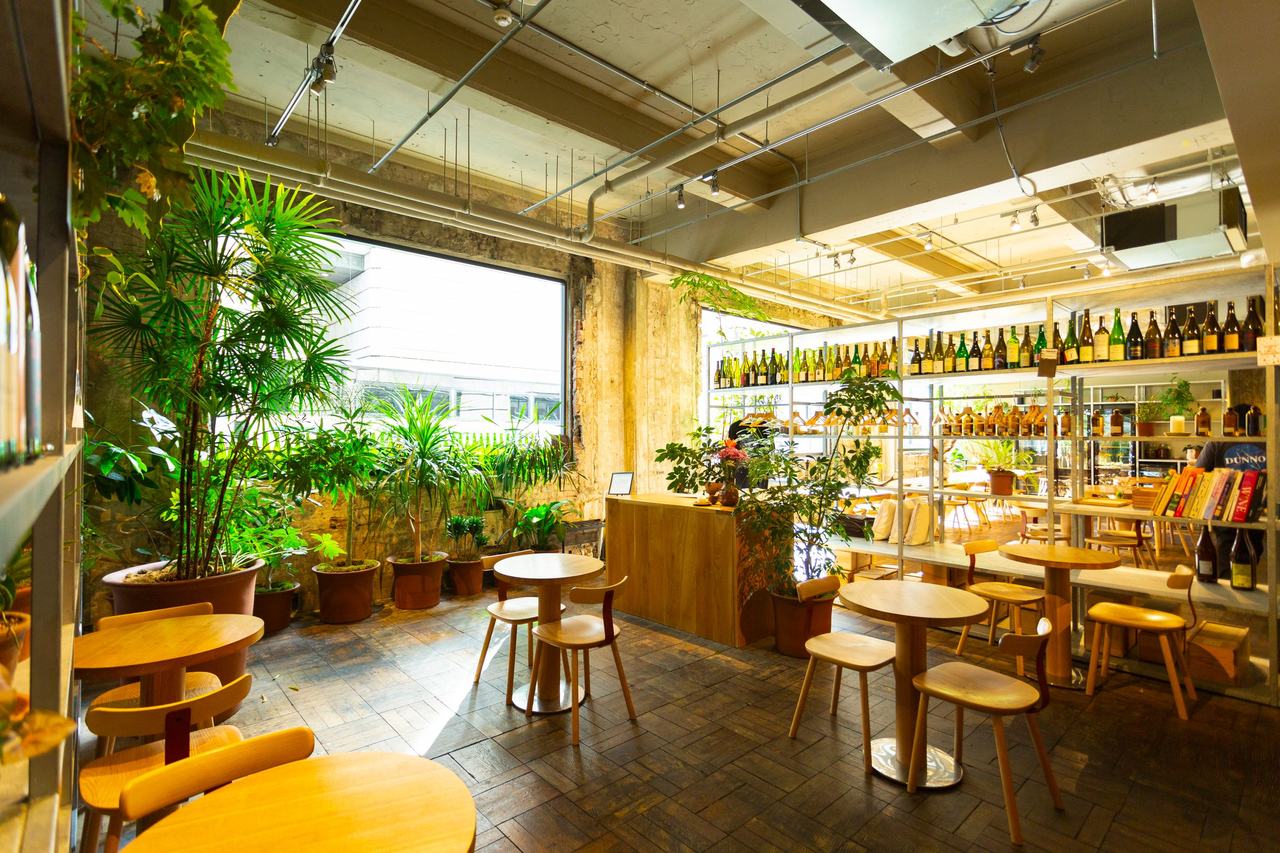
Opening photograph: Empty wooden tables and potted palms fill a sunlit cafe lined with shelves of bottles in Tokyo. Photograph by Gu Ko on Pexels. Blog photo credits.