How to Order in Japan When You Can’t Read the Menu
To order food in Japan without reading the menu, ask what the staff recommend and then point: おすすめは何ですか? (what do you recommend?), followed by じゃあ、それをお願いします (I’ll have that, then). For anything else on the menu, point at it and ask これは何ですか? (what’s this?). With four questions and three ways of saying “this one,” you can order a full meal without reading a word. Below is each line, with the answers you are likely to hear back, from the café, market stall, ramen and izakaya lessons of Koe’s course.
Ask what they recommend
A good first question at any counter is about osusume, the recommendation. It hands the choice to someone who knows the menu, and the answer often comes with a name you can repeat. Here it is at the course’s izakaya, where Ueda-san, the server, has a ready answer:
You ask
おすすめは何ですか?
Osusume wa nan desu ka?
What do you recommend?
Ueda-san, the izakaya server, says
本日のおすすめは刺身の盛り合わせです。
Honjitsu no osusume wa sashimi no moriawase desu.
Today’s special is the sashimi platter.
You say
じゃあ、それをお願いします。
Jā, sore o onegai shimasu.
I’ll have that, then.
じゃあ is well then. Ordering by name works the same way: 枝豆と唐揚げをください, edamame and fried chicken, please.
Listen for honjitsu no osusume, today’s special, at the start of her answer. Whatever follows is the dish. You do not need to catch the name: in the course, じゃあ、それをお願いします answers her suggestion directly, with sore, that, standing for the dish she just named.
The course notes add that ordering by name works the same way, with an izakaya example: edamame and fried chicken. If you have a dish name from a guidebook or a friend, name it and finish with kudasai.
When there are too many choices
A recommendation question with nan asks “what.” When the choices are laid out in front of you, as on a ticket machine or a picture menu, the course switches to dore:
You ask
おすすめはどれですか?
Osusume wa dore desu ka?
Which one do you recommend?
どれ is which one, when there are three or more to point at.
You ask
一番人気はどれですか?
Ichiban ninki wa dore desu ka?
Which is the most popular?
一番 is number one, the most. The top left button is usually the house bowl.
Ishii-san, the ramen chef, says
左上のラーメンが定番です。
Hidariue no rāmen ga teiban desu.
The ramen at the top left is the standard.
Ichiban ninki asks for the most popular. The course notes explain ichiban as number one, the most. The answer in the course comes from a ramen chef, and it uses a word worth knowing: teiban, which the course explains as the classic, the one everyone orders. If you hear teiban, you have found the safe choice.
If you are standing at a ticket machine rather than a menu, the ticket machine guide covers the rest of that routine.
Point at it and ask what it is
When you see something you cannot read, point and ask. This is the most flexible line on the page: it works for a menu photo, a dish at the next table, or a button with no picture.
You ask
これは何ですか?
Kore wa nan desu ka?
What’s this?
Ishii-san, the ramen chef, says
味玉です。味付けの卵です。
Ajitama desu. Ajitsuke no tamago desu.
That’s ajitama, a seasoned egg.
Notice the shape of the answer. The chef gives the name first, ajitama, and then a plainer description, a seasoned egg. When you ask about food, listen past the name for the second sentence, which is often the part you can understand.
Check before you commit
If you do not eat spicy food, ask before you order rather than after the dish arrives. The course keeps it to three words:
You ask
辛いですか?
Karai desu ka?
Is it spicy?
Point at the dish as you ask. The answer you need is a yes or a no. Listen for hai, yes, or iie, which the course notes call the plain no, for facts. If you are unsure what you heard, ask again with すみません、もう一度お願いします.
Order by pointing: this, that, and that too
Once you have decided, you can order without saying the dish’s name at all. The course gives two lines for this, from a market stall, and they work at any counter:
You say
じゃあ、これをください。
Jā, kore o kudasai.
Then I’ll take these.
You say
それもください。
Sore mo kudasai.
That too, please.
In the course’s translations, kore is this and sore is that. Mo adds a dish to what you have already ordered: the course notes describe mo as too, or also. So you can point at one dish and say じゃあ、これをください, point at another and say それもください, and you have ordered two things without a single dish name.
For drinks and dishes in a quantity, the counting words come in. The guide to counters for ordering covers hitotsu, futatsu and the rest.
Finishing the order
At the course’s kissaten, Haruka, the café owner, checks that you are done before she goes:
Haruka, the café owner, asks
ご注文は以上でよろしいですか?
Gochūmon wa ijō de yoroshii desu ka?
Will that be all?
You say
以上です。
Ijō desu.
That’s all.
Ijō desu closes the order. If you do want something else, point and add it with mo instead.
Putting it together at a counter
Here is how a meal can go with nothing but these lines:
- Sit down and ask おすすめは何ですか?. If there is a wall of choices, ask 一番人気はどれですか? instead.
- If the answer is a name you do not know, point at the menu and ask これは何ですか?.
- If spice matters to you, point and ask 辛いですか?.
- Order the recommendation with じゃあ、それをお願いします, or point and say じゃあ、これをください.
- Add a second dish by pointing and saying それもください.
- When you are asked if that will be all, say 以上です.
None of these lines needs you to read a word or know a dish name. They do need you to hear the answers, which is where most of the difficulty lies.
Every line on this page is a recording from Koe’s course. The staff’s answers are the part worth practicing: in the app you hear each line, say your side out loud, and see what it heard, so that a fast reply at a real counter sounds familiar.
Every line on this page
The 13 lines above, in order, for one last listen before you go. Each one is the recording from the Koe course.
おすすめは何ですか?Osusume wa nan desu ka?What do you recommend?
本日のおすすめは刺身の盛り合わせです。Honjitsu no osusume wa sashimi no moriawase desu.Today’s special is the sashimi platter.
じゃあ、それをお願いします。Jā, sore o onegai shimasu.I’ll have that, then.
おすすめはどれですか?Osusume wa dore desu ka?Which one do you recommend?
一番人気はどれですか?Ichiban ninki wa dore desu ka?Which is the most popular?
左上のラーメンが定番です。Hidariue no rāmen ga teiban desu.The ramen at the top left is the standard.
これは何ですか?Kore wa nan desu ka?What’s this?
味玉です。味付けの卵です。Ajitama desu. Ajitsuke no tamago desu.That’s ajitama, a seasoned egg.
辛いですか?Karai desu ka?Is it spicy?
じゃあ、これをください。Jā, kore o kudasai.Then I’ll take these.
それもください。Sore mo kudasai.That too, please.
ご注文は以上でよろしいですか?Gochūmon wa ijō de yoroshii desu ka?Will that be all?
以上です。Ijō desu.That’s all.
Common questions
How do you order food in Japan without speaking Japanese?
Ask for a recommendation with おすすめは何ですか?, then say じゃあ、それをお願いします to order what you were told. For anything else, point and ask これは何ですか?, then order it with じゃあ、これをください. Those few lines cover most menus.
How do you ask “what do you recommend” in Japanese?
Say おすすめは何ですか?. When there are several choices in front of you, such as a ticket machine, the course uses おすすめはどれですか? instead, because dore is which one when there are three or more to point at.
How do you say “this one” when ordering in Japanese?
Point and say じゃあ、これをください. To add something the server just mentioned or is showing you, say それもください, that too, please.
How do you ask if food is spicy in Japanese?
Point at the dish and ask 辛いですか?. Listen for hai, yes, or iie, no.
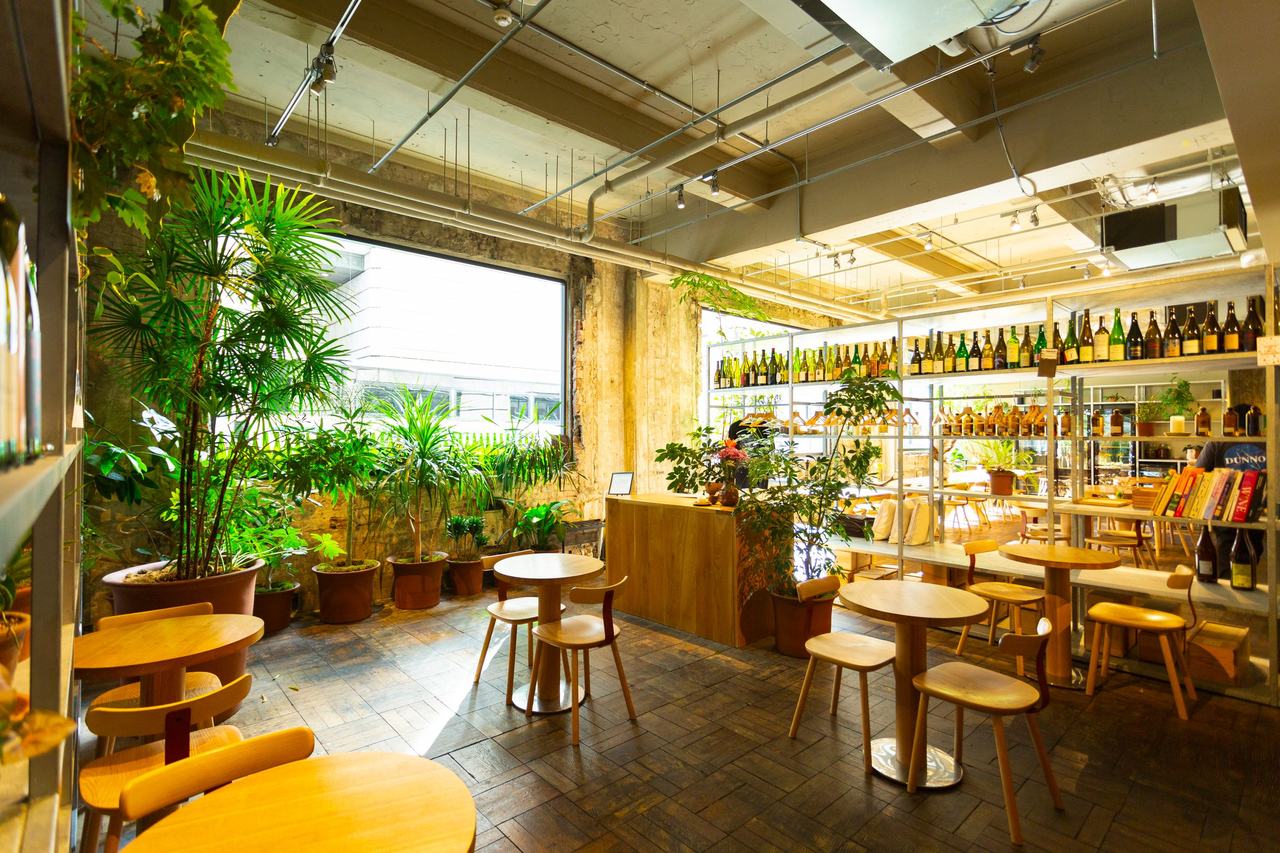
Opening photograph: Empty wooden tables and potted palms fill a sunlit cafe lined with shelves of bottles in Tokyo. Photograph by Gu Ko on Pexels. Blog photo credits.