Itadakimasu and Gochisosama: When to Say Them
Say itadakimasu right before you start eating, and gochisōsama deshita when you finish and as you leave. In a restaurant, いただきます (thanks for the food) comes before the first bite, even when you eat alone, and ごちそうさまでした (thank you for the meal) goes to whoever cooked or served you, on your way out. That settles the question many guides leave open: yes, you say it to the staff. Below are both phrases with real recordings, the two lines that go well with them, and the other everyday use of itadakimasu, from Koe’s course.
What itadakimasu means and when to say it
The course notes give it in one line: said before eating, even alone, hands together. Literally, I humbly receive. The course translates it as “thanks for the food.”
At the course’s ramen counter, the moment comes when the bowl lands in front of you and Ishii-san, the chef, says his line. Yours follows:
Ishii-san, the ramen chef, says
熱いうちにどうぞ。
Atsui uchi ni dōzo.
Enjoy it while it’s hot.
You say
いただきます。
Itadakimasu.
Thanks for the food.
Said before eating, even alone, hands together. Literally, I humbly receive.
The point of “even alone” is that itadakimasu belongs to the start of the meal, whether you are at a counter by yourself or at a table with friends. Hands together, and the word, are enough. The course’s scene at the ramen counter also tells you something useful for the bowl itself: you eat, and slurping is fine. When the bowl is empty, the next line is the one for leaving.
Itadakimasu when someone offers you food
Itadakimasu has a second everyday use: accepting food someone offers you. In the course, a neighbor calls over a garden wall with persimmons from his tree.
Okada-san, a neighbor, says
柿、たくさんなったので、よかったらどうぞ。
Kaki, takusan natta node, yokattara dōzo.
The tree’s given lots of persimmons, so have some, if you like.
You say
ありがとうございます。いただきます。
Arigatō gozaimasu. Itadakimasu.
Thank you, I’d love some.
Accepting food you’re offered. いただきます is also what everyone says before they eat.
The course notes spell out the double role: this line accepts food you are offered, and itadakimasu is also what everyone says before they eat. Putting arigatō gozaimasu in front turns it into “thank you, I’d love some.”
If you only want a little, the course has a gentler version:
You say
じゃあ、ひとつだけいただきます。
Jā, hitotsu dake itadakimasu.
Then just one, thank you.
And if you would rather not take any, the course notes say a plain iie sounds blunt as the answer to an offer, and give the soft way instead: いえ、大丈夫です (no, thank you).
What gochisōsama deshita means, and who you say it to
This is the phrase people are less sure of. The course notes are clear: said as you leave, to whoever cooked or served. Everyone says it when they finish eating, too.
So there are two moments for it. One is when you finish eating. The other is out loud, toward the counter or the kitchen, as you get up to go. At a ramen counter the cook is right in front of you, so the second one is easy: stand, turn toward him, and say it.
In the course, another customer finishes first, and you hear him say it on his way out. Then it is your turn:
A customer says
ごちそうさまでした。
Gochisōsama deshita.
Thank you for the meal.
You say
ごちそうさまでした。
Gochisōsama deshita.
Thank you for the meal.
Said as you leave, to whoever cooked or served. Everyone says it when they finish eating, too.
The course’s note says to say it as you leave, to whoever cooked or served. The customer’s line and yours are the same words, so hearing him say it first is the best rehearsal you could ask for.
Two lines that make a cook’s day
The course adds two lines for the end of a meal you enjoyed. The first tells the cook the food was good. It is in the past tense, because the meal is over:
You say
すごくおいしかったです。
Sugoku oishikatta desu.
That was really good.
Past tense, as you finish. すごく is really, very.
The second, in the course’s own words, is the nicest thing to say to a cook on your way out, after gochisōsama deshita:
You say
また来ます。
Mata kimasu.
I’ll come again.
The nicest thing to say to a cook on your way out, after ごちそうさまでした.
Put together, the exit from a ramen counter can be ごちそうさまでした, then また来ます. Two short lines, both in the polite form.
What you hear back as you leave
The staff have their own closing lines, and it helps to recognize them so you know the exchange is complete. At the course’s small izakaya in Koenji, the owner sees you off like this:
Matsumoto-san, the izakaya owner, says
ありがとうございました。またどうぞ。
Arigatō gozaimashita. Mata dōzo.
Thank you. Come again.
At the course’s kissaten, Haruka, the café owner, closes with the first half alone:
Haruka, the café owner, says
ありがとうございました。
Arigatō gozaimashita.
Thank you.
Arigatō gozaimashita is their thank-you for your visit, and mata dōzo asks you to come again. By then you have said your part.
The whole meal in four lines
Here is the sequence at a ramen counter or any small restaurant:
- The food arrives: いただきます.
- You finish and want to say it was good: すごくおいしかったです.
- You stand up to leave: ごちそうさまでした, toward whoever cooked or served.
- If you liked it: また来ます.
Every line on this page is a recording from Koe’s course. These are lines you say rather than hear, so the practice is in your own mouth: in the app you hear each one, say it out loud, and see what it heard. If you want more of the ramen visit itself, the ticket machine guide starts at the door.
Every line on this page
The 11 lines above, in order, for one last listen before you go. Each one is the recording from the Koe course.
熱いうちにどうぞ。Atsui uchi ni dōzo.Enjoy it while it’s hot.
いただきます。Itadakimasu.Thanks for the food.
柿、たくさんなったので、よかったらどうぞ。Kaki, takusan natta node, yokattara dōzo.The tree’s given lots of persimmons, so have some, if you like.
ありがとうございます。いただきます。Arigatō gozaimasu. Itadakimasu.Thank you, I’d love some.
じゃあ、ひとつだけいただきます。Jā, hitotsu dake itadakimasu.Then just one, thank you.
ごちそうさまでした。Gochisōsama deshita.Thank you for the meal.
ごちそうさまでした。Gochisōsama deshita.Thank you for the meal.
すごくおいしかったです。Sugoku oishikatta desu.That was really good.
また来ます。Mata kimasu.I’ll come again.
ありがとうございました。またどうぞ。Arigatō gozaimashita. Mata dōzo.Thank you. Come again.
ありがとうございました。Arigatō gozaimashita.Thank you.
Common questions
Do you say itadakimasu when eating alone?
Yes. The course notes say it is said before eating, even alone, hands together. It marks the start of the meal.
Do you say gochisōsama to restaurant staff?
Yes. The course notes say it is said as you leave, to whoever cooked or served. Everyone also says it when they finish eating. At a counter, say it toward the cook as you get up.
What does itadakimasu mean literally?
The course gives the literal meaning as “I humbly receive,” and translates it as “thanks for the food.” It is also how you accept food someone offers you: ありがとうございます。いただきます, thank you, I’d love some.
What can you say to a cook besides gochisōsama?
The course gives two lines: すごくおいしかったです, that was really good, and また来ます, I’ll come again, which the course notes call the nicest thing to say to a cook on your way out.
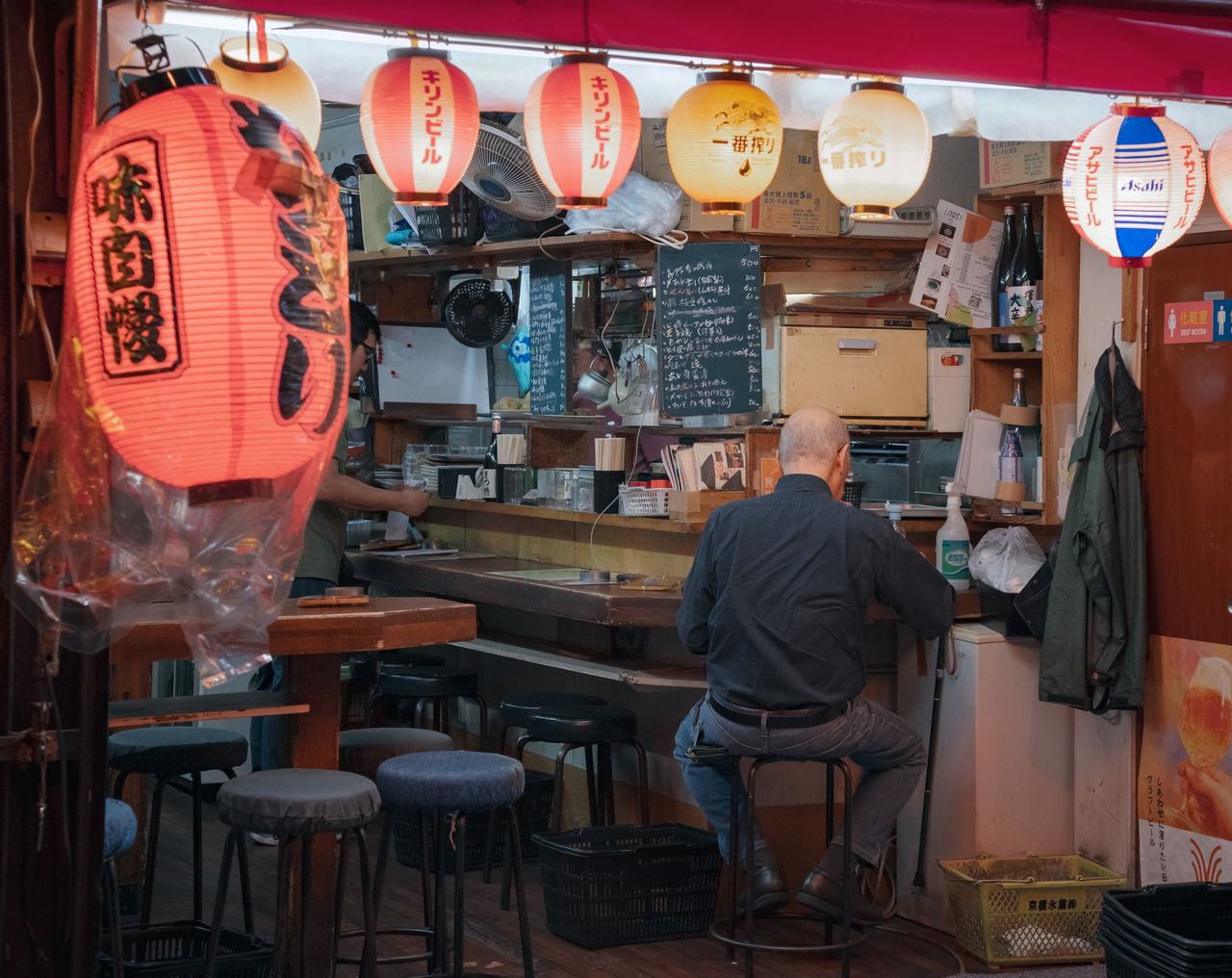
Opening photograph: A lone customer sits at the counter of a small izakaya under rows of paper lanterns in Tokyo. Photograph by Iban Lopez Luna on Pexels. Blog photo credits.