Japanese Counters for Ordering: Hitotsu, Futatsu, Mittsu
To order food in Japan, start with one set of numbers: hitotsu, futatsu, mittsu, up to ten, which the course uses for things you count, from coffees to apples. Put the number after the thing and add please: ホットコーヒーをひとつください, one hot coffee. On top of that you need only a few special counters: hai for another glass, hon for long things, zen for chopsticks, mai for towels, haku for hotel nights, and futari for a party of two.
One to ten for almost anything
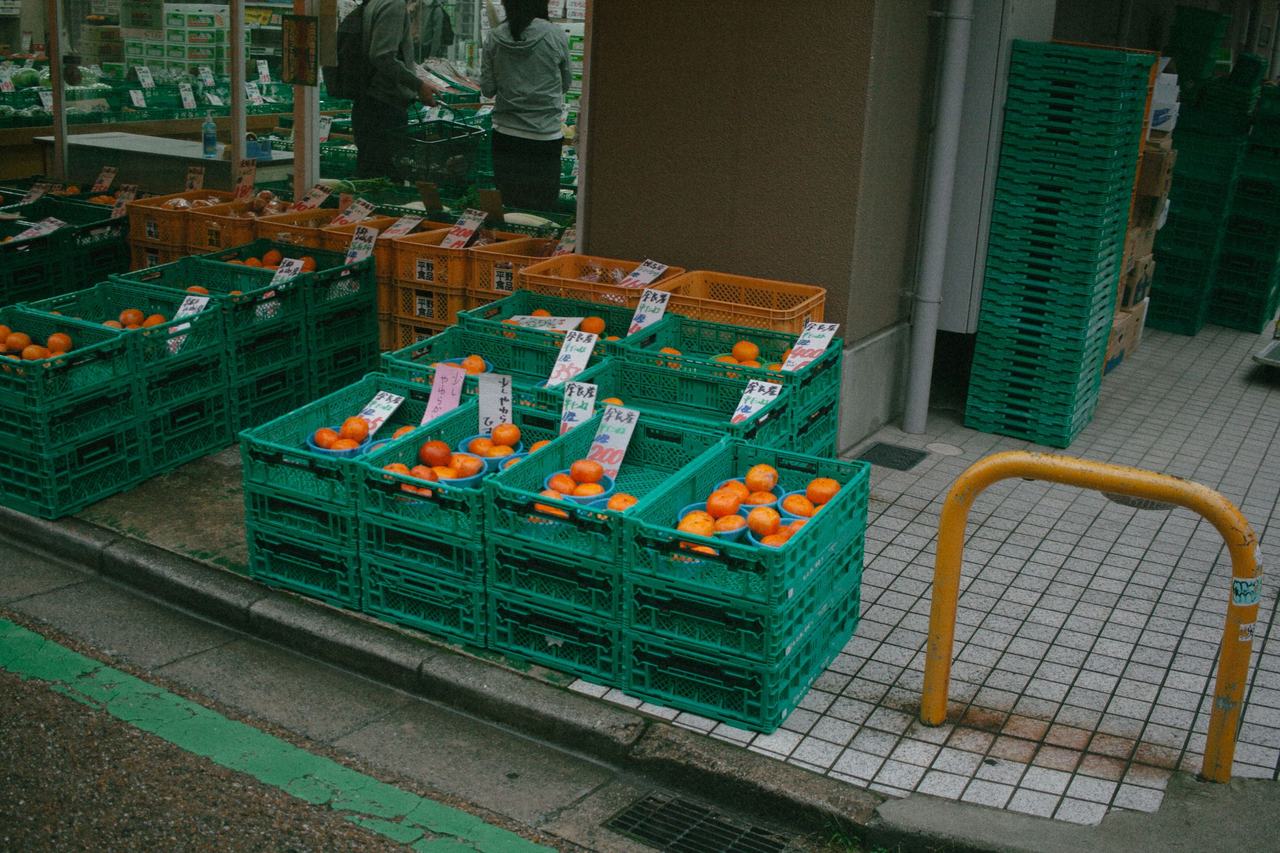
The course teaches the numbers at a fruit and vegetable stand on Togoshi Ginza’s long shopping street, where apples, persimmons and pears are sold one by one. Its note lists the full set:
You say
りんごをふたつください。
Ringo o futatsu kudasai.
Two apples, please.
Count things with ひとつ, ふたつ, みっつ, よっつ, いつつ, むっつ, ななつ, やっつ, ここのつ and とお: one to ten.
Those ten words cover a lot of ordering. Here are two more from the same stand, with three and five:
You say
柿をみっつください。
Kaki o mittsu kudasai.
Three persimmons, please.
You say
梨をいつつください。
Nashi o itsutsu kudasai.
Five pears, please.
Japanese pears are round and crisp, a little like apples.
In every one of these lines the thing comes first, then o, then the number, then kudasai. Keep that order and you can swap in any item. In the course, Haruka, the café owner, buys eight apples the same way:
Haruka, the café owner, says
じゃあ、りんごをやっつください。
Jā, ringo o yattsu kudasai.
Then eight apples, please.
Ordering coffee, food and drinks with the same numbers
The same numbers work at a counter. At the kissaten in Jimbocho, the course orders iced coffee for two:
You say
アイスコーヒーをふたつください。
Aisu kōhī o futatsu kudasai.
Two iced coffees, please.
At an izakaya, it orders beer the same way:
You say
生ビールをふたつお願いします。
Namabīru o futatsu onegai shimasu.
Two draft beers, please.
When you want one each of two different things, the course has a neat trick. Its note says ひとつずつ is one of each, so you can name both items and count them once:
You say
プリンとホットをひとつずつください。
Purin to hotto o hitotsu zutsu kudasai.
One pudding and one hot coffee, please.
ひとつずつ is one of each.
Listen for the number coming back. The course notes that staff repeat an order back, and Haruka, the café owner, does it like this:
Haruka, the café owner, says
ホットおひとつですね。
Hotto ohitotsu desu ne.
One hot coffee, then.
The course’s note on ordering adds that staff close an order with かしこまりました, certainly, and that it is their word. Yours is はい or お願いします.
By the piece, the bag or the pile
At a market stand, you may want the price of one before you decide how many. The course’s explanation notes that fruit and vegetable stands sell by the pile, the bag or the piece. Asking the price of one, you hear back a price for each:
You ask
1個いくらですか?
Ikko ikura desu ka?
How much is one?
Ōno-san, the greengrocer, says
1個150円です。
Ikko hyakugojūen desu.
They’re ¥150 each.
For things sold by the bag, the course buys みかんを一袋ください, a bag of mandarins. For a pile, the greengrocer quotes a price per pile, and you point and say じゃあ、これをください. Then 全部でいくらですか? asks the total for everything.
Another round: hai for glasses and bowls
The counter you will want most at an izakaya is the one for a refill. The course’s note says 杯 counts glasses and bowls. You do not even need to name the drink:
You say
もう1杯お願いします。
Mō ippai onegai shimasu.
One more, please.
杯 counts glasses and bowls. No tipping anywhere in Japan, taxis and hotels included; the extras you’ll meet are the お通し and, at upscale places, a service charge already on the check.
The same note carries a useful fact for the bill: there is no tipping anywhere in Japan, and the extras you meet are the お通し, a small starter that comes with the seat, and at upscale places a service charge already on the check.
Long things, pairs and flat things: hon, zen and mai
Three more counters come up on a short trip. Long things, like a daikon radish, are counted with hon. The course’s note gives the first three, which change sound as they go: いっぽん, にほん, さんぼん.
You say
大根を1本ください。
Daikon o ippon kudasai.
One daikon, please.
Long things are counted with 本: 1本, 2本, 3本.
At the konbini, the night clerk may ask how many pairs of chopsticks you need. The answer uses zen, the counter for pairs of chopsticks, and the course notes that ふたつ works too:
Tamura-san, the night clerk, asks
お箸は何膳お付けしますか?
Ohashi wa nanzen otsuke shimasu ka?
How many pairs of chopsticks?
You say
2膳お願いします。
Nizen onegai shimasu.
Two pairs, please.
膳 counts pairs of chopsticks. ふたつ works too.
At the hotel, flat things use mai. The course’s note lists towels, sheets and tickets:
You ask
タオルをもう1枚もらえますか?
Taoru o mō ichimai moraemasu ka?
Could I have one more towel?
枚 counts flat things: towels, sheets, tickets.
People and nights: futari and haku
Two more come up at the door of a restaurant and at a hotel desk. When the server asks how many of you there are, answer with the number of people. The course’s note adds that the server’s question uses an honorific, 様, that is hers alone, so you answer plainly:
You say
2人です。
Futari desu.
Two of us.
With two fingers up. The server asks 何名様ですか?, how many of you. The 様 is the honorific, and it is hers alone: you say 2人です, or 2名です.
Booking a table by phone works the same way. The course’s line is 15日の7時から、2人でお願いします, for two, on the 15th, at seven, and its note repeats the point: the host’s 様 honors the customer, so it never goes on your own number. Give the number of people, the date and the time in one breath, and the host can check for a table.
At check-in, nights are counted with haku, and again the course gives the first three readings, which change sound: いっぱく, にはく, さんぱく.
You say
2泊です。
Nihaku desu.
Two nights.
泊 counts nights: 1泊, 2泊, 3泊.
If you forget the right counter
Do not freeze. The course itself shows that there is sometimes more than one acceptable answer: for chopsticks, ふたつ works as well as 2膳, and for people, the note on futari gives a second form that works as well as 2人. Holding up fingers helps too. The course’s note on futari says to say it with two fingers up.
For a shopping list, here is the whole kit in one place:
- Most things: hitotsu, futatsu, mittsu and on to ten.
- Another glass or bowl: mō ippai.
- Long things: いっぽん, にほん, さんぼん.
- Pairs of chopsticks: nizen.
- Towels and other flat things: ichimai.
- People: futari.
- Hotel nights: nihaku.
Every line here is a recording from Koe’s course. In the app you hear each order, say it out loud, and see what it heard, so futatsu and mittsu come out without counting on your fingers first.
Every line on this page
The 17 lines above, in order, for one last listen before you go. Each one is the recording from the Koe course.
りんごをふたつください。Ringo o futatsu kudasai.Two apples, please.
柿をみっつください。Kaki o mittsu kudasai.Three persimmons, please.
梨をいつつください。Nashi o itsutsu kudasai.Five pears, please.
じゃあ、りんごをやっつください。Jā, ringo o yattsu kudasai.Then eight apples, please.
アイスコーヒーをふたつください。Aisu kōhī o futatsu kudasai.Two iced coffees, please.
生ビールをふたつお願いします。Namabīru o futatsu onegai shimasu.Two draft beers, please.
プリンとホットをひとつずつください。Purin to hotto o hitotsu zutsu kudasai.One pudding and one hot coffee, please.
ホットおひとつですね。Hotto ohitotsu desu ne.One hot coffee, then.
1個いくらですか?Ikko ikura desu ka?How much is one?
1個150円です。Ikko hyakugojūen desu.They’re ¥150 each.
もう1杯お願いします。Mō ippai onegai shimasu.One more, please.
大根を1本ください。Daikon o ippon kudasai.One daikon, please.
お箸は何膳お付けしますか?Ohashi wa nanzen otsuke shimasu ka?How many pairs of chopsticks?
2膳お願いします。Nizen onegai shimasu.Two pairs, please.
タオルをもう1枚もらえますか?Taoru o mō ichimai moraemasu ka?Could I have one more towel?
2人です。Futari desu.Two of us.
2泊です。Nihaku desu.Two nights.
Common questions
How do you count when ordering food in Japanese?
Use hitotsu, futatsu, mittsu and on up to ten, after the thing you want: アイスコーヒーをふたつください, two iced coffees. The course uses this set for things you count, from fruit to coffee.
What is the Japanese counter for drinks?
For another glass, the course uses 杯, which counts glasses and bowls: もう1杯お願いします, one more, please. For a first order, the plain numbers work, as in 生ビールをふたつお願いします.
How do you say “two people” at a Japanese restaurant?
2人です, with two fingers up. The course gives one other form that is fine too, but notes you never add the server’s honorific 様 to your own answer.
How do you say “one of each” in Japanese?
Name both things and add ひとつずつ, which the course notes means one of each: プリンとホットをひとつずつください.
Opening photograph: Green crates of oranges with handwritten price cards sit on the sidewalk outside a Tokyo greengrocer. Photograph by Giuseppe Macri on Pexels. Blog photo credits.