How to Order Iekei Ramen: Noodles, Broth and Oil
To order iekei ramen, buy your ticket, hand it over, and expect one fast question about three things: how firm you want the noodles, how strong the broth, and how much oil. If you have no preference, the whole answer is 全部普通でお願いします (everything regular, please). If you like your noodles with more bite, say 麺硬めでお願いします (firm noodles, please). The hard part is not the answer but catching the question, so this guide plays it at full speed, breaks it into its three pieces, and gives you the lines for a large bowl, no green onions and the free rice, all from the ramen unit of Koe’s course.
What iekei ramen is, and why the chef asks
The course notes describe iekei as the Yokohama style: a rich pork and soy broth with thick noodles. What matters for a visitor is the next part of the note: iekei counters ask three things about how you want your bowl. In the course, the chef asks right after he takes your ticket, before anything else, so the question comes at a moment when you may still be settling onto your stool.
If you have not bought the ticket yet, the ticket machine guide covers that part, including what to do when the machine will not take your bill.
The three-part question, at full speed
Here is the moment in the course. Ishii-san, the ramen chef, takes your ticket and asks straight away:
Ishii-san, the ramen chef, says
食券、お預かりします。
Shokken, oazukari shimasu.
I’ll take your ticket.
Ishii-san, the ramen chef, asks
麺の硬さ、味の濃さ、油の量、お好みはありますか?
Men no katasa, aji no kosa, abura no ryō, okonomi wa arimasu ka?
Any preference for the noodles’ firmness, the broth’s strength, or the amount of oil?
Played at speed it sounds like one long sentence. Slowed down, it is a list of three things and then the question itself:
- men no katasa: the noodles’ firmness, how firm
- aji no kosa: the broth’s strength, how strong
- abura no ryō: the amount of oil, how much oil
- okonomi wa arimasu ka: do you have a preference
Once you can pick out men, aji and abura, the question stops being a wall of sound. You will know what he is asking even if you miss the rest.
If it still goes by too fast, it is fine to ask for it again. The course’s lines for that are すみません、もう一度お願いします (sorry, could you say that again) and もう少しゆっくりお願いします (a little more slowly, please). On the second pass, listen only for the three words men, aji and abura, in that order.
The safe answer: everything regular
If this is your first iekei bowl, there is no reason to change anything. The course gives one answer that covers all three:
You say
全部普通でお願いします。
Zenbu futsū de onegai shimasu.
Everything regular, please.
Iekei is the Yokohama style: rich pork and soy broth with thick noodles. Its counters ask three things: 麺の硬さ, how firm; 味の濃さ, how strong; 油の量, how much oil. 普通 is regular for all three.
Futsū is regular, and zenbu is everything. Said together, they tell the chef to make the bowl the way the shop makes it. It is a complete, natural answer, and you can say it the moment he finishes asking.
Firm noodles, if you want them
If you like your noodles with more bite, change just that. The course line for it is short:
You say
麺硬めでお願いします。
Men katame de onegai shimasu.
Firm noodles, please.
硬め is on the firm side; やわらかめ is softer.
Katame is on the firm side, and the course notes give やわらかめ as the softer option. If the noodles are the only thing you care about, this one line is your whole answer. The course does not teach separate answers for the broth and the oil, so if you want those as the shop makes them, stay with futsū.
A large bowl, no green onions
The course has two more requests for the counter. The first is a bigger portion:
You ask
大盛りにできますか?
Ōmori ni dekimasu ka?
Can I get a large portion?
大盛り is a large serving. At some counters it’s a button on the machine; at others you ask.
Ishii-san, the ramen chef, says
はい、大盛りですね。
Hai, ōmori desu ne.
Sure, a large.
As the course notes say, at some counters ōmori is a button on the machine, and at others you ask. If you see no button for it, ask when you hand over the ticket.
The second is leaving a topping out. Nuki after a topping means without it, so green onions become neginuki:
You say
ネギ抜きでお願いします。
Neginuki de onegai shimasu.
No green onions, please.
抜き after a topping means without it.
Free rice, and what to do with it
Then there is the rice. In the course, Ishii-san brings it up himself:
Ishii-san, the ramen chef, says
ライスは無料です。
Raisu wa muryō desu.
Rice is free.
You say
ライスもお願いします。
Raisu mo onegai shimasu.
Rice too, please.
At an iekei counter the rice is often free, 無料, or ¥100 or so. People dip the nori from the bowl in the broth and eat it over the rice.
Muryō is free of charge. The course notes say the rice is often free at an iekei counter, or about ¥100. They also describe the habit that goes with it: people dip the nori from the bowl in the broth and eat it over the rice. If you hear raisu and muryō together, that is your cue to say yes.
When the bowl arrives
The bowl comes down over the counter with a short line, the same one the course’s café owner uses when your coffee arrives:
Ishii-san, the ramen chef, says
お待たせしました。ラーメンです。
Omatase shimashita. Rāmen desu.
Here you are, your ramen.
Iekei broth is rich, and the course has a line for that too. The notes say rich broth splashes, and many ramen places keep paper bibs behind the counter:
You ask
紙エプロンはありますか?
Kamiepuron wa arimasu ka?
Do you have a paper bib?
Rich broth splashes. Many ramen places keep paper bibs behind the counter; ask, and one may appear.
What you say before the first sip, and on your way out, is its own small ritual, covered in the guide to itadakimasu and gochisōsama.
Every line on this page is a recording from Koe’s course. The chef’s question is the one worth hearing many times: in the app you hear it, answer out loud, and see what it heard, so that at a real counter you can answer before he has finished asking.
Every line on this page
The 11 lines above, in order, for one last listen before you go. Each one is the recording from the Koe course.
食券、お預かりします。Shokken, oazukari shimasu.I’ll take your ticket.
麺の硬さ、味の濃さ、油の量、お好みはありますか?Men no katasa, aji no kosa, abura no ryō, okonomi wa arimasu ka?Any preference for the noodles’ firmness, the broth’s strength, or the amount of oil?
全部普通でお願いします。Zenbu futsū de onegai shimasu.Everything regular, please.
麺硬めでお願いします。Men katame de onegai shimasu.Firm noodles, please.
大盛りにできますか?Ōmori ni dekimasu ka?Can I get a large portion?
はい、大盛りですね。Hai, ōmori desu ne.Sure, a large.
ネギ抜きでお願いします。Neginuki de onegai shimasu.No green onions, please.
ライスは無料です。Raisu wa muryō desu.Rice is free.
ライスもお願いします。Raisu mo onegai shimasu.Rice too, please.
お待たせしました。ラーメンです。Omatase shimashita. Rāmen desu.Here you are, your ramen.
紙エプロンはありますか?Kamiepuron wa arimasu ka?Do you have a paper bib?
Common questions
What does the iekei ramen chef ask you?
He asks your preference for three things: men no katasa, the noodles’ firmness; aji no kosa, the broth’s strength; and abura no ryō, the amount of oil. It ends with okonomi wa arimasu ka, do you have a preference.
What should you say if you do not know how you want it?
Say 全部普通でお願いします, everything regular, please. Futsū is regular for all three, and it is a complete, natural answer.
What does katame mean in ramen?
Katame means on the firm side, for the noodles. Order it with 麺硬めでお願いします. The course gives やわらかめ as the softer option.
Is rice free at iekei ramen shops?
Often. The course notes say the rice at an iekei counter is often free, muryō, or about ¥100. Ask for it with ライスもお願いします.
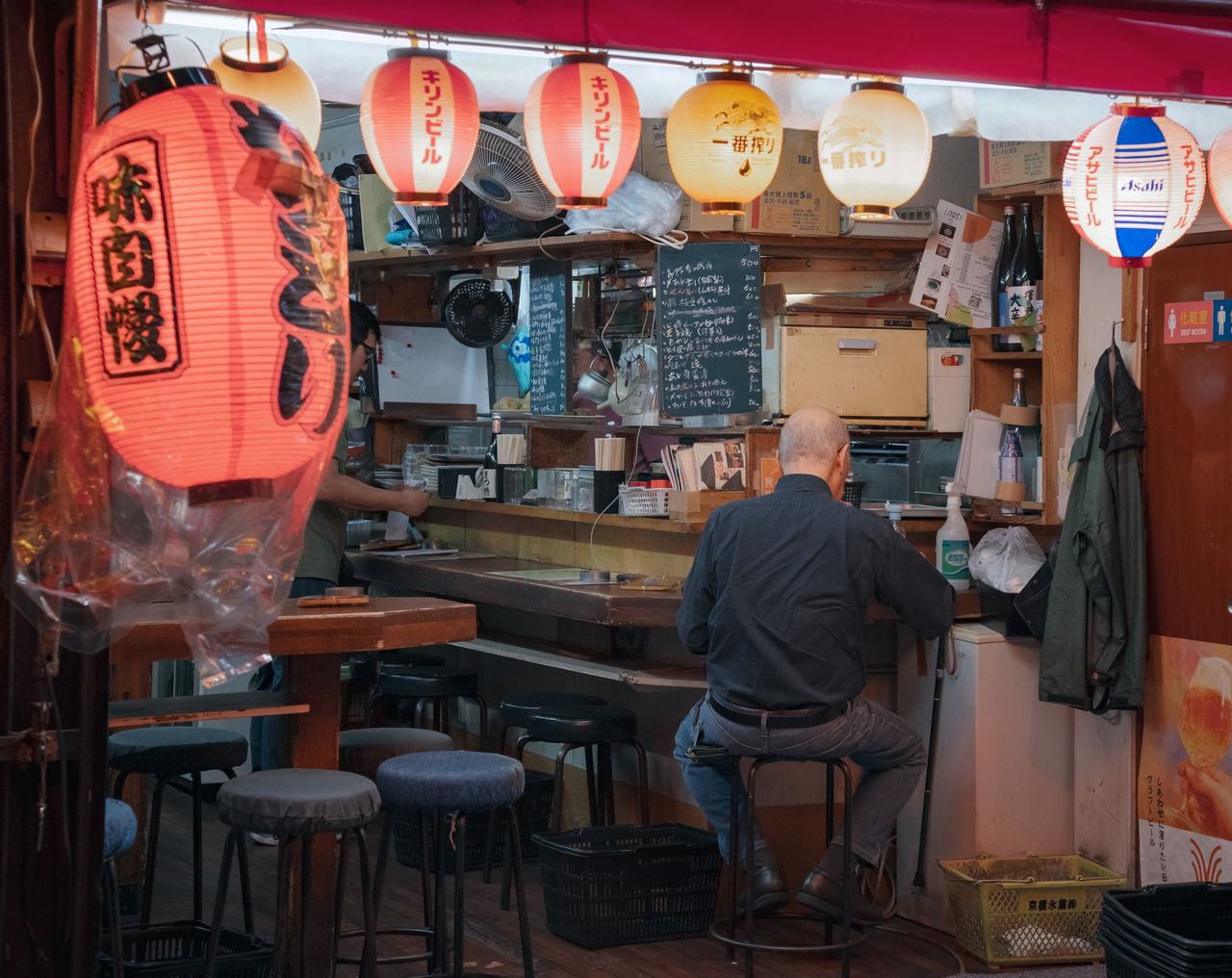
Opening photograph: A lone customer sits at the counter of a small izakaya under rows of paper lanterns in Tokyo. Photograph by Iban Lopez Luna on Pexels. Blog photo credits.