For Here or To Go in Japanese: Tennai or Mochikaeri
At a Tokyo counter, the for-here question sounds like 店内でお召し上がりですか?, Tennai de omeshiagari desu ka? The course translates it simply as “For here?” Answer はい、店内で, yes, for here, or いえ、持ち帰りで, no, to go. That is the whole exchange. The staff’s question is long and very polite, but the course notes it is Japanese you only need to understand: you can answer simply, and you never repeat their verb.
Hearing the question
This question comes right after you order, and it is easy to miss because it is long. In the course, Haruka, the café owner, asks it at the counter of a small kissaten in Jimbocho:
Haruka, the café owner, asks
店内でお召し上がりですか?
Tennai de omeshiagari desu ka?
For here?
Break it into two parts. Tennai de is the part you need: it is the same phrase you will answer with. Omeshiagari desu ka is the staff’s polite way to ask about eating, and you can let it wash over you. If you catch tennai at the start and ka at the end, you have the question.
It matters enough that the course plays it in the very first minute of the app, right after your first coffee order, before any lesson begins.
Because it is a yes or no question, “For here?”, you can start with yes or no, or simply name your choice.
Saying for here
The course’s simplest answer is two words. Its note explains why you keep it that short: the staff ask with お召し上がり, a verb that honors the person eating, so you never use it about yourself. 店内で is the whole answer.
You say
店内で。
Tennai de.
For here.
The staff ask with お召し上がり, a verb that honors the person eating, so you never use it about yourself. 店内で is the whole answer.
If you want to answer the question as a yes, put hai in front. The course’s note on this line says the same thing in another way: the staff’s question is polite Japanese you only need to understand, and you can answer simply.
You say
はい、店内で。
Hai, tennai de.
Yes, for here.
The staff’s question is polite Japanese you only need to understand. You can answer simply.
Both answers end in de, the same de that comes before onegai shimasu in the course’s other answers about how you want something, like カードでお願いします, by card, and 食後でお願いします, after the meal. Once you hear that pattern, the whole exchange feels smaller.
Saying to go
For takeout, the answer is a no, then the word for to go. In the course, Kenta, a friend, is ordering with you, and he is taking his with him:
Kenta, a friend, says
いえ、持ち帰りで。
Ie, mochikaeri de.
No, to go.
Kenta’s answer shows the pattern for every no in this exchange: ie first, then the choice, then de. You can say it the same way, or shorter. The course’s note adds a detail about the polite お you might hear on the front of the word: customers say it that way too, and the お only softens it.
You say
持ち帰りで。
Mochikaeri de.
To go.
Customers say お持ち帰りで too: the お only softens the word.
For a fuller version, add onegai shimasu:
You say
持ち帰りでお願いします。
Mochikaeri de onegai shimasu.
To go, please.
And if mochikaeri will not come to mind, the English-based word works just as well. The course notes that the loanword is just as common:
You say
テイクアウトでお願いします。
Teikuauto de onegai shimasu.
Takeout, please.
The loanword is just as common as 持ち帰り.
Paying together or separately
When two of you order together, the next question is about the bill. In the course, Haruka asks whether you are paying together:
Haruka, the café owner, asks
お会計はご一緒でよろしいですか?
Okaikei wa goissho de yoroshii desu ka?
Will you be paying together?
You say
別々でお願いします。
Betsubetsu de onegai shimasu.
Separately, please.
When you’re asked if you’re paying together.
The course’s scene is exactly this: you are staying, your friend is taking his to go, and you each pay for your own. If you are paying for both, a simple hai answers the question. Then you hear the total:
Haruka, the café owner, says
580円です。
Gohyakuhachijūen desu.
That’s ¥580.
There is more on paying at the end of a meal in how to ask for the bill in Japanese.
After you order: your drink comes to you
At Haruka’s kissaten, once you have paid, you sit down and the order comes to your table. She tells you so:
Haruka, the café owner, says
お席までお持ちしますので、おかけになってお待ちください。
Oseki made omochi shimasu node, okake ni natte omachi kudasai.
I’ll bring it to your seat, so please sit down and wait.
The useful words here are oseki made, to your seat. The sentence is long, but it ends in a request, omachi kudasai, please wait, and that is the part to act on. If you hear it, find a seat and do not wait at the counter.
At a street stand: can I eat it here?
The same question turns around at a food stand. On Togoshi Ginza’s shopping street, the croquette stand fries at its window, and in the course’s scene people eat right there on the street. Here it is your question to ask, not the staff’s:
You ask
ここで食べてもいいですか?
Koko de tabetemo ii desu ka?
May I eat it here?
Notice the difference in politeness. At the cafe, the staff ask you with an honoring verb. At the stand, you ask with plain polite Japanese, Koko de tabetemo ii desu ka, may I eat it here. Each side uses the words that fit their role.
The whole exchange, start to finish
Here is the course’s scene in order, with you staying and your friend taking his coffee with him:
- Haruka asks 店内でお召し上がりですか?, for here?
- You answer はい、店内で. Your friend answers いえ、持ち帰りで.
- Haruka asks お会計はご一緒でよろしいですか?, paying together?
- You answer 別々でお願いします, separately, please.
- Haruka tells you the total, then that she will bring your coffee to your seat.
Five turns, and your part in each is a handful of words.
Every line on this page is a recording from Koe’s course. In the app you hear Haruka’s question, answer it out loud, and see what it heard, so tennai de is ready before she finishes asking.
Every line on this page
The 12 lines above, in order, for one last listen before you go. Each one is the recording from the Koe course.
店内でお召し上がりですか?Tennai de omeshiagari desu ka?For here?
店内で。Tennai de.For here.
はい、店内で。Hai, tennai de.Yes, for here.
いえ、持ち帰りで。Ie, mochikaeri de.No, to go.
持ち帰りで。Mochikaeri de.To go.
持ち帰りでお願いします。Mochikaeri de onegai shimasu.To go, please.
テイクアウトでお願いします。Teikuauto de onegai shimasu.Takeout, please.
お会計はご一緒でよろしいですか?Okaikei wa goissho de yoroshii desu ka?Will you be paying together?
別々でお願いします。Betsubetsu de onegai shimasu.Separately, please.
580円です。Gohyakuhachijūen desu.That’s ¥580.
お席までお持ちしますので、おかけになってお待ちください。Oseki made omochi shimasu node, okake ni natte omachi kudasai.I’ll bring it to your seat, so please sit down and wait.
ここで食べてもいいですか?Koko de tabetemo ii desu ka?May I eat it here?
Common questions
What does tennai de omeshiagari desu ka mean?
The course translates it as “For here?” Staff ask it after you order. The verb honors the person eating, so you answer with just 店内で, or はい、店内で.
How do you say “to go” in Japanese?
持ち帰りで, or as an answer to the staff’s question, いえ、持ち帰りで, no, to go. Add onegai shimasu for a fuller version.
Can I say takeout in Japan?
Yes. The course’s line is テイクアウトでお願いします, and its note says the loanword is just as common as 持ち帰り.
Should I say omochikaeri or mochikaeri?
Either. The course notes that customers say it with the お in front too, and that the お only softens the word. What you should not borrow is the staff’s honoring verb お召し上がり.
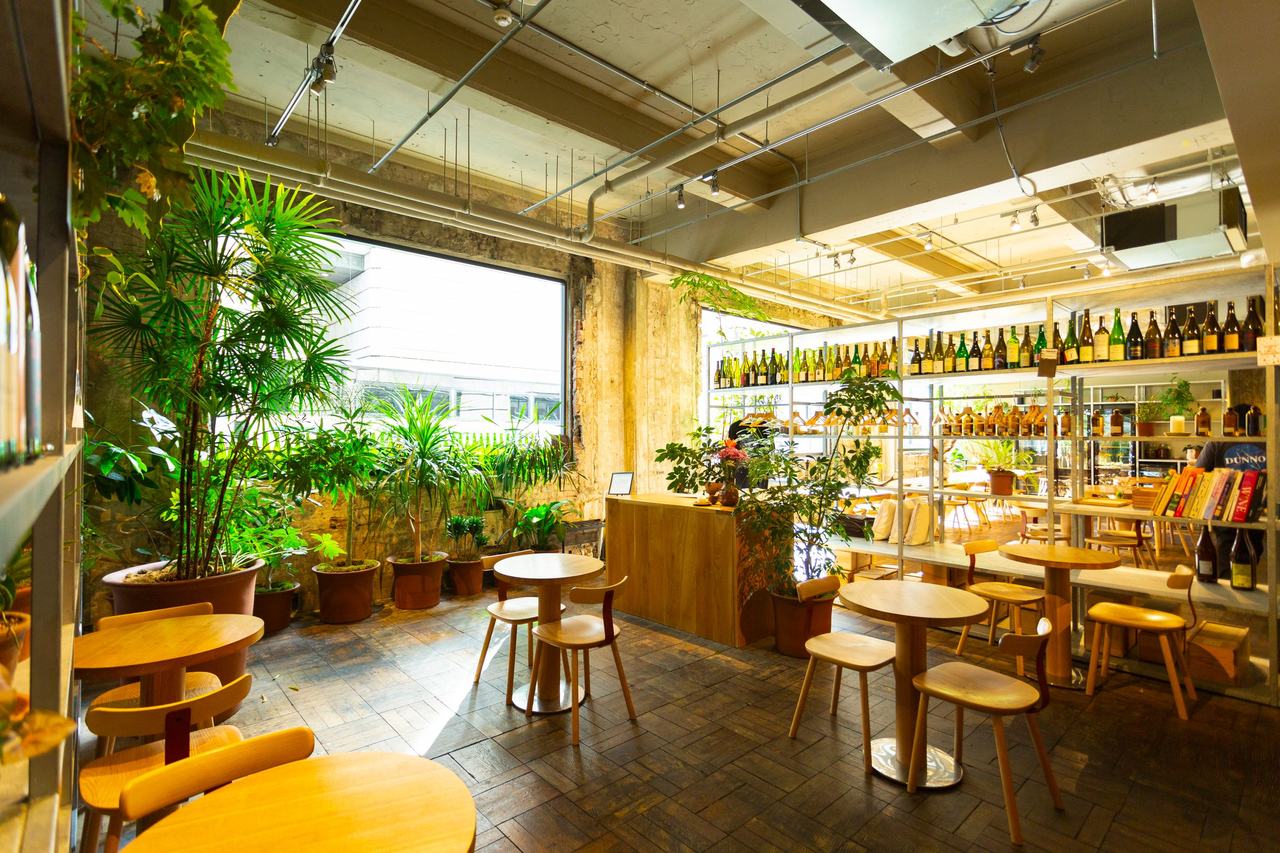
Opening photograph: Empty wooden tables and potted palms fill a sunlit cafe lined with shelves of bottles in Tokyo. Photograph by Gu Ko on Pexels. Blog photo credits.