What Does Irasshaimase Mean and Do You Answer
Irasshaimase means welcome. Staff say it to everyone who comes in, at cafes, shops and hotels, and the course is direct about the reply: you don’t say it back. Walk in and get on with what you came for. If a clerk adds “please take your time,” the course says that needs no answer either: a nod, or ありがとうございます.
What irasshaimase means and who says it
In the course, the very first thing you hear at the kissaten in Jimbocho is Haruka, the café owner, greeting the morning line:
Haruka, the café owner, says
いらっしゃいませ。
Irasshaimase.
Welcome.
The course’s note on this moment is a single line: staff say いらっしゃいませ to everyone when you come in, and you don’t say it back. It is part of the shop’s script, like a door chime with a voice. Nobody is waiting for a reply, so a missing reply is not rude.
What you do next is simply order, browse or ask your question. At the cafe that means stepping up to the counter. Haruka’s next line is the real question, Gochūmon, oukagai shimasu, what can I get you, and that one you answer.
In a clothing store: take your time
At a clothing store the greeting can come with a second line. At the vintage store in Shimokitazawa, Nomura-san, the store clerk, greets you as you start browsing the racks:
Nomura-san, the store clerk, says
いらっしゃいませ。どうぞごゆっくりご覧ください。
Irasshaimase. Dōzo goyukkuri goran kudasai.
Welcome. Please take your time.
The course’s explanation says どうぞごゆっくりご覧ください, please take your time, needs no answer. Its note on the next line is more specific: a nod, or ありがとうございます. If the clerk then asks whether you are looking for something in particular, that question you do answer:
Nomura-san, the store clerk, asks
何かお探しですか?
Nani ka osagashi desu ka?
Looking for anything in particular?
You say
ちょっと見てるだけです。
Chotto miteru dake desu.
I’m just looking.
The clerk’s いらっしゃいませ。どうぞごゆっくりご覧ください, welcome, please take your time, needs no answer: a nod, or ありがとうございます. If she asks what you’re after, this is the reply.
There is more on browsing in just looking in Japanese.
At a hotel desk: welcome, then a question
At the hotel near Ueno, Maeda-san, the front desk clerk, uses the same greeting and goes straight into a question. You answer the question and let the welcome go:
Maeda-san, at the front desk, says
いらっしゃいませ。ご予約のお名前をお願いします。
Irasshaimase. Goyoyaku no onamae o onegai shimasu.
Welcome. The name on the reservation, please.
You say
予約しているブラウンです。
Yoyaku shite iru Buraun desu.
I have a reservation. The name is Brown.
The clerk asks パスポートを拝見してもよろしいでしょうか?, may I see your passport. 拝見します and お伺いします are the staff’s humble words for their own looking and asking, so you never echo them.
That note points to something you will meet all over Tokyo. Staff speak in a very polite register about what they do, and those words belong to them. You answer in plain polite Japanese.
Other lines staff say that you never say back
Irasshaimase is one of a small family of set lines that only staff use. Knowing them makes a counter much less mysterious.
When you order, staff repeat it back and close it with kashikomarimashita, certainly. The course’s note on this is clear: that’s their word, and yours is はい or お願いします.
Haruka, the café owner, says
ホットおひとつですね。
Hotto ohitotsu desu ne.
One hot coffee, then.
Haruka, the café owner, says
かしこまりました。
Kashikomarimashita.
Certainly.
When your order arrives, you hear this. The course translates it as here you are:
Haruka, the café owner, says
お待たせしました。
Omatase shimashita.
Here you are.
A few more you will hear without needing to echo:
- お付けしますか, shall I add, for chopsticks at the konbini or milk and sugar at a cafe. The course notes お付けします and ございます are the clerk’s humble and formal forms for what the clerk does, so you never say them back.
- 店内でお召し上がりですか, for here? The course notes the verb honors the person eating, so you never use it about yourself. Your answer is just 店内で. See for here or to go.
- 1,000円お預かりします, out of a thousand yen. The course calls it the cashier’s line, and says the answer is a nod or ありがとうございます.
- ちょうどいただきます, that’s exactly right, when you pay the exact amount. Again the course calls it the cashier’s line, with a nod or ありがとうございます as yours.
- 何名様でしょうか, for how many people? The course notes the 様 honors the customer, so you answer 2人です and never put 様 on your own number.
Thank you and come again
The script ends the way it began, with a set line from the staff. At the konbini late at night, Tamura-san, the night clerk, says:
Tamura-san, the night clerk, says
ありがとうございました。またお越しくださいませ。
Arigatō gozaimashita. Mata okoshi kudasaimase.
Thank you. Please come again.
At the izakaya in Koenji, the owner, Matsumoto-san, uses a shorter version:
Matsumoto-san, the izakaya owner, says
ありがとうございました。またどうぞ。
Arigatō gozaimashita. Mata dōzo.
Thank you. Come again.
And on the phone, a restaurant host closes a booking with this, which is the same idea in advance:
Yamaguchi-san, the restaurant host, says
お待ちしております。
Omachi shite orimasu.
We look forward to seeing you.
Again, these are lines you hear rather than say.
What you say as the customer
So what does a customer say? Very little, and all of it short. The course gives you a light, polite thanks that also works as a quick hello with a nod:
You say
どうも。
Dōmo.
Thanks. (polite)
Quick and light. With a nod, it’s also a quick hello.
Leaving a place that fed you, there is one line everyone says to whoever cooked or served:
You say
ごちそうさまでした。
Gochisōsama deshita.
Thank you for the meal.
Said as you leave, to whoever cooked or served. Everyone says it when they finish eating, too.
Put together, a whole visit to a cafe can run: staff say irasshaimase, you say nothing and step up; they ask for your order, you order; they say kashikomarimashita, you say hai; they say omatase shimashita, you take your coffee with dōmo; you leave with gochisōsama deshita, and they say arigatō gozaimashita. The staff do most of the talking, and your lines are the short ones.
Every line on this page is a recording from Koe’s course. In the app you hear each one, say your own lines out loud, and see what it heard, so the staff’s script becomes familiar before you walk in.
Every line on this page
The 14 lines above, in order, for one last listen before you go. Each one is the recording from the Koe course.
いらっしゃいませ。Irasshaimase.Welcome.
いらっしゃいませ。どうぞごゆっくりご覧ください。Irasshaimase. Dōzo goyukkuri goran kudasai.Welcome. Please take your time.
何かお探しですか?Nani ka osagashi desu ka?Looking for anything in particular?
ちょっと見てるだけです。Chotto miteru dake desu.I’m just looking.
いらっしゃいませ。ご予約のお名前をお願いします。Irasshaimase. Goyoyaku no onamae o onegai shimasu.Welcome. The name on the reservation, please.
予約しているブラウンです。Yoyaku shite iru Buraun desu.I have a reservation. The name is Brown.
ホットおひとつですね。Hotto ohitotsu desu ne.One hot coffee, then.
かしこまりました。Kashikomarimashita.Certainly.
お待たせしました。Omatase shimashita.Here you are.
ありがとうございました。またお越しくださいませ。Arigatō gozaimashita. Mata okoshi kudasaimase.Thank you. Please come again.
ありがとうございました。またどうぞ。Arigatō gozaimashita. Mata dōzo.Thank you. Come again.
お待ちしております。Omachi shite orimasu.We look forward to seeing you.
どうも。Dōmo.Thanks. (polite)
ごちそうさまでした。Gochisōsama deshita.Thank you for the meal.
Common questions
Do you say irasshaimase back?
No. The course notes that staff say いらっしゃいませ to everyone when you come in, and you don’t say it back. Walk in and order, browse or ask your question.
What should I say when I walk into a shop in Japan?
Nothing is required. If the clerk adds please take your time, the course says it needs no answer beyond a nod or ありがとうございます. If she asks what you are looking for, say ちょっと見てるだけです.
What does kashikomarimashita mean?
Certainly. Staff say it to close your order after repeating it back. The course notes it is their word: yours is はい or お願いします.
What does omatase shimashita mean?
The course translates it as here you are. Staff say it when they bring your order, and you can answer with a quick dōmo, thanks.
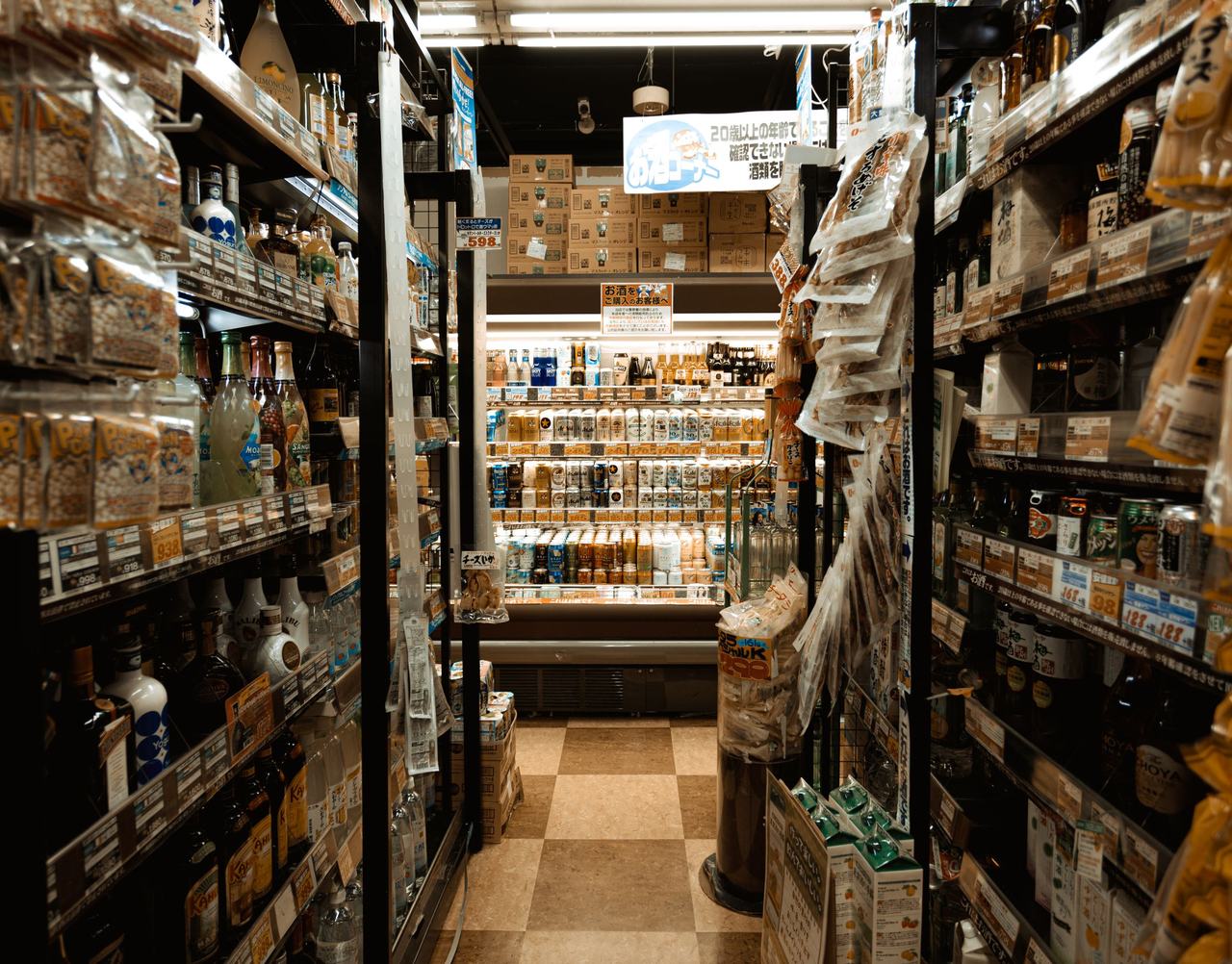
Opening photograph: A narrow convenience store aisle in Tokyo lined with packed shelves and a glowing drinks fridge at the back. Photograph by Aleksandar Pasaric on Pexels. Blog photo credits.