Sumimasen vs Gomen: Sorry and Excuse Me in Tokyo
Use すみません with everyone in Tokyo: it means excuse me, it means sorry, and it can even mean thank you when someone went to some trouble for you. Gomen is the casual sorry, and it belongs to friends who already talk to you casually. If you only learn one of the two before your trip, learn sumimasen. It works with staff, strangers, neighbors and coworkers, and it is polite enough for anyone.
One word that does many jobs
The course’s note on sumimasen is short: it also means sorry, and Tokyo uses it all day, to get someone’s attention, to apologize, and even to thank someone who went to some trouble for you. That is why it shows up at the start of so many lines in the course. It opens the door before you ask for something, and it softens what comes next.
You say
すみません。
Sumimasen.
Excuse me.
Also sorry. Tokyo uses it all day: to get someone’s attention, to apologize, and even to thank someone who went to some trouble for you.
The rest of this page follows one day in the city, in the order you are likely to need the word.
Calling staff and stopping a stranger
At a restaurant or izakaya, sumimasen is how you get a server’s attention. The check comes the same way: say it, then ask.
You say
すみません、お会計お願いします。
Sumimasen, okaikei onegai shimasu.
Excuse me, the check, please.
On a shopping street, the course puts it in front of a price question, so the stallholder knows you are talking to him before the question arrives.
You ask
すみません、これはいくらですか?
Sumimasen, kore wa ikura desu ka?
Excuse me, how much is this?
The same goes for directions. The course’s note on asking the way is plain: すみません first, to a stranger. Then the name of the station, then your question. On the phone it does one more job. When a restaurant answers with its own name, the course says to start with すみません rather than もしもし, which is for checking the line or calling a friend.
Getting through a crowd or off a train
In a narrow lane or a packed car, sumimasen clears the way. In the course’s first unit, Haruka, the café owner, comes up behind you on her bicycle on a lane in Yanaka and says this as she passes:
Haruka, the café owner, says
すみません、通ります。
Sumimasen, tōrimasu.
Excuse me, coming through.
You use the same word on a crowded train. The course’s line for it is said toward the door as you move:
You say
すみません、降ります。
Sumimasen, orimasu.
Excuse me, I’m getting off.
On a crowded train, said toward the door as you move. The announcements you hear, まいります, お下がりください, are never answered.
And when the ticket gate beeps and shuts in front of you, you take your problem to the attendant’s window with sumimasen in front of it:
You say
すみません、改札が通れません。
Sumimasen, kaisatsu ga tōremasen.
Excuse me, I can’t get through the gate.
改札 is the ticket gate. When it shuts on you, the attendant’s window, or an intercom, is beside it.
Saying sorry and meaning it
Sumimasen is also a real apology. The course uses it for being late, and its note on this line is direct: Tokyo runs on time, and if you will be even five minutes late, call or send a message ahead with an apology.
You say
すみません、10分ぐらい遅れます。
Sumimasen, juppun gurai okuremasu.
Sorry, I’ll be about ten minutes late.
Tokyo runs on time. If you’ll be even five minutes late, call or send a message ahead with an apology. 10分 is right too.
It also covers the small awkward moments at a register. If all you have is a large bill, this line apologizes and explains at once. The course notes that ending on なくて leaves the rest unsaid, which sounds soft.
You say
すみません、細かいのがなくて。
Sumimasen, komakai no ga nakute.
Sorry, I don’t have anything smaller.
細かいの is small change, or smaller bills. Ending on なくて leaves the rest unsaid, which sounds soft.
For something that already happened, the course has a separate line, the one you say to your coworker the next morning, once a cold has passed:
You say
昨日はすみませんでした。
Kinō wa sumimasen deshita.
Sorry about yesterday.
You will hear staff use the word too. At the vegetable stand in Togoshi Ginza, the greengrocer apologizes that he cannot take your card:
Ōno-san, the greengrocer, says
すみませんね、うちは現金だけなんですよ。
Sumimasen ne, uchi wa genkin dake nan desu yo.
Sorry, we’re cash only.
Sorry and thank you in one breath
This is the use that surprises visitors most. When someone does you a kindness, the course notes that Tokyo often says sorry and thank you in one breath: すみません、ありがとうございます. The sumimasen is for the trouble they went to, and the thanks follows it.
You say
ありがとうございます。
Arigatō gozaimasu.
Thank you.
For a kindness, Tokyo often says sorry and thank you in one breath: すみません、ありがとうございます.
When someone says sumimasen or thanks to you, the easy answer is ieie, not at all. The course adds that どういたしまして is correct, but stiff and rare in Tokyo: people say ieie, or just smile.
You say
いえいえ。
Ieie.
Not at all.
The easy answer to thanks or to an apology. どういたしまして is correct, but stiff and rare in Tokyo: people say いえいえ, or just smile.
When you did not catch what was said
Two of the most useful lines in the course start with sumimasen. The first says you did not understand. The second asks for the whole thing again.
You say
すみません、よく分かりません。
Sumimasen, yoku wakarimasen.
Sorry, I don’t quite understand.
You say
すみません、もう一度お願いします。
Sumimasen, mō ichido onegai shimasu.
Sorry, could you say that again?
もう一回 is a little more casual, and fine too.
Both are polite enough for anyone, from a neighbor explaining the garbage days to a pharmacist explaining a dose. If speed is the problem rather than the words, see what to say when you don’t understand Japanese.
Gomen: the casual sorry among friends
Gomen is the word you hear between friends. The course teaches it in one line, at a Koenji izakaya, when a friend suggests a day that does not work for you:
You say
ごめん、その日はちょっと…
Gomen, sono hi wa chotto...
Sorry, that day’s not good for me.
ごめん is the casual sorry. The no still trails off, as it does in polite Japanese.
Compare it with the polite version of the same refusal. Earlier, Mori-san, a coworker, turns down a Saturday drink with sumimasen and the same trailing chotto:
Mori-san, a coworker, says
すみません、土曜日はちょっと用事があって…
Sumimasen, doyōbi wa chotto yōji ga atte...
Sorry, I have plans on Saturday...
The difference is who you are talking to, not how sorry you are. The course is clear that you do not switch to casual Japanese on your own: the other person opens the door, by talking to you casually first or saying so outright. Until then, polite Japanese is never wrong. So gomen waits until a friend has made that switch. Staff and strangers still get sumimasen. More on that line in casual vs polite Japanese.
Every line on this page is a recording from Koe’s course. In the app you hear a line, say it out loud, and see what it heard, so that sumimasen comes out before you have to think about it.
Every line on this page
The 16 lines above, in order, for one last listen before you go. Each one is the recording from the Koe course.
すみません。Sumimasen.Excuse me.
すみません、お会計お願いします。Sumimasen, okaikei onegai shimasu.Excuse me, the check, please.
すみません、これはいくらですか?Sumimasen, kore wa ikura desu ka?Excuse me, how much is this?
すみません、通ります。Sumimasen, tōrimasu.Excuse me, coming through.
すみません、降ります。Sumimasen, orimasu.Excuse me, I’m getting off.
すみません、改札が通れません。Sumimasen, kaisatsu ga tōremasen.Excuse me, I can’t get through the gate.
すみません、10分ぐらい遅れます。Sumimasen, juppun gurai okuremasu.Sorry, I’ll be about ten minutes late.
すみません、細かいのがなくて。Sumimasen, komakai no ga nakute.Sorry, I don’t have anything smaller.
昨日はすみませんでした。Kinō wa sumimasen deshita.Sorry about yesterday.
すみませんね、うちは現金だけなんですよ。Sumimasen ne, uchi wa genkin dake nan desu yo.Sorry, we’re cash only.
ありがとうございます。Arigatō gozaimasu.Thank you.
いえいえ。Ieie.Not at all.
すみません、よく分かりません。Sumimasen, yoku wakarimasen.Sorry, I don’t quite understand.
すみません、もう一度お願いします。Sumimasen, mō ichido onegai shimasu.Sorry, could you say that again?
ごめん、その日はちょっと…Gomen, sono hi wa chotto...Sorry, that day’s not good for me.
すみません、土曜日はちょっと用事があって…Sumimasen, doyōbi wa chotto yōji ga atte...Sorry, I have plans on Saturday...
Common questions
Does sumimasen mean sorry or excuse me?
Both. The course translates it as excuse me and notes that it is also sorry. Tokyo uses it to get attention, to apologize, and to thank someone who went to some trouble for you.
When can I say gomen instead of sumimasen?
With friends who already speak to you casually. The course teaches gomen as the casual sorry and notes that you never switch to casual speech on your own: the other person opens the door first. With staff and strangers, stay with sumimasen.
How do you reply when someone says sumimasen to you?
Ieie, not at all, is the easy answer to an apology or to thanks. The course notes that どういたしまして is correct but stiff and rare in Tokyo, and that people often just smile.
Can sumimasen mean thank you?
Yes, when someone has gone to some trouble for you. The course notes that Tokyo often says sorry and thank you together: すみません, then ありがとうございます.
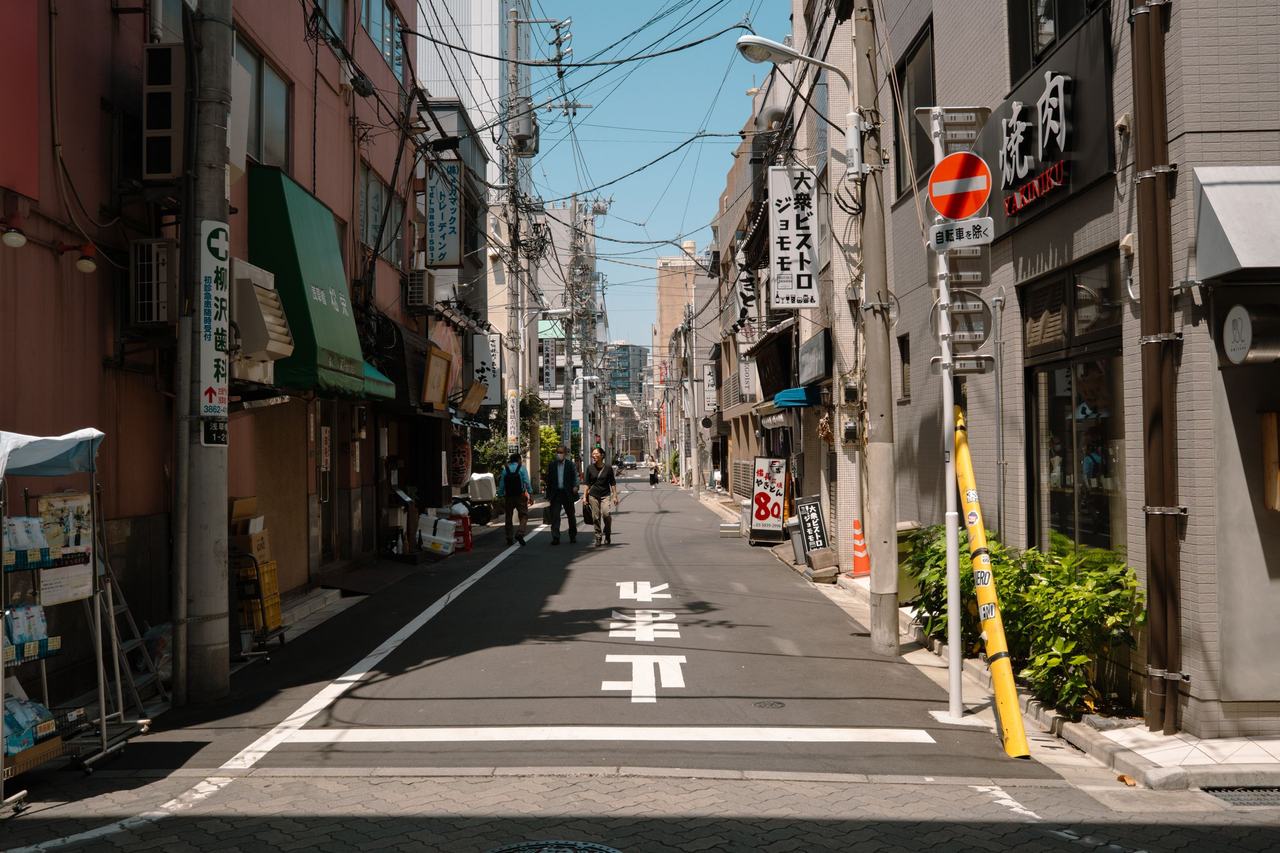
Opening photograph: A few people walk down a narrow, sunlit side street of small shops and overhead wires in Tokyo. Photograph by Iban Lopez Luna on Pexels. Blog photo credits.