How to Ask for the Bill and Split It in Japanese
To ask for the bill in Japanese, say すみません、お会計お願いします, excuse me, the check, please. At a cafe counter where you pay as you order, you will be asked instead whether you are paying together: answer 別々でお願いします to pay separately. Among friends, the even split is 割り勘にしよう, let’s split it evenly, but the course is firm that the request to staff stays polite. Then choose card or cash, and ask for a formal receipt if you need one.
Calling for the check at an izakaya
At a sit-down place, you ask for the check at your table. The course’s line starts with sumimasen, which its note says Tokyo uses all day to get someone’s attention:
You say
すみません、お会計お願いします。
Sumimasen, okaikei onegai shimasu.
Excuse me, the check, please.
Okaikei is the check, and onegai shimasu is the polite please. The course teaches the line at an izakaya on a Friday night, and brings it back at closing time in Koenji, where the owner gets this polite request even though the table has been speaking casually all evening.
What is on the bill, and tipping
Two things about a Japanese check are worth knowing before you ask for it, and the course covers both. The first is the お通し, a small starter that comes with the seat and goes on the check. The course notes it arrives at an izakaya without being ordered, and that turning it down isn’t done.
The second is what is missing. The course’s note on ordering another round says there is no tipping anywhere in Japan, taxis and hotels included. The extras you will meet are the お通し and, at upscale places, a service charge already on the check. So the total you are told is the total you pay. There is more in otoshi explained.
Together or separately at a cafe counter
At a counter where you pay before you sit, the question comes to you. In the course, you and Kenta, a friend, order at the kissaten in Jimbocho, and Haruka, the café owner, asks:
Haruka, the café owner, asks
お会計はご一緒でよろしいですか?
Okaikei wa goissho de yoroshii desu ka?
Will you be paying together?
You say
別々でお願いします。
Betsubetsu de onegai shimasu.
Separately, please.
When you’re asked if you’re paying together.
If one of you is paying for both, a simple hai answers her question. If not, betsubetsu is the word: separately. Each of you then pays for your own order.
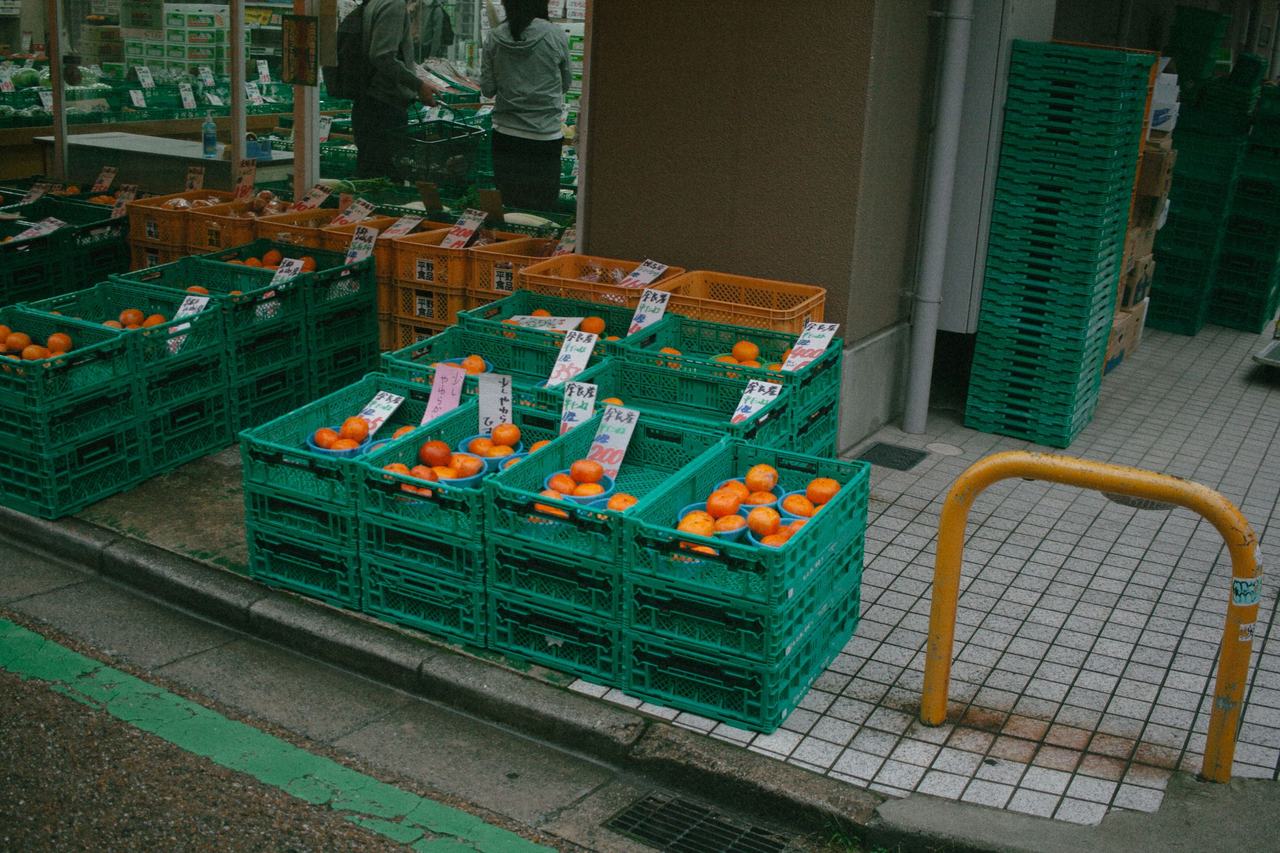
At a market stall or a street food stand there is no check to call for at all. Ask the total with 全部でいくらですか?, how much is it all together?, and pay on the spot.
Splitting evenly with friends
The course’s note on this line says splitting the check evenly is usual among friends. It also draws a firm line: the check itself you ask the owner for, and staff always get polite Japanese.
You say
割り勘にしよう。
Warikan ni shiyō.
Let’s split it evenly.
Splitting the check evenly is usual among friends. The check itself you ask the owner for, and staff always get polite Japanese: never お会計して.
So the casual warikan ni shiyō is for your friends, and sumimasen, okaikei onegai shimasu is for the owner, sometimes in the same minute. When the total arrives, someone does the math. In the course, at closing time in Koenji, Kenta announces each person’s share:
Kenta, a friend, says
1人3,000円ね。
Hitori sanzen'en ne.
It’s ¥3,000 each.
The course’s explanation adds that 1人 is one person, so the line means per person.
Card, cash or phone
Before you count on a card, ask. The course’s note on this line is practical: many small stores on a shotengai take cash only.
You ask
カードは使えますか?
Kādo wa tsukaemasu ka?
Can I pay by card?
Literally, can I use a card? Many small stores on a shotengai take cash only.
If the answer is no, it sounds like this. At the vegetable stand in Togoshi Ginza, the greengrocer apologizes that he only takes cash:
Ōno-san, the greengrocer, says
すみませんね、うちは現金だけなんですよ。
Sumimasen ne, uchi wa genkin dake nan desu yo.
Sorry, we’re cash only.
When there is a choice, say which you want:
You say
カードでお願いします。
Kādo de onegai shimasu.
By card, please.
You say
現金でお願いします。
Genkin de onegai shimasu.
Cash, please.
For paying by phone, the course has スマホ決済は使えますか?, and notes that in practice most people name the app, and that the stickers by the register show which ones a store takes. Paying cash, you will hear the cashier name the bill you handed over, then the change. At the croquette stand in the course, it sounds like this:
Sano-san, at the croquette stand, says
1,000円お預かりします。
Sen'en oazukari shimasu.
Out of ¥1,000.
Sano-san, at the croquette stand, says
550円のお返しです。
Gohyakugojūen no okaeshi desu.
Here’s ¥550 change.
The course’s note on paying is clear that these are the cashier’s lines, not yours, and that the answer is a nod or ありがとうございます. If you are paying cash with a large bill, the course’s soft apology is すみません、細かいのがなくて, sorry, I don’t have anything smaller. For more on all three, see card, cash or Suica.
Receipts and saying thank you
If you need the bill for expenses, ask for the formal kind. The course’s note explains the difference: a 領収書 has a line for the payer’s name, where a レシート is the register’s slip.
You say
領収書をお願いします。
Ryōshūsho o onegai shimasu.
A formal receipt, please.
For expenses. A 領収書 has a line for the payer’s name, where a レシート is the register’s slip.
If the register’s slip is all you want, the course’s line is レシートをください, the receipt, please. Either way, ask as you pay.
Then, on the way out, thank whoever cooked or served. The course’s note says this is said as you leave, and that everyone says it when they finish eating, too:
You say
ごちそうさまでした。
Gochisōsama deshita.
Thank you for the meal.
Said as you leave, to whoever cooked or served. Everyone says it when they finish eating, too.
The owner sees you off with a set line of his own:
Matsumoto-san, the izakaya owner, says
ありがとうございました。またどうぞ。
Arigatō gozaimashita. Mata dōzo.
Thank you. Come again.
Every line on this page is a recording from Koe’s course. In the app you hear each one, say it out loud, and see what it heard, so asking for the check is one easy sentence instead of a moment of hesitation.
Every line on this page
The 14 lines above, in order, for one last listen before you go. Each one is the recording from the Koe course.
すみません、お会計お願いします。Sumimasen, okaikei onegai shimasu.Excuse me, the check, please.
お会計はご一緒でよろしいですか?Okaikei wa goissho de yoroshii desu ka?Will you be paying together?
別々でお願いします。Betsubetsu de onegai shimasu.Separately, please.
割り勘にしよう。Warikan ni shiyō.Let’s split it evenly.
1人3,000円ね。Hitori sanzen'en ne.It’s ¥3,000 each.
カードは使えますか?Kādo wa tsukaemasu ka?Can I pay by card?
すみませんね、うちは現金だけなんですよ。Sumimasen ne, uchi wa genkin dake nan desu yo.Sorry, we’re cash only.
カードでお願いします。Kādo de onegai shimasu.By card, please.
現金でお願いします。Genkin de onegai shimasu.Cash, please.
1,000円お預かりします。Sen'en oazukari shimasu.Out of ¥1,000.
550円のお返しです。Gohyakugojūen no okaeshi desu.Here’s ¥550 change.
領収書をお願いします。Ryōshūsho o onegai shimasu.A formal receipt, please.
ごちそうさまでした。Gochisōsama deshita.Thank you for the meal.
ありがとうございました。またどうぞ。Arigatō gozaimashita. Mata dōzo.Thank you. Come again.
Common questions
How do you ask for the check in Japanese?
Say すみません、お会計お願いします, excuse me, the check, please. The course notes that staff always get polite Japanese, even if you are speaking casually with friends at the table.
How do you say separate checks in Japanese?
When you are asked if you are paying together, answer 別々でお願いします, separately, please. The course’s note says that is exactly when the line is used.
Do you tip in Japan?
No. The course notes there is no tipping anywhere in Japan, taxis and hotels included. The extras you will meet are the お通し at an izakaya and, at upscale places, a service charge already on the check.
What does warikan mean?
Splitting the check evenly. The course’s line is 割り勘にしよう, let’s split it evenly, and its note says this is usual among friends.
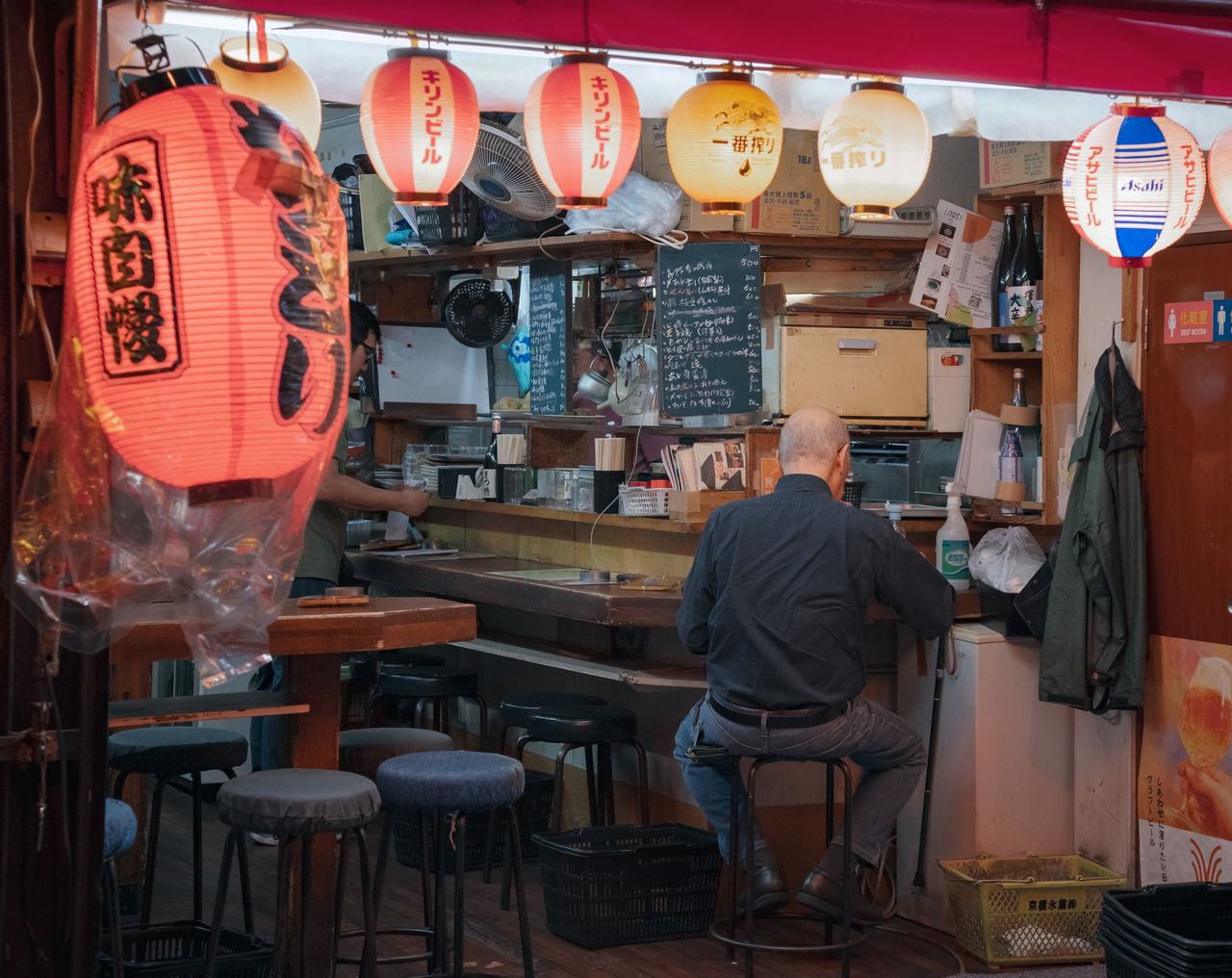
Opening photograph: A lone customer sits at the counter of a small izakaya under rows of paper lanterns in Tokyo. Photograph by Iban Lopez Luna on Pexels. Blog photo credits.