Otoshi Explained: The Izakaya Dish You Didn’t Order
Otoshi is the small dish that arrives at your izakaya table without anyone ordering it, and it is charged on your bill. Koe’s course describes it as a starter that comes with the seat and goes on the check. The server sets it down with こちら、お通しです (this is your otōshi). You do not send it back, and it is not a tip: there is no tipping anywhere in Japan. Below is how the moment unfolds, what the server says, and the Japanese you need when the check comes, all from the course’s izakaya scenes.
When the otoshi arrives
The otoshi comes early: in the course, just after the first drinks are ordered. In the course’s Friday night scene, the order of events is clear. The server asks how many of you there are at the door, you answer 2人です, and once you sit, she asks about drinks:
Ueda-san, the izakaya server, asks
お飲み物は何になさいますか?
Onomimono wa nani ni nasaimasu ka?
What would you like to drink?
You say
とりあえず生で。
Toriaezu nama de.
A draft beer to start.
The classic first order. とりあえず is for now, to start with, and 生 is draft beer. Then a small dish you didn’t order arrives: the お通し, a starter that comes with the seat and goes on the check. Turning it down, お通しはいらないです, isn’t done.
The note on that line already tells you what comes next: a small dish you didn’t order arrives. Here is the line the server says as she puts it down:
Ueda-san, the izakaya server, says
こちら、お通しです。
Kochira, otōshi desu.
This is your otōshi.
If you have never heard the word, it is easy to think there has been a mix-up, or that the dish is a free gift. It is neither. Recognizing otōshi in her sentence is the whole trick: once you hear it, you know what is in front of you.
What otoshi is, and why it is on your bill
The course explanation is short: the otōshi is a small starter that comes with the seat and goes on the check. You do not choose it, and in the course nobody answers the server’s line: the dish simply arrives.
Outside the course, a Japanese culture guide explains the reasoning behind it. The otoshi works as a table charge: a small dish you did not order, served at the start, which helps an izakaya cover the cost of guests occupying a seat over a long evening of drinks. Thinking of it as the price of the seat, with a little food attached, makes the line on the bill make sense.
Can you refuse the otoshi?
This is where online answers disagree, and the course is clear. Its note on the first drink says that turning the otoshi down isn’t done. So the practical answer for a visitor is to accept it, eat it or leave it, and treat the charge as part of the evening.
If you want to understand the dish rather than refuse it, ask what it is. The course’s line for that works for any food in front of you:
You ask
これは何ですか?
Kore wa nan desu ka?
What’s this?
Otoshi and tipping
Because the otoshi is an extra you did not ask for, it is natural to wonder whether it replaces a tip, or whether a tip is expected on top. Neither is the case. The course puts this in a note on ordering another round:
You say
もう1杯お願いします。
Mō ippai onegai shimasu.
One more, please.
杯 counts glasses and bowls. No tipping anywhere in Japan, taxis and hotels included; the extras you’ll meet are the お通し and, at upscale places, a service charge already on the check.
In the course’s words: no tipping anywhere in Japan, taxis and hotels included. The extras you will meet are the otōshi and, at upscale places, a service charge already on the check. So when the bill comes, the total is the total. Leaving extra money on the table is not part of the custom.
Asking for the check
When you are ready to go, catch the server’s attention with sumimasen and ask in one breath:
You say
すみません、お会計お願いします。
Sumimasen, okaikei onegai shimasu.
Excuse me, the check, please.
Keep it polite even if your group has been speaking casually all night. The course notes put it plainly: staff always get polite Japanese. When the check comes, the otoshi is already part of the total, along with everything you ordered.
Splitting the bill per person
Among friends, the course’s Saturday night in Koenji ends with a per-person split. Kenta does the math and announces it, and you agree with the casual line for splitting evenly:
Kenta, a friend, says
1人3,000円ね。
Hitori sanzen'en ne.
It’s ¥3,000 each.
You say
割り勘にしよう。
Warikan ni shiyō.
Let’s split it evenly.
Splitting the check evenly is usual among friends. The check itself you ask the owner for, and staff always get polite Japanese: never お会計して.
Hitori, one person, makes Kenta’s line a per-person amount: in the course, ¥3,000 each. Warikan is splitting the check evenly, which the course notes call usual among friends. The otoshi is simply part of the total you divide. For more on asking for the bill and splitting it, see the guide to the check.
On the way out, thank the people who served you, and you will be seen off with the owner’s line:
You say
ごちそうさまでした。
Gochisōsama deshita.
Thank you for the meal.
Matsumoto-san, the izakaya owner, says
ありがとうございました。またどうぞ。
Arigatō gozaimashita. Mata dōzo.
Thank you. Come again.
Every line on this page is a recording from Koe’s course. The server’s otoshi line is short and easy to miss in a noisy room, which is why it is worth hearing a few times. In the app you hear each line, say your part out loud, and see what it heard. For the rest of the evening, from the door to the last round, the izakaya ordering guide has every line in order.
Every line on this page
The 10 lines above, in order, for one last listen before you go. Each one is the recording from the Koe course.
お飲み物は何になさいますか?Onomimono wa nani ni nasaimasu ka?What would you like to drink?
とりあえず生で。Toriaezu nama de.A draft beer to start.
こちら、お通しです。Kochira, otōshi desu.This is your otōshi.
これは何ですか?Kore wa nan desu ka?What’s this?
もう1杯お願いします。Mō ippai onegai shimasu.One more, please.
すみません、お会計お願いします。Sumimasen, okaikei onegai shimasu.Excuse me, the check, please.
1人3,000円ね。Hitori sanzen'en ne.It’s ¥3,000 each.
割り勘にしよう。Warikan ni shiyō.Let’s split it evenly.
ごちそうさまでした。Gochisōsama deshita.Thank you for the meal.
ありがとうございました。またどうぞ。Arigatō gozaimashita. Mata dōzo.Thank you. Come again.
Common questions
What is otoshi at an izakaya?
A small starter that arrives without being ordered and goes on your check. Koe’s course describes it as a starter that comes with the seat. The server says kochira, otōshi desu, this is your otōshi, as she sets it down.
Do you have to pay for otoshi?
Yes. It goes on the check. A Japanese culture guide describes it as working like a table charge, which helps an izakaya cover the cost of guests occupying a seat over a long evening.
Can you refuse otoshi?
The course notes say turning it down isn’t done. You can leave it uneaten, but the charge stays on the check.
Do you tip at an izakaya in Japan?
No. The course notes say there is no tipping anywhere in Japan, taxis and hotels included. The extras you will meet are the otoshi and, at upscale places, a service charge already on the check.
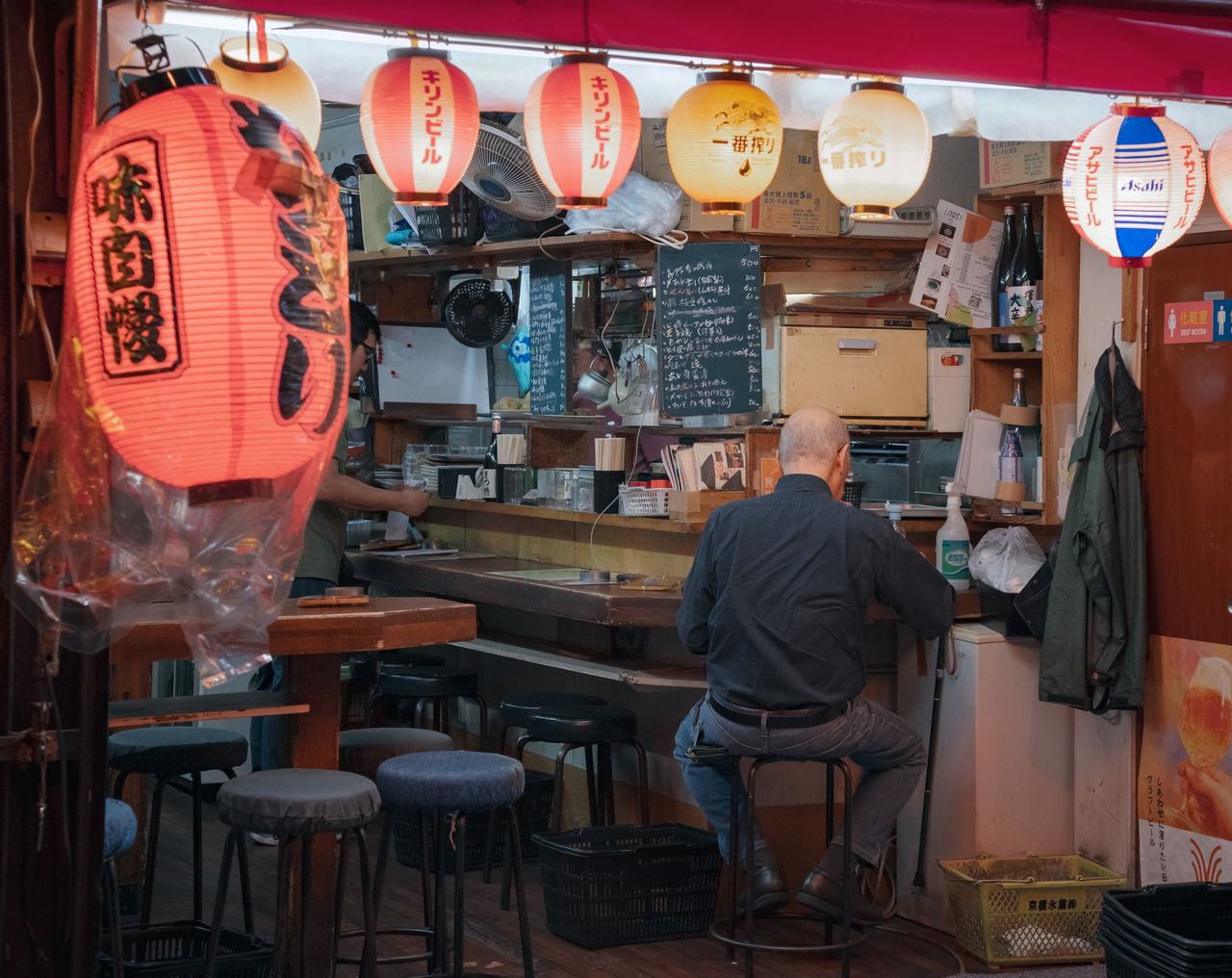
Opening photograph: A lone customer sits at the counter of a small izakaya under rows of paper lanterns in Tokyo. Photograph by Iban Lopez Luna on Pexels. Blog photo credits.