How to Bargain at a Mexican Market in Spanish
To bargain at a Mexican market in Spanish, ask ¿Me hace un descuento?, can you give me a discount? Or name your own price with ¿Me la deja en cien?, will you let me have it for $100? The seller’s answer uses the same verb: se la dejo en cien, I’ll let you have it for a hundred. If the price still is not right, Lo voy a pensar, gracias is the polite no. Below is where bargaining fits, the lines for each step, and what the seller says to you, all from a clothes stall scene in Habla’s shopping unit, with Paty, the clothes vendor.
Where bargaining is normal, and where it is not
The course note on asking for a discount is clear about the line: at a market stall, asking is normal and expected, and in a chain store it is not. Bargaining is normal at a tianguis, the street market, at markets and at street stalls. It is not the custom at supermarkets, malls or convenience chains.
So the lines below are for stalls and markets, not for chain stores.
Start with the price, and listen for the deal
Before you bargain, you need the price. Point and ask:
You ask
¿Cuánto cuesta esto?
How much is this?
Point and ask. ¿Cuánto vale? means the same.
¿Cuánto cuesta esto? is how much is this? The course notes that ¿Cuánto vale? means the same. At Paty’s stall, Diego asks about a T-shirt and gets a price with an offer attached:
Paty, the clothes vendor, says
Ciento veinte pesos. Y le dejo dos en doscientos.
$120. And I’ll let you have two for $200.
Ciento veinte pesos is $120. Y le dejo dos en doscientos is and I’ll let you have two for $200. The course explanation calls it her offer of two for $200. Here the seller makes the first offer: a better price if you buy more.
Notice the verb in her offer, dejar. You will hear it again, from both sides, through the rest of the deal.
Asking for a discount
The simplest move is to ask:
You ask
¿Me hace un descuento?
Can you give me a discount?
At a market stall, asking is normal and expected. In a chain store it isn’t.
¿Me hace un descuento? is can you give me a discount? In the course, Diego asks it right after deciding:
You ask
Me la llevo. ¿Me hace un descuento?
I’ll take it. Can you give me a discount?
Me la llevo is I’ll take it, and then the question. Here is Paty’s answer:
Paty, the clothes vendor, says
Se la dejo en cien.
I’ll let you have it for a hundred.
Se la dejo en cien is I’ll let you have it for a hundred. From $120 to $100, with one polite question.

Naming your own price
Instead of waiting for the seller’s number, you can offer one. The course gives the pattern:
You ask
¿Me la deja en cien?
Will you let me have it for $100?
Dejar en…: to let something go for a price. The seller says se la dejo en…
¿Me la deja en cien? is will you let me have it for $100? The course notes that dejar en... means to let something go for a price, and that the seller says se la dejo en... So you ask with me la deja en plus your number, and the seller answers with se la dejo en plus theirs: the same verb from the other side.
Use la for a la thing, like la playera, and lo for an el thing, as the course notes in the same unit. The number goes at the end. For saying it, see understanding prices in pesos.
What the seller asks you
While you decide, the seller keeps the conversation going with short questions. These three come from Paty in the role play:
Paty, the clothes vendor, asks
¿Se la lleva?
Will you take it?
Paty, the clothes vendor, asks
¿Cómo ve?
What do you say?
Paty, the clothes vendor, asks
¿Está bien?
Is that all right?
¿Se la lleva? is will you take it? ¿Cómo ve? is what do you say? ¿Está bien? is is that all right? Each one is a nudge to decide. You do not need a long answer. A yes, a price of your own, or a polite no all work.
Closing the deal, or walking away
When the price is right, close it in three words:
You say
Me lo llevo.
I’ll take it.
Literally: I take it with me. Me la llevo for a la thing.
Me lo llevo literally means I take it with me, and the course notes that me la llevo is for a la thing. Then pay. As the course notes, many small places take cash only, and in the course Paty answers a question about cards with nada más efectivo, cash only. For that exchange, see cash or card in Mexico.
When the price is not right, walk away politely:
You say
Lo voy a pensar, gracias.
I’ll think about it, thanks.
The polite no. Ahorita regreso, I’ll be right back, is the classic version.
Lo voy a pensar, gracias is I’ll think about it, thanks. The course calls it the polite no, and gives ahorita regreso, I’ll be right back, as the classic version. Either one ends the conversation kindly.
The whole bargain in five lines
Here is a full exchange at a stall, in order:
- Ask the price: ¿Cuánto cuesta esto?
- Listen for a deal, like dos en doscientos.
- Ask for a discount, ¿Me hace un descuento?, or name a price, as in ¿Me la deja en cien?
- Hear the seller’s number: se la dejo en...
- Close with me la llevo, or step away with lo voy a pensar, gracias.
Every line on this page is a recording from Habla’s course. In the app you hear each line, say it out loud, and see what it heard. If clothes are what you are shopping for, the same stall has its own lines for trying things on: trying on clothes in Spanish.
Every line on this page
The 11 lines above, in order, for one last listen before you go. Each one is the recording from the Habla course.
¿Cuánto cuesta esto?How much is this?
Ciento veinte pesos. Y le dejo dos en doscientos.$120. And I’ll let you have two for $200.
¿Me hace un descuento?Can you give me a discount?
Me la llevo. ¿Me hace un descuento?I’ll take it. Can you give me a discount?
Se la dejo en cien.I’ll let you have it for a hundred.
¿Me la deja en cien?Will you let me have it for $100?
¿Se la lleva?Will you take it?
¿Cómo ve?What do you say?
¿Está bien?Is that all right?
Me lo llevo.I’ll take it.
Lo voy a pensar, gracias.I’ll think about it, thanks.
Common questions
Is it rude to bargain in Mexico?
Not at a market stall. The course notes that at a market stall, asking for a discount is normal and expected, and in a chain store it is not. Supermarkets, malls and convenience chains are not places to bargain.
How do you ask for a discount in Spanish?
Say ¿Me hace un descuento? To offer a price instead, use ¿Me la deja en cien?
What does se la dejo en mean?
It is how a seller names a price: I’ll let you have it for. The course notes that dejar en... means to let something go for a price, as in se la dejo en cien, I’ll let you have it for a hundred.
How do I say no politely at a market in Mexico?
Say Lo voy a pensar, gracias, I’ll think about it, thanks. The course calls it the polite no, and gives ahorita regreso, I’ll be right back, as the classic version.
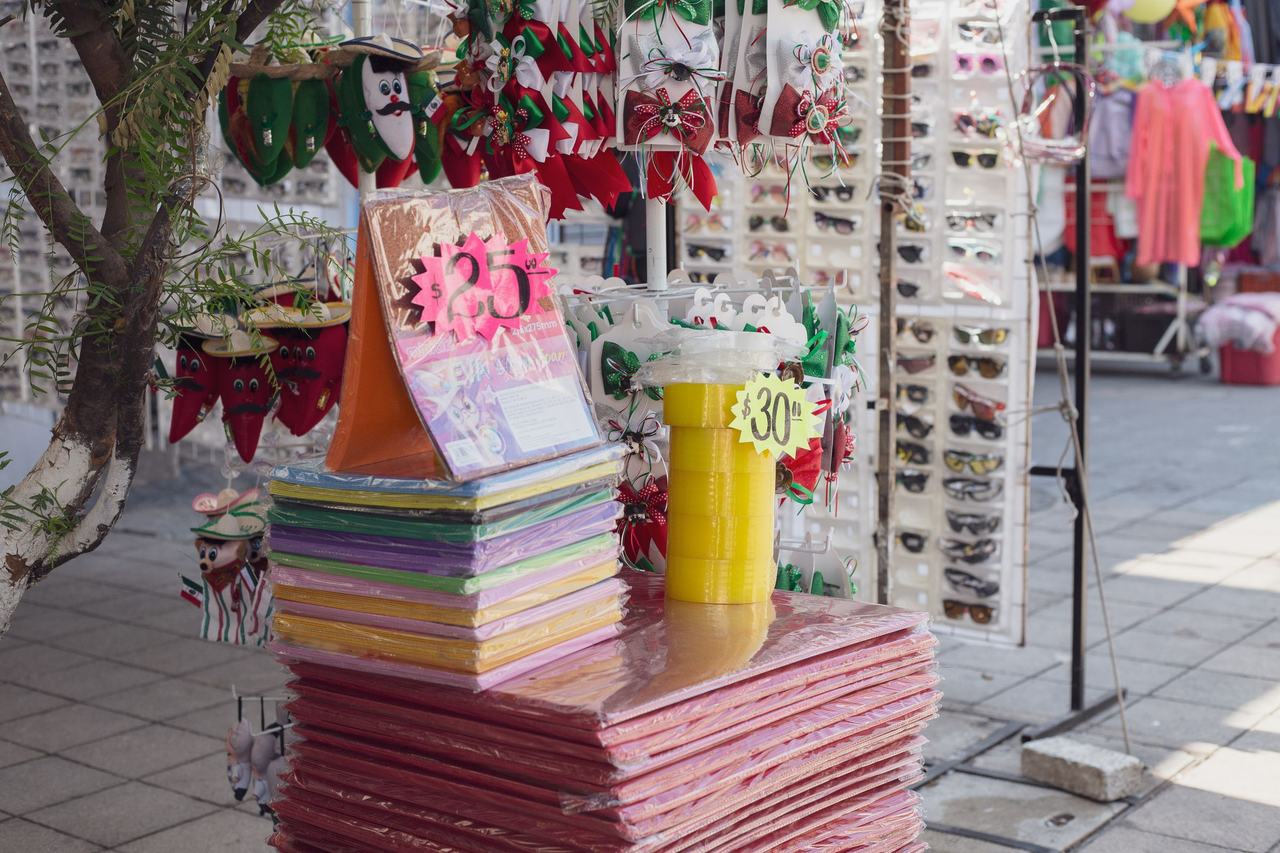
Opening photograph: A street market stall in Mexico City selling colored paper, sunglasses and festive decorations. Photograph by Noemí Jiménez on Pexels. Blog photo credits.