Bag, Receipt and Change at a Mexico City Checkout
To ask for a receipt in Mexico, say ¿Me da el ticket, por favor? (could I have the receipt, please?). In Mexico the receipt is el ticket, said the English way. El recibo is understood too, but as the course notes, it usually means a bill you pay, like the light or the phone. Just before that, the cashier will likely ask ¿Quiere bolsa?, do you want a bag, and you can answer No, gracias, traigo bolsa if you brought your own. Here is the whole checkout, in order, with every line recorded, from Habla’s corner-store unit at Doña Chelo’s register.
The total and the bag question
At the register, the price and the bag question often arrive together, in one breath. In the course, Doña Chelo says both before you have your wallet out:
Doña Chelo, at the corner store, asks
Son treinta y dos pesos. ¿Quiere bolsa?
That’s $32. Do you want a bag?
Son treinta y dos pesos is the total, 32 pesos. ¿Quiere bolsa? is the bag question. The course’s note on it explains why it comes up so often: Mexico City stores stopped giving out free plastic bags in 2020, so many people carry their own. The cashier is not offering something extra. They are checking whether you need one.
If you missed the total
Because the bag question follows the price so closely, the number is easy to miss. If the cashier has not said a total yet, ask for it with the question the course gives for when you are ready to pay:
You ask
¿Cuánto es?
How much is it?
When you’re ready to pay.
If you heard a number but are not sure of it, say it back as a question. The course teaches this as a habit for prices, and its example is a taxi fare:
You ask
¿Ciento sesenta pesos?
$160?
Saying the price back to check it.
The cashier will answer with a yes or the right number. It is a small move, but it keeps you from handing over the wrong bill while also trying to answer the bag question.
Saying no to a bag, or yes
There are two easy ways to say no. The first tells the cashier you brought a bag:
You say
No, gracias, traigo bolsa.
No thanks, I have a bag.
Literally: I bring a bag. Traer is the everyday Mexican verb for having something with you.
The course’s note on this line is worth knowing beyond the store. Traer, literally to bring, is the everyday Mexican verb for having something with you. So traigo bolsa means I have a bag on me.
The second way to say no is for when you have only one or two things and do not need a bag at all. Tom uses it in the course:
Tom, a newcomer, says
No, gracias, así está bien.
No thanks, it’s fine like this.
No, gracias, así está bien means no thanks, it’s fine like this. It says you are happy to carry your things as they are, without any excuse.
If you do want a bag, the answer is two words and a please:
You say
Sí, por favor.
Yes, please.
Doña Chelo, at the corner store, says
Muy bien.
All right.
Muy bien, all right, is the cashier’s way of saying noted.
Asking for the receipt
Now the receipt. The Mexican word is the English one, el ticket, and the polite way to ask is the everyday ¿Me da…?, will you give me:
You ask
¿Me da el ticket, por favor?
Could I have the receipt, please?
El ticket, said the English way, is the receipt in Mexico. Stores with a register print one; a small tiendita often can’t, so ask only where you see one. El recibo is understood too, though it usually means a bill you pay, like the light or the phone.
Doña Chelo, at the corner store, says
Sí, cómo no. Aquí tiene.
Yes, of course. Here you go.
Read the course’s note closely, because it carries a real tip. Stores with a register print a receipt. A small tiendita, a corner store, often cannot, so ask only where you see a register. And el recibo, while understood, usually means a bill you pay. If you ask for el ticket, you will get exactly what you want.
The reply in the course is Sí, cómo no. Aquí tiene: yes, of course, here you go. Cómo no, in the course’s translation, is of course. In the listening scene, Doña Chelo answers with the shorter Claro, aquí tiene. Either one means the receipt is coming.
Handing over money and getting your change
When you hand over your money, there is a phrase for that too. The course notes that aquí tiene is said when you hand something over, and that staff say it to you as well:
You say
Aquí tiene.
Here you go.
Said when you hand something over. Staff say it to you too.
Then the change comes back with its own short sentence:
Doña Chelo, at the corner store, says
Aquí está su cambio.
Here’s your change.
Aquí está su cambio means here’s your change. Cambio is the same word you use to ask for change before you pay with a big bill. If that is your situation, see asking for change in Spanish. If you are wondering whether to pay by card at all, see cash or card in Mexico.
A thank you and a goodbye closes it:
You say
Gracias, hasta luego.
Thanks, bye.
The whole checkout in order
Here is how the end of a purchase tends to run. The cashier says the total and asks ¿Quiere bolsa? You say No, gracias, traigo bolsa, or así está bien if you need nothing. You ask ¿Me da el ticket, por favor? You hand over the money with aquí tiene. The cashier hands back your change and your receipt and says Aquí está su cambio. You say Gracias, hasta luego.
That is four short lines of your own and two to recognize. The bag question is the easiest one to miss, because it comes right after the price, before you have finished hearing the number. Every line on this page is a recording from Habla’s course. In the app you hear a line, say it out loud and see what it heard, which makes the bag question something you expect instead of something that surprises you.
Every line on this page
The 12 lines above, in order, for one last listen before you go. Each one is the recording from the Habla course.
Son treinta y dos pesos. ¿Quiere bolsa?That’s $32. Do you want a bag?
¿Cuánto es?How much is it?
¿Ciento sesenta pesos?$160?
No, gracias, traigo bolsa.No thanks, I have a bag.
No, gracias, así está bien.No thanks, it’s fine like this.
Sí, por favor.Yes, please.
Muy bien.All right.
¿Me da el ticket, por favor?Could I have the receipt, please?
Sí, cómo no. Aquí tiene.Yes, of course. Here you go.
Aquí tiene.Here you go.
Aquí está su cambio.Here’s your change.
Gracias, hasta luego.Thanks, bye.
Common questions
How do you say receipt in Mexican Spanish?
In Mexico the receipt is el ticket, said the English way. Ask ¿Me da el ticket, por favor? The course notes that el recibo is understood, though it usually means a bill you pay.
What does ¿Quiere bolsa? mean?
It means do you want a bag. Answer No, gracias, traigo bolsa if you brought one, no, gracias, así está bien if you need none, or Sí, por favor if you want one.
Why do Mexico City stores ask about a bag?
The course notes that Mexico City stores stopped giving out free plastic bags in 2020, so many people carry their own. The question checks whether you need one.
Can I get a receipt at a small corner store?
Often not. The course notes that stores with a register print one, while a small tiendita often cannot. Ask where you see a register.
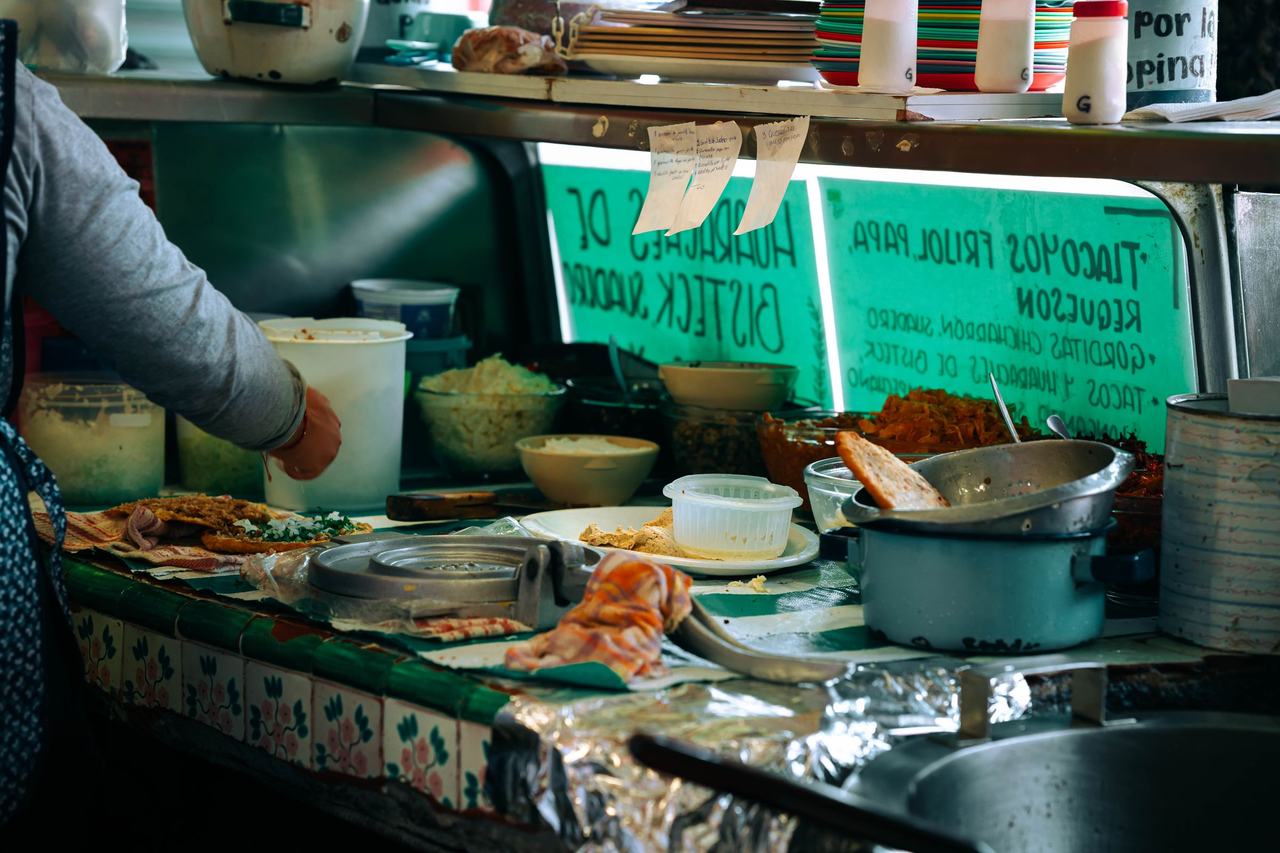
Opening photograph: A vendor reaches across a tiled street food counter crowded with pots and taco fillings in Mexico City. Photograph by Viridiana Rivera on Pexels. Blog photo credits.