Polite Spanish for Mexico: Please, Thanks, Sorry, Excuse Me
The polite words you need in Mexico City are few: por favor after any request, Gracias for anything, Perdón for a small bump and Disculpe to get a stranger’s attention. The skill is picking the right one for the moment and knowing the replies you will hear back: de nada or con gusto after thanks, no pasa nada after sorry. Each one is below, with its recording from Habla’s course and the scene where it comes up.
Please: two words to add to anything
The course’s very first line is a café order, and its note is the whole lesson: anything plus por favor is the simplest way to order. You do not need a verb or a full sentence. A thing and por favor, as in Un café, por favor, is a complete and polite request.
The same two words make a polite yes. When Sofía the barista offers milk, you answer with sí, por favor. When you do not want something, it is no, gracias.
You say
Sí, por favor.
Yes, please.
You say
No, gracias.
No, thank you.
You will use the no a lot, because staff offer things: a bag, milk, something else. At Doña Chelo’s corner store, Tom turns down a bag with a slightly longer version that adds it’s fine like this:
Tom, a newcomer, says
No, gracias, así está bien.
No thanks, it’s fine like this.
Thank you, and a thousand thanks
Gracias goes with everything. The course note on it is short: for anyone, any time. The taxi driver, the barista and a friend all get the same word.
You say
Gracias.
Thank you.
For anyone, any time.
You say
Muchas gracias.
Thank you very much.
You’ll also hear mil gracias, a thousand thanks.
In the course, muchas gracias follows real help: Tom says it when Doña Lupe gives him directions to the metro, and she says it when Diego hands back her bag. Listen for mil gracias too: the course notes it as something you will hear, a thousand thanks.
You’re welcome, and what staff say instead
The answer to thanks is de nada. That is the one to say yourself. The course adds a useful note about what you will hear: people serving you often say con gusto, my pleasure.
You say
De nada.
You’re welcome.
People serving you often say con gusto, my pleasure.
At Sofía’s café, con gusto comes even before any thanks. When Mariana orders, Sofía answers with it and then asks if there is anything else. The course translates it here as sure, a cheerful yes to a request:
Sofía, the barista, asks
Con gusto. ¿Algo más?
Sure. Anything else?
So if you hear con gusto at a counter, it is not a question and needs no answer beyond your next request, or nada más, gracias if you are done.
Which sorry to use: a bump, a stranger, real regret
Spanish has several words where English uses sorry or excuse me, and the course separates them clearly.
- Perdón is for small things: a bump, a spill, getting past someone.
- Lo siento is for real regret, not for brushing someone’s arm.
- Disculpe is for getting a stranger’s attention politely, or for saying sorry. To someone your age, it becomes disculpa.
You say
Perdón.
Sorry.
For small things: a bump, a spill, getting past someone. Lo siento is for real regret.
You say
Disculpe.
Excuse me.
To get a stranger’s attention politely, or to say sorry. To someone your age: disculpa.
The course’s note on asking for the metro says it plainly: disculpe first, to a stranger. When Tom needs the metro, he opens with it before asking the way:
Tom, a newcomer, asks
Disculpe, ¿dónde está el metro?
Excuse me, where’s the metro?
It works the same at a counter when the person you need is busy. Getting past someone in a crowded aisle, by contrast, is a perdón moment.
The bump at Doña Lupe’s stall
The course teaches thank you and sorry through one small scene: a bump at the market. There has been a bump between Diego and Doña Lupe. She brushes it off, he hands her bag back, and they finish with thanks:
Doña Lupe says
No pasa nada, joven.
That’s all right, young man.
Diego, a friend, says
Aquí tiene su bolsa.
Here’s your bag.
Doña Lupe says
Muchas gracias.
Thank you very much.
Diego, a friend, says
De nada.
You’re welcome.
Two things are worth taking from it. First, no pasa nada is the reply to perdón. If someone bumps into you and apologizes, it is the easy, kind thing to say back.
You say
No pasa nada.
It’s okay.
Literally: nothing’s happening. The easy answer to perdón.
Second, Diego hands the bag over with Aquí tiene, here you go. The course notes that you say it when you hand something over, and that staff say it to you too. You will hear Aquí tiene as people hand you your coffee, your change or your receipt.
You may also notice how Doña Lupe addresses Diego. Vendors in the course call him joven, young man, and Don Toño the taxi driver calls Mariana señorita, miss. Those are words you will hear rather than say.
A polite exchange from start to finish
Put together, the courtesy words make a full exchange at any stall or counter. You open with a greeting or disculpe, ask for what you want with por favor, say gracias when it is handed over, and hear con gusto or de nada back. If you bump someone on the way out, perdón, and if they bump you, no pasa nada. For the right greeting by time of day, see how to greet people in Mexico City, and for the way out, how to say goodbye in Mexico.
Every line on this page is a recording from the app’s course. In Habla you hear each one, say it out loud, and the app shows what it heard, so disculpe and no pasa nada come out on their own when the moment arrives.
Every line on this page
The 15 lines above, in order, for one last listen before you go. Each one is the recording from the Habla course.
Sí, por favor.Yes, please.
No, gracias.No, thank you.
No, gracias, así está bien.No thanks, it’s fine like this.
Gracias.Thank you.
Muchas gracias.Thank you very much.
De nada.You’re welcome.
Con gusto. ¿Algo más?Sure. Anything else?
Perdón.Sorry.
Disculpe.Excuse me.
Disculpe, ¿dónde está el metro?Excuse me, where’s the metro?
No pasa nada, joven.That’s all right, young man.
Aquí tiene su bolsa.Here’s your bag.
Muchas gracias.Thank you very much.
De nada.You’re welcome.
No pasa nada.It’s okay.
Common questions
What is the difference between perdón and disculpe?
Perdón is for small mishaps, like a bump or a spill. Disculpe is for getting a stranger’s attention politely, and it can also say sorry. To someone your age, the course gives disculpa.
How do you say you’re welcome in Mexico?
Say de nada. The course notes that people serving you often say con gusto, my pleasure, so expect to hear that at shops and cafés.
What does no pasa nada mean?
Literally, nothing’s happening. It is the easy answer to perdón, the way to say it’s okay after a small bump.
When should I say lo siento?
For real regret. The course keeps lo siento apart from the everyday perdón, which covers bumps, spills and getting past someone.
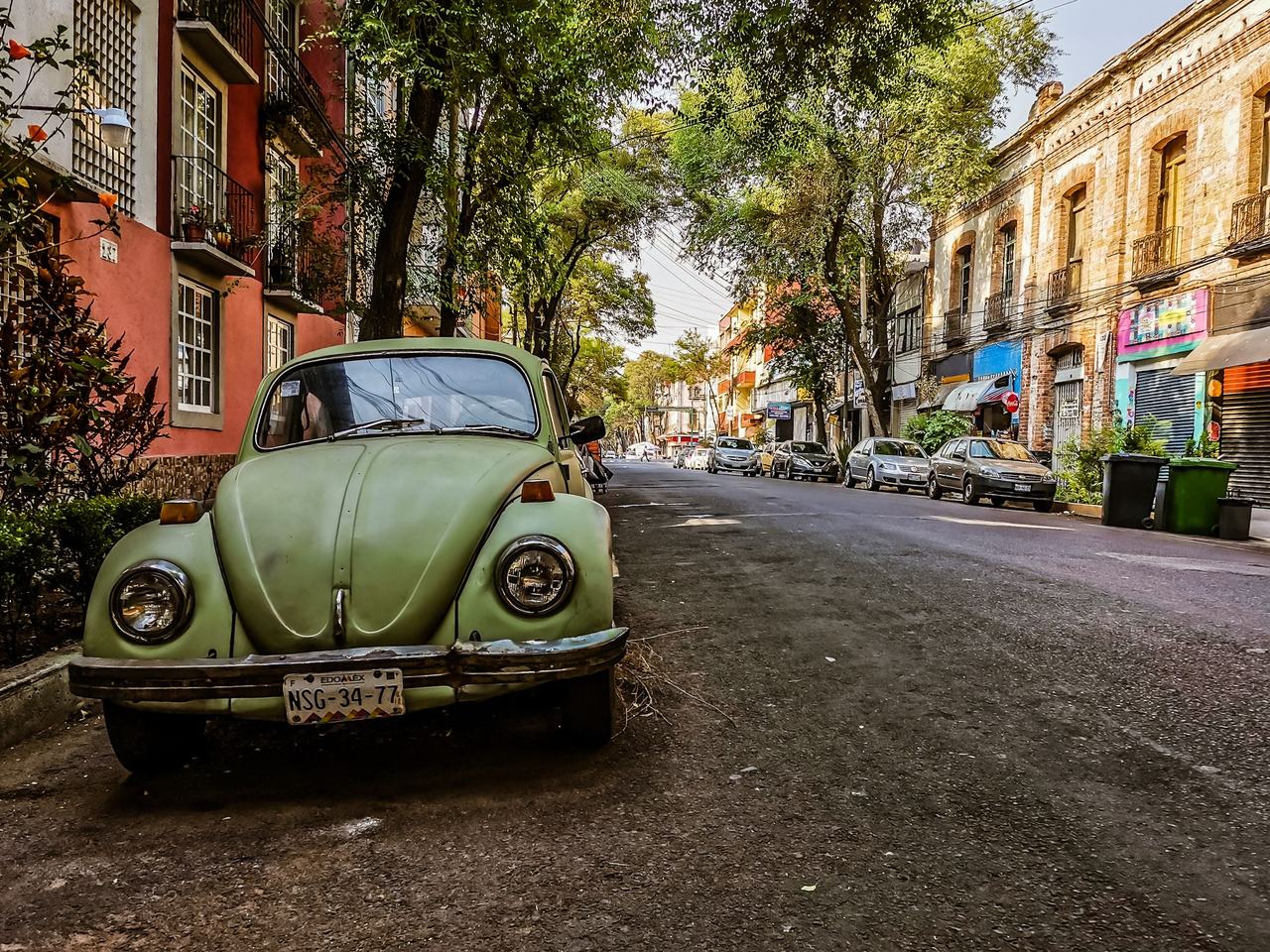
Opening photograph: A pale green Volkswagen Beetle parked on a quiet, tree-lined street in Mexico City. Photograph by Roland DRz on Pexels. Blog photo credits.