How to Order Food Delivery by Phone in Spanish in Mexico
To order food delivery by phone in Mexico, open with Quiero pedir unos tacos a domicilio, I want to order some tacos for delivery. A domicilio means to your door, and it is the phrase that tells the person on the line this is a delivery order. From there the call follows a short, predictable path: what you want, anything else, how long it takes, your address and the total. Below is that whole call, line by line, from Habla’s phone unit, where Diego and Mariana call Beto’s taquería at night.
How the call opens
In the course, the phone rings at the taco stand and Beto answers with the name of the place and a greeting:
Beto, the taquero, says
Tacos Beto, buenas noches.
Tacos Beto, good evening.
You say
Quiero pedir unos tacos a domicilio.
I want to order some tacos for delivery.
A domicilio: to your door. Pedir: to order; Mexicans also say ordenar.
That is Tacos Beto, buenas noches: the name of the place and good evening. Your first line does two jobs at once. Quiero pedir says you want to order, and a domicilio says you want it brought to you. The course notes that pedir is to order and that Mexicans also say ordenar, so you may hear either.
If you are not sure a place delivers, ask before you start ordering:
You ask
¿Tienen servicio a domicilio?
Do you deliver?
¿Tienen servicio a domicilio? asks whether they have delivery service. A sí or a claro means go ahead with your order.
You may also call somewhere that answers with a plain ¿Bueno? The course notes that this is how Mexico answers the phone, and only the phone. It is simply hello, and you go straight into your order.
Saying what you want
Next comes the question about your order. Beto asks what he can send you:
Beto, the taquero, asks
Claro. ¿Qué le mando?
Sure. What can I send you?
You say
Seis de pastor con todo, por favor.
Six al pastor with everything, please.
At a taquería you say the number and the filling: seis de pastor or seis al pastor. Con todo: with onion and cilantro.
¿Qué le mando? literally asks what should I send you. The answer at a taquería is short: the number, then the filling, then any extras. Seis de pastor con todo is six al pastor with everything, and the course notes that con todo means with onion and cilantro.
If you want a mix, keep the same pattern, as in this course line:
You say
Cuatro de pastor y dos de bistec, por favor.
Four al pastor and two of beef, please.
Bistec on a taco menu is grilled beef.
On the phone there is no menu board to point at and no tray to check, so it is worth saying your order clearly and in this order: number, filling, extras. Then pause and let the person repeat it back.
Anything else, and how long it will take
Beto says your order back, then asks if there is anything more. This is the place to check that he heard you right:
Beto, the taquero, asks
Seis de pastor con todo. ¿Algo más?
Six al pastor with everything. Anything else?
You ask
No, es todo. ¿Cuánto tarda?
No, that’s all. How long will it take?
¿Algo más? is anything else. If you are done, no, es todo says no, that’s all. In the course, Diego goes straight on to the question every delivery caller wants answered: ¿Cuánto tarda?, how long will it take.
The course notes that tardar is to take time and that the answer comes in minutes. Here is the answer Beto gives:
Beto, the taquero, says
Como media hora.
About half an hour.
Como media hora is about half an hour. The course explanation points out that como before a number means about, which is useful far beyond this call. You will hear it in prices, in distances and in times.

Giving your address
Once the order and the timing are settled, the questions turn to where you are. In the course, Beto asks for the address in the same breath as the timing:
Beto, the taquero, asks
Como media hora. ¿Me da su dirección?
About half an hour. Can I have your address?
You say
Calle Durango, número ciento cinco, departamento tres, colonia Roma Norte.
Durango Street, number 105, apartment 3, Roma Norte.
¿Me da su dirección? asks for your address. The answer runs street, number, apartment, then colonia, the neighborhood. In the course Beto then asks for the two cross streets as well, ¿Entre qué calles?, and the course calls the cross streets the most useful part of the address for a driver. Saying an address aloud has its own small rules, so it gets its own page: how to give your address in Spanish in Mexico City.
When the address is clear, Beto confirms the delivery time:
Beto, the taquero, says
Perfecto. Llega en media hora.
Perfect. It’ll be there in half an hour.
Llega en media hora means it will get there in half an hour. If you have your address written down, keep it in front of you during the call, so you can read it out instead of putting it together on the spot.
Catching the total on a bad line
Prices are hard to catch on the phone, and the course gives this its own lesson. At the end of the call, Beto gives the total and the time together:
Beto, the taquero, says
Son ciento ochenta y cinco pesos, y llega en veinticinco minutos.
That’s $185, and it’ll be there in twenty-five minutes.
You ask
¿Me lo repite?
Could you say that again?
Literally: will you repeat it to me? To a friend: ¿Me lo repites? ¿Mande? works too.
The total is ciento ochenta y cinco pesos, $185, and the time is veinticinco minutos. That is a lot of numbers in one line. ¿Me lo repite? asks him to say it again, and the course notes that ¿Mande? works too. If it is still too fast, the course line for that is Más despacio, por favor.
The best check of all is to say the number back as a question:
You ask
¿Ciento ochenta y cinco pesos?
$185?
Beto, the taquero, says
Así es. Gracias por su pedido.
That’s right. Thank you for your order.
Así es means that’s right, and gracias por su pedido is thank you for your order. When you hear that, the call is done and the food is on its way. For more ways to ask someone to repeat themselves, see what to say when you don’t understand Spanish in Mexico.
Getting ready for the call
A phone order is harder than ordering at the counter for one reason: you cannot see anything. There is no pointing, no menu to tap and no face to read. What helps is knowing the order of the questions, so each one arrives when you expect it.
Write down three things before you dial: your order with the numbers, your address with the cross streets, and the two questions you want to ask, ¿Tienen servicio a domicilio? and ¿Cuánto tarda? Then the call is mostly listening.
Every line on this page is a recording from Habla’s course. In the app you hear each line, say it out loud, and see what it heard. Playing Beto’s questions in order and answering each one aloud is a good rehearsal for a real call.
Every line on this page
The 16 lines above, in order, for one last listen before you go. Each one is the recording from the Habla course.
Tacos Beto, buenas noches.Tacos Beto, good evening.
Quiero pedir unos tacos a domicilio.I want to order some tacos for delivery.
¿Tienen servicio a domicilio?Do you deliver?
Claro. ¿Qué le mando?Sure. What can I send you?
Seis de pastor con todo, por favor.Six al pastor with everything, please.
Cuatro de pastor y dos de bistec, por favor.Four al pastor and two of beef, please.
Seis de pastor con todo. ¿Algo más?Six al pastor with everything. Anything else?
No, es todo. ¿Cuánto tarda?No, that’s all. How long will it take?
Como media hora.About half an hour.
Como media hora. ¿Me da su dirección?About half an hour. Can I have your address?
Calle Durango, número ciento cinco, departamento tres, colonia Roma Norte.Durango Street, number 105, apartment 3, Roma Norte.
Perfecto. Llega en media hora.Perfect. It’ll be there in half an hour.
Son ciento ochenta y cinco pesos, y llega en veinticinco minutos.That’s $185, and it’ll be there in twenty-five minutes.
¿Me lo repite?Could you say that again?
¿Ciento ochenta y cinco pesos?$185?
Así es. Gracias por su pedido.That’s right. Thank you for your order.
Common questions
How do you say “delivery” in Spanish in Mexico?
The course uses a domicilio, to your door. You order with Quiero pedir unos tacos a domicilio, and you ask whether a place delivers with ¿Tienen servicio a domicilio?
How do I ask how long delivery will take?
Ask ¿Cuánto tarda?, how long will it take. The course notes that the answer comes in minutes, such as como media hora, about half an hour.
What does ¿Qué le mando? mean on the phone?
It is what the restaurant asks when you call to order: literally, what should I send you. Answer with the number and the filling, as in Seis de pastor con todo, por favor.
Should I say pedir or ordenar?
Either works. The course uses pedir, to order, and notes that Mexicans also say ordenar.
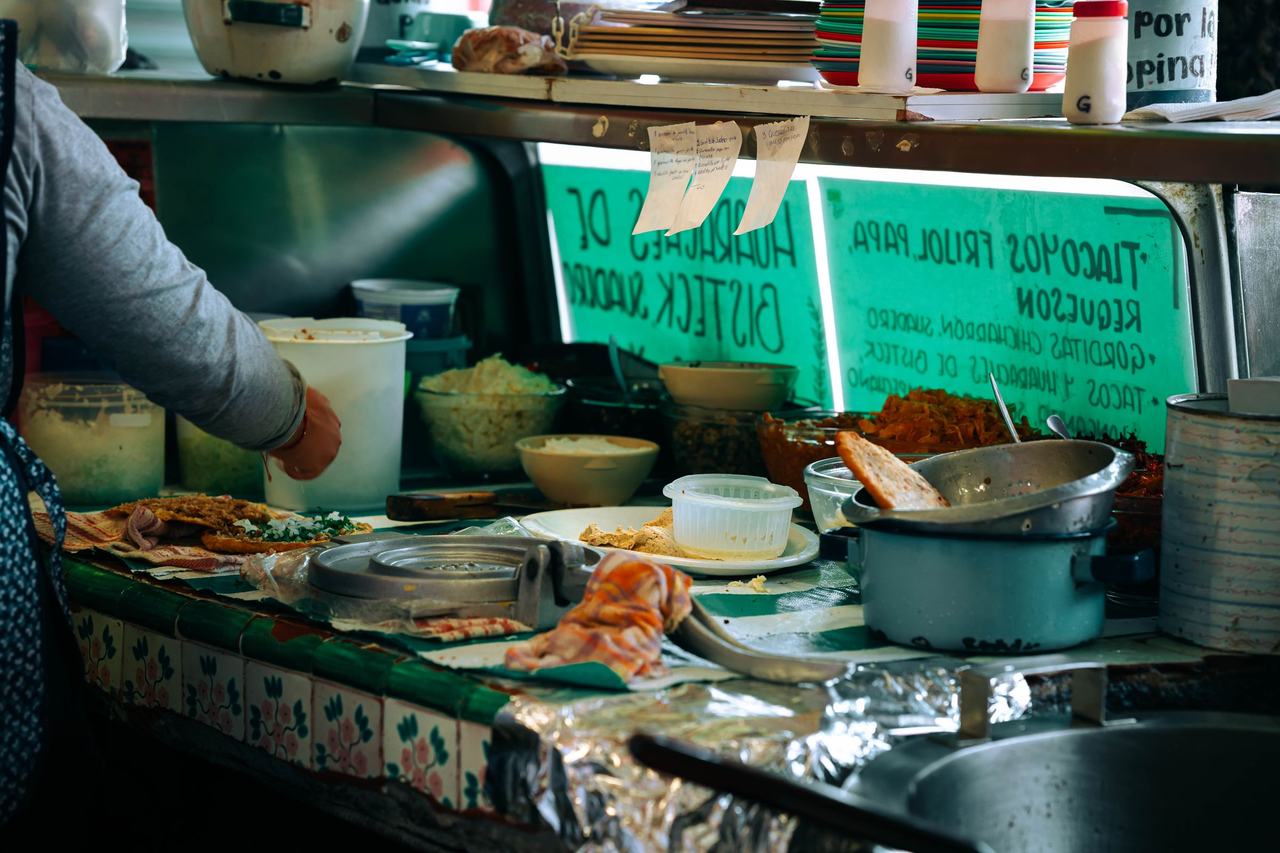
Opening photograph: A vendor reaches across a tiled street food counter crowded with pots and taco fillings in Mexico City. Photograph by Viridiana Rivera on Pexels. Blog photo credits.