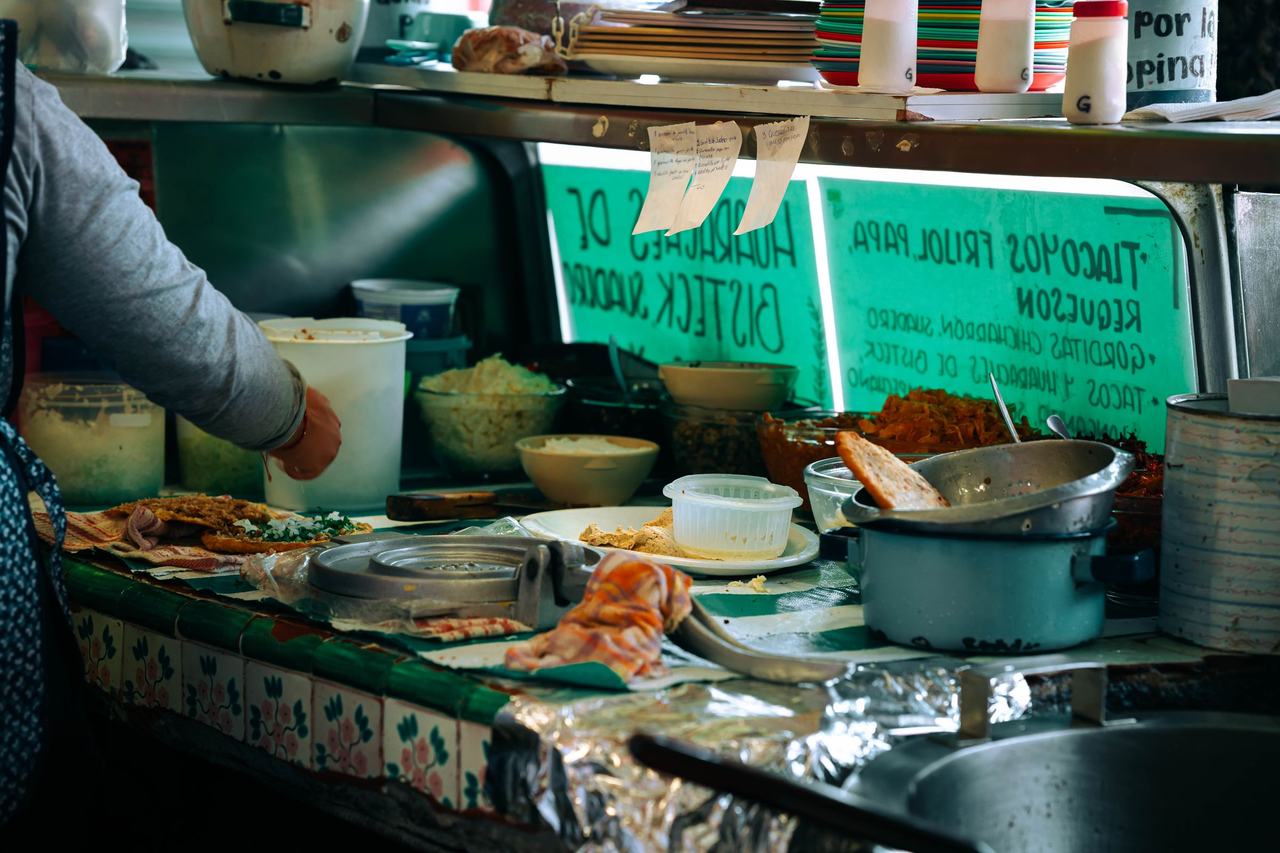
How to Order Tacos in Spanish at a Mexico City Stand
To order tacos in Spanish at a Mexico City street stand, say a number, de, and the filling, then por favor: Tres de pastor, por favor, three al pastor, please. The taquero will usually ask ¿Con todo?, with everything?, which at a stand means onion and cilantro. Answer Con todo or say what you want left off. Below is the whole exchange at Beto’s stand, in the order it happens, each line with its recording from Habla’s taco unit.
What the taquero asks first
At night, Beto greets you with the time of day and a question. ¿Qué va a querer? means what will you have?, and it is your cue to order:
Beto, the taquero, asks
Buenas noches. ¿Qué va a querer?
Good evening. What will you have?
If you do not know what the stand serves, ask before you order. The course gives one short question for it, and its note says it is the question at any stand:
You ask
¿De qué hay?
What kinds are there?
Literally: of what is there? The question at any stand.
The answer will be a list of fillings. Listen for the ones you know, and if a word is new, you can point or ask again with ¿Mande?
The order: a number, de, and the filling
The shape of a taco order is always the same in the course: how many, then de, then the filling. Tres de pastor is three tacos al pastor. At the stand, the course notes, you just say de pastor.
You say
Tres de pastor, por favor.
Three al pastor, please.
Al pastor: pork marinated red, shaved off a spit, with a bit of pineapple. At the stand you just say de pastor.
The second filling to know is suadero. The course describes it as a beef cut cooked slowly in fat until soft, and calls it a Mexico City specialty. Its note also names the other everyday fillings, bistec and longaniza:
You say
Dos de suadero, por favor.
Two suadero, please.
Suadero is a beef cut cooked slowly in fat until soft, a Mexico City specialty. Bistec and longaniza are the other everyday ones.
To change the number, change only the first word. Two is dos:
You say
Dos de pastor, por favor.
Two al pastor, please.
You can order two fillings in one go. Diego does it in the course scene, adding y dos de suadero, and two suadero, after his al pastor. For more on what each filling is, and how to order a mix, see the guide to Mexico City taco fillings.
With everything: onion and cilantro
Right after you order, the taquero asks one quick question. It sounds like a single word, so hear it a few times before your trip:
You ask
¿Con todo?
With everything?
What the taquero asks: onion and cilantro. Salsa is usually a separate question, ¿Con salsa?, or you spoon it on yourself from the bowls.
You say
Con todo.
With everything.
The course note is precise: con todo means onion and cilantro. Salsa is usually a separate question, ¿Con salsa?, or you spoon it on yourself from the bowls. Some ordering guides online describe con todo as every sauce and garnish on offer, so it is worth knowing the narrower meaning before you reach a Mexico City stand.
If you do not want onion, this is the moment to say so. The salsa question, and how to ask whether a salsa is spicy, are in the guide to salsa Spanish.
Hearing your order back
Beto repeats the order back, which gives you a chance to check it. He says salen, coming up, and then exactly what you asked for:
Beto, the taquero, says
Salen tres de pastor y dos de suadero.
Three pastor and two suadero coming up.
The course does the arithmetic for you: three al pastor and two suadero, five in all. If what you hear is wrong, this is the moment to fix it, by saying the number and filling again.
Then comes the question you hear at every counter in the course. You can add something, or finish:
Beto, the taquero, asks
¿Algo más?
Anything else?
You say
Es todo, gracias.
That’s all, thanks.
Es todo, gracias, that’s all, thanks, ends the order politely. In the course, Beto answers with Va. Ahorita salen: okay, they’ll be right out.
One more, or you’re done
Partway through, Beto checks on you. ¿Le preparo otro? means want another one? If you want one, the answer is simple:
Beto, the taquero, asks
¿Le preparo otro?
Want another one?
You say
Otro, por favor.
Another one, please.
Otro for a taco; otra for an agua.
Beto, the taquero, says
Sale, otro de pastor.
Coming up, another pastor.
The course note adds a small detail: otro for a taco, otra for an agua, the drink. You can name the filling too, as in Beto’s reply, Sale, otro de pastor.
When you have had enough, there is a kind way to say it. The course note explains that ya no means not anymore, so the line is no more, thanks:
You say
Ya no, gracias.
No more, thanks.
Ya no: not anymore. The kind way to say you are done.
After that, it is time to pay. At a street stand, the question is ¿Cuánto le debo?, what do I owe you?, rather than asking for a check. The guide to asking for the check in Mexico covers the total and paying.
The whole order in five lines
Put together, a stand order is short. Beto asks what you will have, and you say a number and a filling with por favor. He asks ¿Con todo?, and you say con todo or leave something off. He repeats it, asks if there is anything else, and you say Es todo, gracias. Later he offers another, and you say Otro, por favor or Ya no, gracias.
Every line on this page is a recording from the app’s course. In Habla you hear each line, say it out loud and see what the app heard, so your order comes out before the line behind you gets restless.
Every line on this page
The 14 lines above, in order, for one last listen before you go. Each one is the recording from the Habla course.
Buenas noches. ¿Qué va a querer?Good evening. What will you have?
¿De qué hay?What kinds are there?
Tres de pastor, por favor.Three al pastor, please.
Dos de suadero, por favor.Two suadero, please.
Dos de pastor, por favor.Two al pastor, please.
¿Con todo?With everything?
Con todo.With everything.
Salen tres de pastor y dos de suadero.Three pastor and two suadero coming up.
¿Algo más?Anything else?
Es todo, gracias.That’s all, thanks.
¿Le preparo otro?Want another one?
Otro, por favor.Another one, please.
Sale, otro de pastor.Coming up, another pastor.
Ya no, gracias.No more, thanks.
Common questions
How do you order tacos in Spanish?
Say the number, de, and the filling, then por favor: Tres de pastor, por favor. To order two fillings, join them with y, as Diego does with y dos de suadero.
What does con todo mean at a taco stand?
With everything. In the course, at a Mexico City stand, it means onion and cilantro. Salsa is usually a separate question, ¿Con salsa?, or you serve it yourself from bowls.
What does ¿De qué hay? mean?
Literally, of what is there? It asks what kinds of tacos the stand has, and the course calls it the question at any stand.
How do you say no more, thanks at a taco stand?
Say Ya no, gracias. The course notes that ya no means not anymore, and calls it the kind way to say you are done.
Opening photograph: A vendor reaches across a tiled street food counter crowded with pots and taco fillings in Mexico City. Photograph by Viridiana Rivera on Pexels. Blog photo credits.