How to Order Food in Spanish in Mexico: The Basic Pattern
To order food in Spanish in Mexico, name what you want and add por favor: Un café, por favor, or tres de pastor, por favor at a taco stand. That one move is the core of every order in the course. The rest is knowing what you will hear around it: a greeting with a question when you walk up, a follow-up about your order, ¿Algo más? when you seem done, and the moment you pay. Below is that pattern in five steps, with the real lines from Habla’s café, taco stand and market units.
Step one: what you hear when you walk up
In the course, the first words come from the other side of the counter. It is a question, and you do not need to answer it word for word. It is your cue to order.
At Sofía’s café, it is this:
Sofía, the barista, asks
¿Qué le sirvo?
What can I get you?
At Beto’s taco stand at night, it comes with a greeting:
Beto, the taquero, asks
Buenas noches. ¿Qué va a querer?
Good evening. What will you have?
And at Doña Lupe’s fruit stall in the market, it comes with an invitation to step up:
Doña Lupe asks
Pásele, joven. ¿Qué le damos?
Step right up, young man. What can I get you?
¿Qué le sirvo?, ¿Qué va a querer? and ¿Qué le damos? all mean roughly what can I get you. Pásele is step right up. The words change from place to place, but the shape does not: a question, then a pause for you. If you do not catch it, ¿Mande? is the polite Mexican way to ask someone to say it again.
Step two: name it and say please
The simplest answer is the thing you want plus por favor. The course’s own note on this is short: anything plus por favor is the simplest way to order.
You say
Un café, por favor.
A coffee, please.
Anything + por favor: the simplest way to order.
There are also two everyday frames you can put in front of it. ¿Me da...? is the one the course calls the everyday Mexican way to ask for something. It literally means will you give me.
You ask
¿Me da un café con leche, por favor?
Could I have a coffee with milk, please?
¿Me da…?, literally will you give me…?, is the everyday Mexican way to ask for something.
Quisiera is I’d like. The course notes that quiero, I want, is fine too, as long as por favor goes with it.
You say
Quisiera un té, por favor.
I’d like a tea, please.
Quisiera: I’d like. Quiero, I want, is fine too with por favor.
Any of the three works at any counter. Pick one and use it everywhere until it comes out without thinking.
Step three: name the amount the local way
Food often comes in numbers. At a taco stand, the order is the number, then de, then the filling:
You say
Tres de pastor, por favor.
Three al pastor, please.
Al pastor: pork marinated red, shaved off a spit, with a bit of pineapple. At the stand you just say de pastor.
At the market it is the weight. The course uses un kilo and medio kilo, a kilo and half a kilo, for fruit and vegetables. Either way, the number goes first.
If you do not know what there is, ask before you order. The course gives one short question for any stand:
You ask
¿De qué hay?
What kinds are there?
Literally: of what is there? The question at any stand.
¿De qué hay? literally asks of what is there. The answer is a list of fillings or flavors, and you pick one with the same pattern: number, de, the filling, por favor.
After you order, expect one follow-up question about the details. At the taco stand it is ¿Con todo?, with everything, which the course explains means onion and cilantro. At the café it is the size, or milk. Answer with the short word they used: con todo, grande, con leche.

Step four: anything else, and the drink
Once you stop, you will hear the question that comes at every counter in the course:
Sofía, the barista, asks
¿Algo más?
Anything else?
¿Algo más? is anything else. If you want more, name the next thing. If you are done, the course gives two easy answers:
You say
Nada más, gracias.
Nothing else, thanks.
The answer to ¿Algo más?, anything else?
You say
Es todo, gracias.
That’s all, thanks.
Nada más, gracias is nothing else, thanks, and es todo, gracias is that’s all, thanks. Both close the order politely.
At Beto’s taco stand, there is one more question: whether you want something to drink.
Beto, the taquero, asks
¿Algo de tomar?
Anything to drink?
¿Algo de tomar? means anything to drink. Answer with the drink and por favor, or with No, gracias if you do not want one. For the drinks themselves, see ordering horchata and jamaica.
Step five: the bathroom and paying
If you are staying to eat, this is the line you will want before you sit down:
You ask
¿Dónde está el baño?
Where’s the bathroom?
Then comes paying, and here the course makes a useful distinction between two kinds of places:
You say
La cuenta, por favor.
The check, please.
At a sit-down taquería. At a stand you ask ¿Cuánto le debo?
You ask
¿Cuánto le debo?
What do I owe you?
The usual question at the end of a taxi ride, or at a stall.
La cuenta, por favor is for a sit-down taquería, where you ask for the check at the table. At a stand, the course notes, you ask ¿Cuánto le debo?, what do I owe you, and pay on the spot. The course notes that prices take son, as in son cuarenta y cinco pesos, it’s $45. For the difference in more detail, see how to ask for the check in Mexico.
The pattern at a glance
Here are the five steps in the order they happen:
- Listen for the opening question: ¿Qué le sirvo?, ¿Qué va a querer? or ¿Qué le damos?
- Name what you want with por favor, or with ¿Me da...? or quisiera in front.
- Put the number first, and answer the one follow-up with the short word they used.
- Answer ¿Algo más? with another item or nada más, gracias.
- Ask for the check at a table, or ask ¿Cuánto le debo? at a stand.
None of this needs grammar you have to work out on the spot. What makes it hard is the speed of the questions, and the different words for the same question at different places. For one place in full detail, see how to order coffee in Mexico City.
Every line on this page is a recording from Habla’s course. In the app you hear a line, say it out loud, and it shows you what it heard, so the opening questions on this page become familiar before you hear them across a real counter.
Every line on this page
The 15 lines above, in order, for one last listen before you go. Each one is the recording from the Habla course.
¿Qué le sirvo?What can I get you?
Buenas noches. ¿Qué va a querer?Good evening. What will you have?
Pásele, joven. ¿Qué le damos?Step right up, young man. What can I get you?
Un café, por favor.A coffee, please.
¿Me da un café con leche, por favor?Could I have a coffee with milk, please?
Quisiera un té, por favor.I’d like a tea, please.
Tres de pastor, por favor.Three al pastor, please.
¿De qué hay?What kinds are there?
¿Algo más?Anything else?
Nada más, gracias.Nothing else, thanks.
Es todo, gracias.That’s all, thanks.
¿Algo de tomar?Anything to drink?
¿Dónde está el baño?Where’s the bathroom?
La cuenta, por favor.The check, please.
¿Cuánto le debo?What do I owe you?
Common questions
What is the most polite way to order food in Spanish?
Name the item and add por favor. The course calls this the simplest way to order. ¿Me da...? is the everyday Mexican way to ask for something, and quisiera, I’d like, is another polite option.
Is it rude to say quiero when ordering?
No. The course notes that quiero, I want, is fine too with por favor. It teaches quisiera, I’d like, alongside it, and both are fine at any counter.
How do I say “that’s all” when ordering in Spanish?
Say Es todo, gracias or Nada más, gracias. Both answer ¿Algo más?, anything else.
How do I ask for the check in Mexico?
At a sit-down place, say La cuenta, por favor. At a stand, the course notes that you ask ¿Cuánto le debo?, what do I owe you.
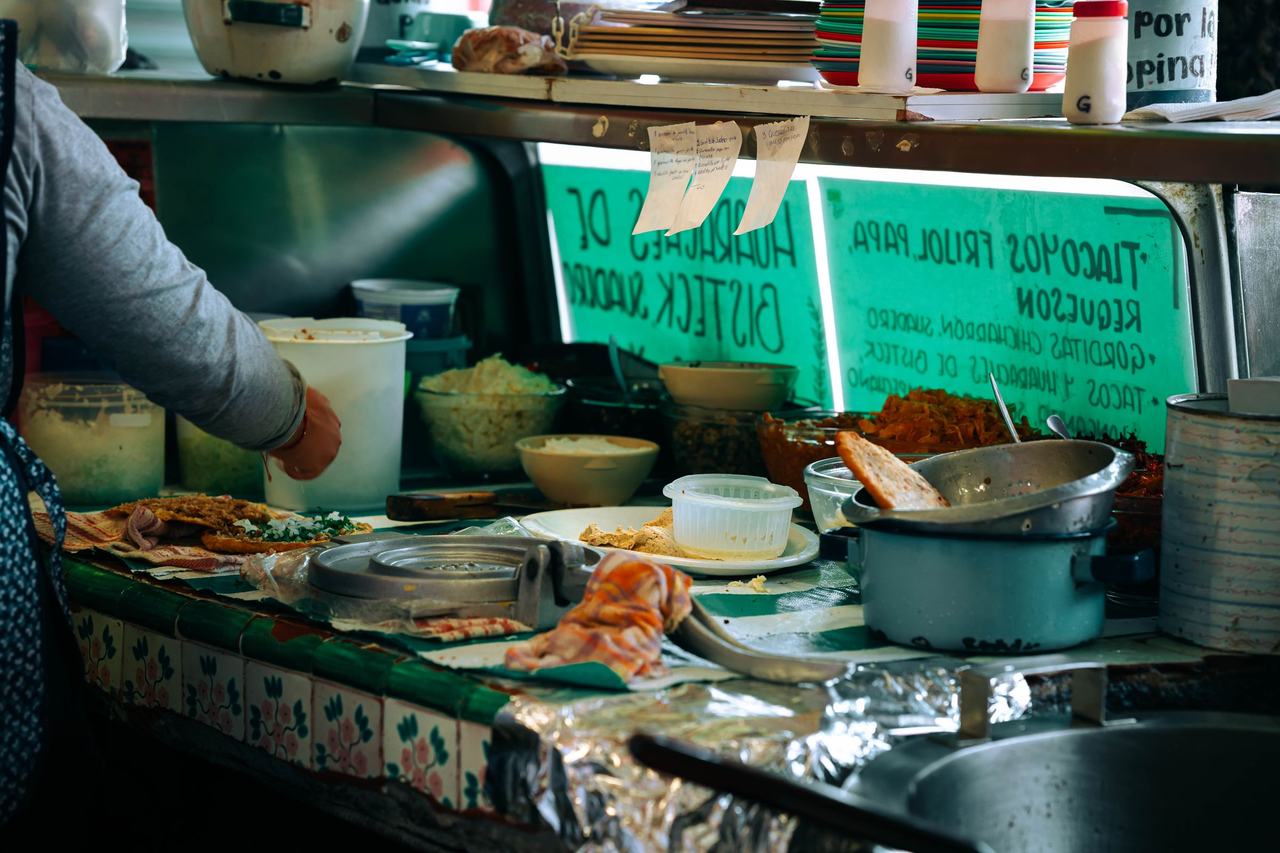
Opening photograph: A vendor reaches across a tiled street food counter crowded with pots and taco fillings in Mexico City. Photograph by Viridiana Rivera on Pexels. Blog photo credits.