What Korean Cashiers Ask You and How to Answer
At a Korean checkout, the questions a cashier asks are short and few: do you need a bag, bongtu piryohaseyo; would you like the receipt, yeongsujeung deurilkkayo; and, if you bought a lunch box, shall I heat it up, dewo deurilkkayo. For a yes, the answers mostly end in juseyo, as in 봉투 하나 주세요, one bag, please. For a no, 괜찮아요, “it’s okay,” covers almost all of them. Here are five questions from Sori’s convenience store unit, each recorded as the clerk says it, with a yes and a no for the first four and an amount for the last.
Two endings that give the question away
The questions come quickly, and you will not catch every word. The good news is that the questions in the course end in one of two ways, and the ending tells you what kind of question it is.
- Piryohaseyo: in the course, this comes at the end of “do you need a bag?” and “do you need chopsticks?” If you hear it, the clerk is asking whether you need something.
- Deurilkkayo: this ends the receipt question, the heat question, the chopsticks offer and the top-up question. The course translates each of these as “would you like” or “shall I.” If you hear it, the clerk is offering to do something for you.
The word in front of the ending is the thing being offered: bongtu, a bag; yeongsujeung, the receipt; jeotgarak, chopsticks. Catch that word and the ending, and you have the question.
Do you need a bag?
This comes as the clerk rings up your things. The course notes that bags cost a little extra at a convenience store.
Junho, the store clerk, asks
봉투 필요하세요?
bongtu piryohaseyo?
Do you need a bag?
You say
봉투 하나 주세요.
bongtu hana juseyo.
One bag, please.
Junho, the store clerk, says
네, 봉투에 담아 드릴게요.
ne, bongtue dama deurilgeyo.
Okay, I’ll put your things in a bag.
You say
봉투는 괜찮아요.
bongtuneun gwaenchanayo.
No bag, thanks.
괜찮아요 here means no thanks.
For yes: bongtu hana juseyo, one bag, please. The clerk’s reply, ne, bongtue dama deurilgeyo, means “okay, I’ll put your things in a bag.” For no: bongtuneun gwaenchanayo, no bag, thanks. The course notes that gwaenchanayo here means no thanks.
Would you like the receipt?
In the course, this one comes right after the bag question, once you have paid.
Junho, the store clerk, asks
네. 영수증 드릴까요?
ne. yeongsujeung deurilkkayo?
Okay. Would you like the receipt?
You say
영수증 주세요.
yeongsujeung juseyo.
The receipt, please.
You say
영수증은 버려 주세요.
yeongsujeungeun beoryeo juseyo.
Please throw the receipt away.
버려 주세요: please throw it away.
Ne. yeongsujeung deurilkkayo means “okay. Would you like the receipt?” For yes: yeongsujeung juseyo, the receipt, please. For no, the course’s line is yeongsujeungeun beoryeo juseyo, please throw the receipt away. The note says beoryeo juseyo means please throw it away. A plain gwaenchanayo also works as a polite no.
Shall I heat it up?
If you buy a lunch box, expect this one. The course notes that the clerk asks it about a lunch box or a hot snack, and that 데우다 means to heat up.
Junho, the store clerk, asks
도시락 데워 드릴까요?
dosirak dewo deurilkkayo?
Shall I heat up the lunch box?
You say
네, 데워 주세요.
ne, dewo juseyo.
Yes, please heat it up.
Junho, the store clerk, says
네, 잠시만 기다려 주세요.
ne, jamsiman gidaryeo juseyo.
Sure, just a moment, please.
Dosirak dewo deurilkkayo means “shall I heat up the lunch box?” Dosirak is the lunch box. For yes: ne, dewo juseyo, yes, please heat it up. The clerk’s ne, jamsiman gidaryeo juseyo means “sure, just a moment, please.” For no, use the all-purpose answer:
You say
괜찮아요.
gwaenchanayo.
It’s okay.
Also no thanks, or I’m fine.
The course notes that gwaenchanayo also means no thanks, or I’m fine. It works as the no for every yes-or-no question on this page. For eating in the store once your lunch is hot, see convenience store ramen and lunch boxes.
Do you need chopsticks?
With a lunch box or noodles, the clerk may ask about chopsticks. The course has it two ways, jeotgarakdo deurilkkayo, would you like chopsticks too, and this shorter one:
Junho, the store clerk, asks
젓가락 필요하세요?
jeotgarak piryohaseyo?
Do you need chopsticks?
You say
젓가락 하나 주세요.
jeotgarak hana juseyo.
A pair of chopsticks, please.
Convenience store chopsticks come one pair to a paper sleeve, counted 하나, 두 개.
You say
젓가락 두 개 주세요.
jeotgarak du gae juseyo.
Two pairs of chopsticks, please.
Jeotgarak piryohaseyo means “do you need chopsticks?” For yes: jeotgarak hana juseyo, a pair of chopsticks, please. The course notes that convenience store chopsticks come one pair to a paper sleeve, counted 하나, 두 개. So for two people, it is jeotgarak du gae juseyo, two pairs, please. For no: gwaenchanayo.
How much would you like to add?
This one only comes up if you ask to top up a transit card, and it is the one question here that needs more than a yes or a no:
Junho, the store clerk, asks
얼마 충전해 드릴까요?
eolma chungjeonhae deurilkkayo?
How much would you like to add?
You say
만 원 충전해 주세요.
man won chungjeonhae juseyo.
Please add 10,000 won.
충전: charging, topping up.
Eolma chungjeonhae deurilkkayo means “how much would you like to add?” Eolma is how much. Answer with an amount plus chungjeonhae juseyo: man won chungjeonhae juseyo is “please add 10,000 won.” The course notes that 충전 means charging, topping up. The whole top-up exchange, including the cash-only rule, is in how to top up a T-money card in Korean.
Five questions, nine answers
Here is the full set in one place:
- Bongtu piryohaseyo? Yes: bongtu hana juseyo. No: bongtuneun gwaenchanayo.
- Yeongsujeung deurilkkayo? Yes: yeongsujeung juseyo. No: yeongsujeungeun beoryeo juseyo.
- Dosirak dewo deurilkkayo? Yes: ne, dewo juseyo. No: gwaenchanayo.
- Jeotgarak piryohaseyo? Yes: jeotgarak hana juseyo. No: gwaenchanayo.
- Eolma chungjeonhae deurilkkayo? Answer: the amount plus chungjeonhae juseyo.
The point of this page is recognition. Play the clerk’s lines out of order and answer each one out loud before the recording ends. Every line here is a recording from Sori’s course, and in the app you hear a line, say your answer out loud and see what it heard. For the rest of a store visit, see what to say at a Korean convenience store.
Every line on this page
The 16 lines above, in order, for one last listen before you go. Each one is the recording from the Sori course.
봉투 필요하세요?bongtu piryohaseyo?Do you need a bag?
봉투 하나 주세요.bongtu hana juseyo.One bag, please.
네, 봉투에 담아 드릴게요.ne, bongtue dama deurilgeyo.Okay, I’ll put your things in a bag.
봉투는 괜찮아요.bongtuneun gwaenchanayo.No bag, thanks.
네. 영수증 드릴까요?ne. yeongsujeung deurilkkayo?Okay. Would you like the receipt?
영수증 주세요.yeongsujeung juseyo.The receipt, please.
영수증은 버려 주세요.yeongsujeungeun beoryeo juseyo.Please throw the receipt away.
도시락 데워 드릴까요?dosirak dewo deurilkkayo?Shall I heat up the lunch box?
네, 데워 주세요.ne, dewo juseyo.Yes, please heat it up.
네, 잠시만 기다려 주세요.ne, jamsiman gidaryeo juseyo.Sure, just a moment, please.
괜찮아요.gwaenchanayo.It’s okay.
젓가락 필요하세요?jeotgarak piryohaseyo?Do you need chopsticks?
젓가락 하나 주세요.jeotgarak hana juseyo.A pair of chopsticks, please.
젓가락 두 개 주세요.jeotgarak du gae juseyo.Two pairs of chopsticks, please.
얼마 충전해 드릴까요?eolma chungjeonhae deurilkkayo?How much would you like to add?
만 원 충전해 주세요.man won chungjeonhae juseyo.Please add 10,000 won.
Common questions
What does “bongtu piryohaseyo” mean?
It means “do you need a bag?” The course notes that bags cost a little extra at a convenience store. Answer 봉투 하나 주세요 for yes, or 봉투는 괜찮아요 for no.
How do you say “no thank you” to a cashier in Korean?
Say 괜찮아요, “it’s okay.” The course notes that it also means no thanks, or I’m fine, and it works for the bag, the receipt, the heat question and chopsticks.
What does “deurilkkayo” mean at the end of a question?
In the course’s checkout questions, it is the clerk offering to do something for you. The course translates those questions as “would you like” or “shall I,” as in yeongsujeung deurilkkayo, would you like the receipt?
What does “dewo deurilkkayo” mean?
It means “shall I heat it up?” The course notes that the clerk asks it about a lunch box or a hot snack. Say 네, 데워 주세요 for yes.
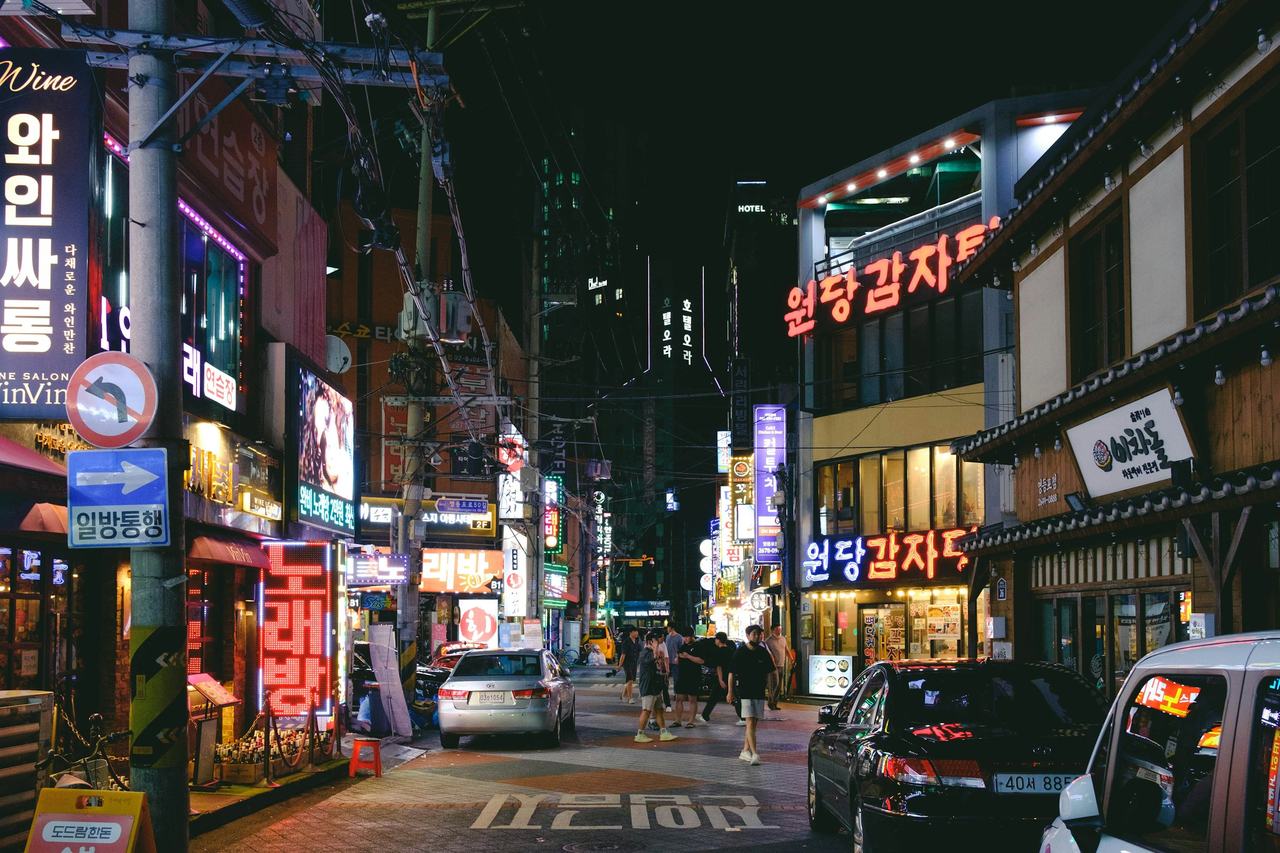
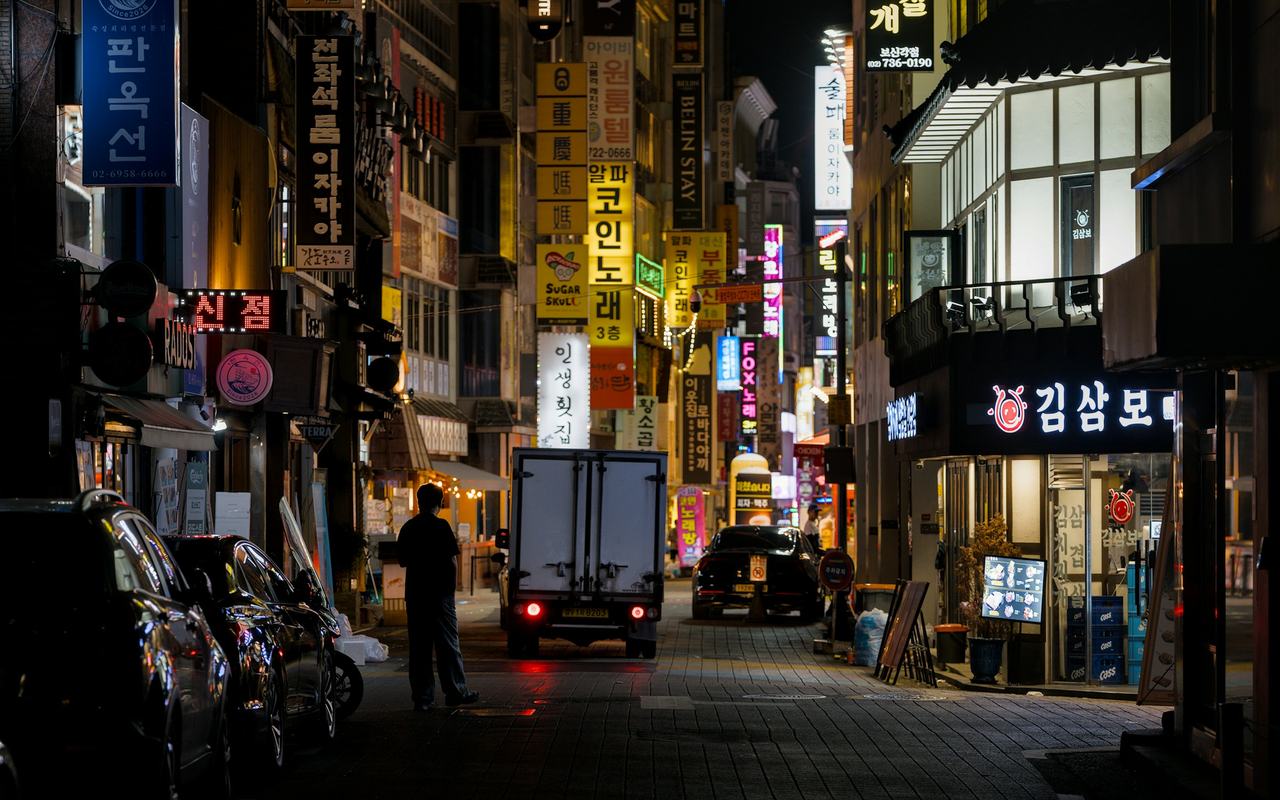
Opening photograph: A person stands in a narrow Seoul street at night under stacked signs. Photograph by Julien on Unsplash. Blog photo credits.