Korean for Convenience Store Ramen and Lunch Boxes
Korean convenience stores provide free hot water and microwaves, so you can cook instant noodles or heat a ready meal on the spot. To find the noodles, ask 저기요, 라면 어디 있어요?, “excuse me, where’s the ramen?” To find the hot water, ask 뜨거운 물 어디 있어요?. If you buy a lunch box, the clerk may offer to heat it, and your yes is 네, 데워 주세요, “yes, please heat it up.” Here is the whole meal in Korean, from the shelf to the table, with recordings from Sori’s convenience store unit.
Finding the ramen
If the noodles are not in sight, get the clerk’s attention and ask in one line:
You ask
저기요, 라면 어디 있어요?
jeogiyo, ramyeon eodi isseoyo?
Excuse me, where’s the ramen?
Jeogiyo is “excuse me,” and ramyeon eodi isseoyo is “where’s the ramen?” The course notes that eodi isseoyo?, where is it?, is the question for things in a shop or a room. In the course, the clerk’s answers to this kind of question use jeojjok, over there.
Hot water for cup noodles
Once you have your cup, the next thing to find is the hot water. The course has a line for exactly this:
You ask
뜨거운 물 어디 있어요?
tteugeoun mul eodi isseoyo?
Where’s the hot water?
For cup noodles.
Tteugeoun mul eodi isseoyo means “where’s the hot water?” Mul is water, and the course’s note on the line is simply “for cup noodles.” The hot water is free, like the microwave, so there is nothing to pay for beyond the noodles themselves.
If you are heating something yourself, the question is the same shape:
You ask
전자레인지 어디 있어요?
jeonjareinji eodi isseoyo?
Where’s the microwave?
Jeonjareinji is the microwave. It is a long word, so play it a few times: you will hear it again from the clerk in a moment.
Shall I heat it up: the lunch box
A lunch box, dosirak, comes with a question at the counter. The course notes that the clerk asks it about a lunch box or a hot snack, and that 데우다 means to heat up.
Junho, the store clerk, asks
도시락 데워 드릴까요?
dosirak dewo deurilkkayo?
Shall I heat up the lunch box?
You say
네, 데워 주세요.
ne, dewo juseyo.
Yes, please heat it up.
Dosirak dewo deurilkkayo means “shall I heat up the lunch box?” Your answer, ne, dewo juseyo, is “yes, please heat it up.” What happens next can go two ways, and the course records both. In one, the clerk heats it for you:
Junho, the store clerk, says
네, 잠시만 기다려 주세요.
ne, jamsiman gidaryeo juseyo.
Sure, just a moment, please.
Ne, jamsiman gidaryeo juseyo means “sure, just a moment, please.” Wait at the counter. In the other, the clerk points you to the microwave to do it yourself:
Junho, the store clerk, says
네, 전자레인지는 저쪽에 있어요.
ne, jeonjareinjineun jeojjoge isseoyo.
Okay, the microwave is over there.
Ne, jeonjareinjineun jeojjoge isseoyo means “okay, the microwave is over there.” Listen for jeonjareinji, the microwave, and jeojjok, over there. If you hear them, take your lunch box and go.
If you do not want it heated, the course’s all-purpose no is gwaenchanayo, which it notes also means no thanks.
Chopsticks and a spoon
Then the utensils. The clerk in the course offers chopsticks along with the lunch box:
Junho, the store clerk, asks
젓가락도 드릴까요?
jeotgarakdo deurilkkayo?
Would you like chopsticks too?
You say
젓가락 하나 주세요.
jeotgarak hana juseyo.
A pair of chopsticks, please.
Convenience store chopsticks come one pair to a paper sleeve, counted 하나, 두 개.
You say
젓가락 두 개 주세요.
jeotgarak du gae juseyo.
Two pairs of chopsticks, please.
Jeotgarakdo deurilkkayo means “would you like chopsticks too?” The course notes that convenience store chopsticks come one pair to a paper sleeve, counted 하나, 두 개. So one pair is jeotgarak hana juseyo, and two pairs, if you are sharing, is jeotgarak du gae juseyo.
For soup or a noodle broth, ask for a spoon as well:
You say
숟가락도 주세요.
sutgarakdo juseyo.
A spoon too, please.
도: too, as well.
Junho, the store clerk, says
여기 있습니다. 맛있게 드세요.
yeogi itseumnida. masitge deuseyo.
Here you are. Enjoy.
Sutgarakdo juseyo means “a spoon too, please.” The course notes that 도 means too, as well, which is why it is the right word when you have already asked for chopsticks. The clerk hands them over with yeogi itseumnida. masitge deuseyo: “here you are. Enjoy.”
Eating in the store
Many Korean convenience stores have tables and chairs for eating in the store, so you can sit down with your noodles or lunch box right there. Add the hot water or heat the lunch box, take a seat, and eat. When you leave, the clerk’s goodbye is annyeonghi gaseyo, and yours, as the one leaving, is annyeonghi gyeseyo. More on the rest of a store visit, from the bag question to the receipt, is in what to say at a Korean convenience store.
The convenience store meal, step by step
Here is the whole meal, with the line for each step:
- Find the noodles: jeogiyo, ramyeon eodi isseoyo?
- Pay at the counter. For a lunch box, the clerk asks dosirak dewo deurilkkayo? You say ne, dewo juseyo.
- Listen for the outcome: jamsiman gidaryeo juseyo, wait a moment, or jeonjareinjineun jeojjoge isseoyo, the microwave is over there.
- Chopsticks: jeotgarak hana juseyo. A spoon: sutgarakdo juseyo.
- For cup noodles: tteugeoun mul eodi isseoyo?
- Sit down and eat.
Every line on this page is a recording from Sori’s course. In the app you hear each line, say it out loud and see what it heard. The clerk’s two possible answers in step three are worth playing back to back, since they start the same way and the meaning comes at the end. For the other questions you may hear at the register, see what Korean cashiers ask you.
Every line on this page
The 12 lines above, in order, for one last listen before you go. Each one is the recording from the Sori course.
저기요, 라면 어디 있어요?jeogiyo, ramyeon eodi isseoyo?Excuse me, where’s the ramen?
뜨거운 물 어디 있어요?tteugeoun mul eodi isseoyo?Where’s the hot water?
전자레인지 어디 있어요?jeonjareinji eodi isseoyo?Where’s the microwave?
도시락 데워 드릴까요?dosirak dewo deurilkkayo?Shall I heat up the lunch box?
네, 데워 주세요.ne, dewo juseyo.Yes, please heat it up.
네, 잠시만 기다려 주세요.ne, jamsiman gidaryeo juseyo.Sure, just a moment, please.
네, 전자레인지는 저쪽에 있어요.ne, jeonjareinjineun jeojjoge isseoyo.Okay, the microwave is over there.
젓가락도 드릴까요?jeotgarakdo deurilkkayo?Would you like chopsticks too?
젓가락 하나 주세요.jeotgarak hana juseyo.A pair of chopsticks, please.
젓가락 두 개 주세요.jeotgarak du gae juseyo.Two pairs of chopsticks, please.
숟가락도 주세요.sutgarakdo juseyo.A spoon too, please.
여기 있습니다. 맛있게 드세요.yeogi itseumnida. masitge deuseyo.Here you are. Enjoy.
Common questions
How do you say “please heat it up” in Korean?
Say 네, 데워 주세요, “yes, please heat it up.” It is the answer to the clerk’s dewo deurilkkayo, shall I heat it up?, which the course notes is asked about a lunch box or a hot snack.
Do Korean convenience stores have hot water for ramen?
Yes. Korean convenience stores provide free hot water and microwaves so customers can cook instant noodles and ready meals on the spot. To find the hot water, ask 뜨거운 물 어디 있어요?.
How do you ask for a spoon in Korean?
Say 숟가락도 주세요, “a spoon too, please.” The course notes that 도 means too, as well, so it fits after you have asked for chopsticks.
What does “dosirak” mean?
Dosirak is a lunch box. At a convenience store, the clerk may ask dosirak dewo deurilkkayo, shall I heat up the lunch box? Answer ne, dewo juseyo for yes.
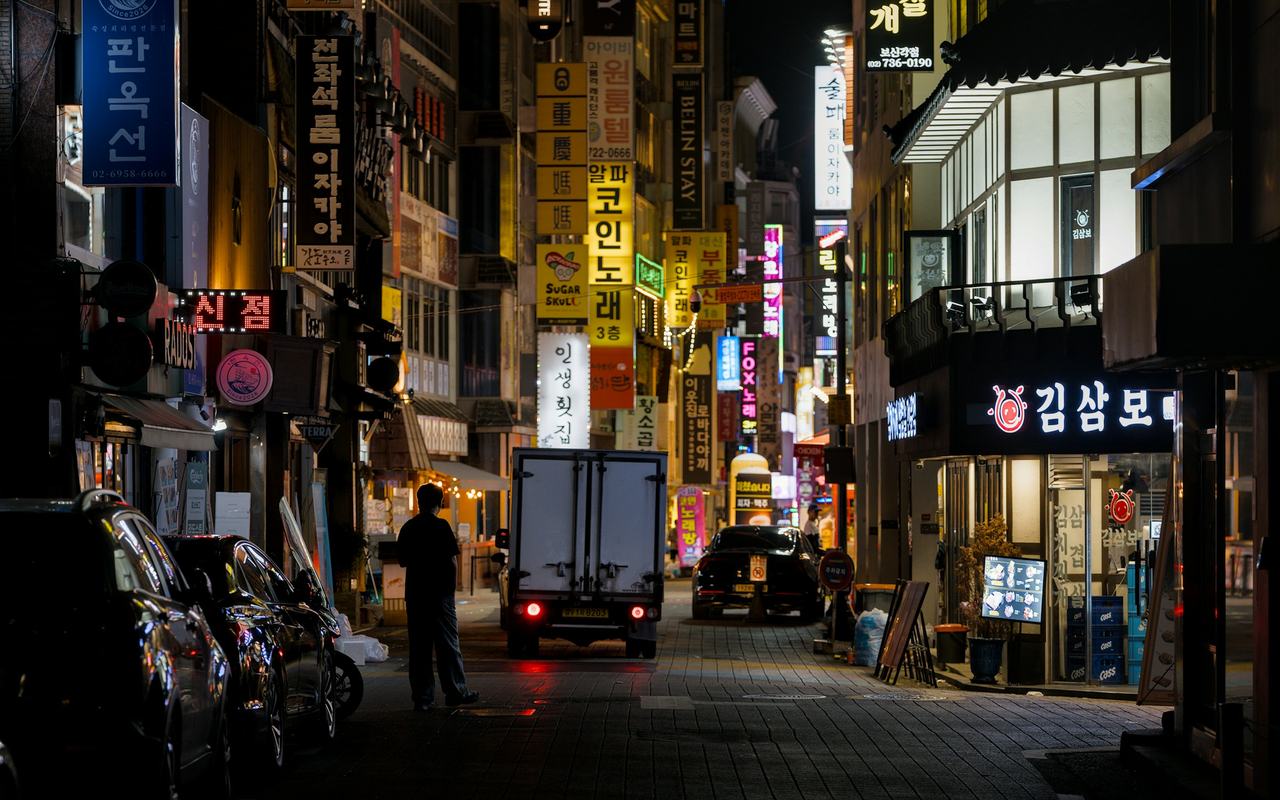
Opening photograph: A person stands in a narrow Seoul street at night under stacked signs. Photograph by Julien on Unsplash. Blog photo credits.