What 1+1 Means at a Korean Convenience Store
At a Korean convenience store, 1+1 means buy one, get one free. When a clerk says 이거 원 플러스 원이에요, won peulleoseu wonieyo, they are telling you the item you are buying is one plus one. In the course, the clerk adds hana deo gajeooseyo, “go and get another,” and your reply is 하나 더 가져올게요, “I’ll get one more.” Here is that moment at the register from Sori’s convenience store unit, with every line recorded.
The moment at the register
It happens when you bring one item to the counter and the deal is for two. In the course, the customer has found the milk and brings it to the counter:
You ask
우유 어디 있어요?
uyu eodi isseoyo?
Where’s the milk?
Junho, the store clerk, says
저쪽 냉장고에 있어요.
jeojjok naengjanggoe isseoyo.
It’s in the fridge over there.
Uyu eodi isseoyo is “where’s the milk?” The clerk’s jeojjok naengjanggoe isseoyo means “it’s in the fridge over there.” Then, at the counter:
You say
이거 계산해 주세요.
igeo gyesanhae juseyo.
I’d like to pay for this.
Junho, the store clerk, says
이거 원 플러스 원이에요. 하나 더 가져오세요.
igeo won peulleoseu wonieyo. hana deo gajeooseyo.
This one’s buy one, get one free. Go and get another.
Igeo gyesanhae juseyo means “I’d like to pay for this.” The clerk answers in two sentences. Igeo won peulleoseu wonieyo means “this one’s buy one, get one free.” Hana deo gajeooseyo means “go and get another.” The clerk is not asking a question. They are telling you there is a free second item and sending you back to get it.
What “won peulleoseu won” means
The course explains it directly: 원 플러스 원이에요 means one plus one, buy one and get one free. It also points out something worth knowing before you hear it. Won here is the English word “one,” said the Korean way. It is not the currency.
That matters because you also hear won in every price, as in man won, 10,000 won. When won comes before peulleoseu, plus, it is the number one. At full speed the clerk’s sentence runs together, so listen for peulleoseu in the middle: it is the easiest part to catch, and once you hear it, you know what the rest means. Labels on the shelf show it as 1+1. The course adds that 2+1 is 투 플러스 원.
Your answer: I’ll get one more
The reply is short, and it tells the clerk you understood:
You say
하나 더 가져올게요.
hana deo gajeoolgeyo.
I’ll get one more.
Junho, the store clerk, says
네, 같은 걸로 가져오세요.
ne, gateun geollo gajeooseyo.
Sure, bring the same one.
Hana deo gajeoolgeyo means “I’ll get one more.” Hana is one and deo is more. You can hear the same word, gajeo, in the clerk’s gajeooseyo and in your gajeoolgeyo: the clerk says go and get it, and you say you will. The clerk’s answer, ne, gateun geollo gajeooseyo, means “sure, bring the same one.” That is the rule of the deal in the course: the free item is the same product. Go back to the fridge or shelf, take a second one of what you already have, and bring it to the counter.
Here is the shorter version from the role play, where the clerk only says the first sentence:
Junho, the store clerk, says
이거 원 플러스 원이에요.
igeo won peulleoseu wonieyo.
This one’s buy one, get one free.
If you hear just won peulleoseu wonieyo with nothing after it, the meaning is the same. Answer hana deo gajeoolgeyo and go and get it.
If you only want one
If you would rather not take a second one, the course’s polite no is one word:
You say
괜찮아요.
gwaenchanayo.
It’s okay.
Also no thanks, or I’m fine.
Gwaenchanayo means “it’s okay,” and the course notes that it also means no thanks, or I’m fine. It is the same word you use to turn down a bag or a receipt.
Related price and counting lines
A few nearby lines from the course help around a 1+1 deal. To check a price before you decide:
You ask
이거 얼마예요?
igeo eolmayeyo?
How much is this?
Igeo eolmayeyo means “how much is this?” When you want a set number of something, the counting line works:
You say
이거 한 개 주세요.
igeo han gae juseyo.
One of these, please.
Count with 한, 두, 세, 네 before counters like 개 (things), 잔 (cups) and 명 (people); with no counter, say 하나, 둘, 셋. Prices in 원 use 일, 이, 삼 instead: 삼천 원, 이만 원.
Igeo han gae juseyo means “one of these, please.” The course’s note on it explains Korean counting in one go: han, du, se, ne before counters like 개 for things, 잔 for cups and 명 for people, and 하나, 둘, 셋 with no counter. That is why the clerk says hana deo, one more, with no counter after it.
And if the deal makes your shopping feel like a bargain, the course has the word:
You say
싸요.
ssayo.
It’s cheap.
Ssayo means “it’s cheap.” For how prices themselves sound, see how to say and understand prices in Korean won.
The 1+1 exchange in order
- You, at the counter: igeo gyesanhae juseyo.
- Clerk: igeo won peulleoseu wonieyo. hana deo gajeooseyo.
- You: hana deo gajeoolgeyo. Clerk: ne, gateun geollo gajeooseyo.
- You come back with the second one, and the clerk rings up both.
The rest of the visit, from the bag question to the receipt, is in what to say at a Korean convenience store, and the other quick questions at the register are in what Korean cashiers ask you. Every line on this page is a recording from Sori’s course. In the app you hear each line, say it out loud and see what it heard, which helps most with catching won peulleoseu won at full speed.
Every line on this page
The 11 lines above, in order, for one last listen before you go. Each one is the recording from the Sori course.
우유 어디 있어요?uyu eodi isseoyo?Where’s the milk?
저쪽 냉장고에 있어요.jeojjok naengjanggoe isseoyo.It’s in the fridge over there.
이거 계산해 주세요.igeo gyesanhae juseyo.I’d like to pay for this.
이거 원 플러스 원이에요. 하나 더 가져오세요.igeo won peulleoseu wonieyo. hana deo gajeooseyo.This one’s buy one, get one free. Go and get another.
하나 더 가져올게요.hana deo gajeoolgeyo.I’ll get one more.
네, 같은 걸로 가져오세요.ne, gateun geollo gajeooseyo.Sure, bring the same one.
이거 원 플러스 원이에요.igeo won peulleoseu wonieyo.This one’s buy one, get one free.
괜찮아요.gwaenchanayo.It’s okay.
이거 얼마예요?igeo eolmayeyo?How much is this?
이거 한 개 주세요.igeo han gae juseyo.One of these, please.
싸요.ssayo.It’s cheap.
Common questions
What does 1+1 mean in Korea?
It means buy one, get one free. The course explains that 원 플러스 원 is one plus one, and that won here is the English word “one,” not the currency. Labels on the shelf show it as 1+1.
What does “hana deo gajeooseyo” mean?
It means “go and get another.” The clerk says it after telling you your item is one plus one. Answer 하나 더 가져올게요, “I’ll get one more,” and bring the same item.
How is 2+1 said at a Korean convenience store?
The course notes that labels also show 2+1, which is said 투 플러스 원. As with 1+1, listen for peulleoseu, plus, in the middle.
How do you say “I’ll get one more” in Korean?
Say 하나 더 가져올게요. Hana is one and deo is more. In the course, the clerk replies ne, gateun geollo gajeooseyo, sure, bring the same one.
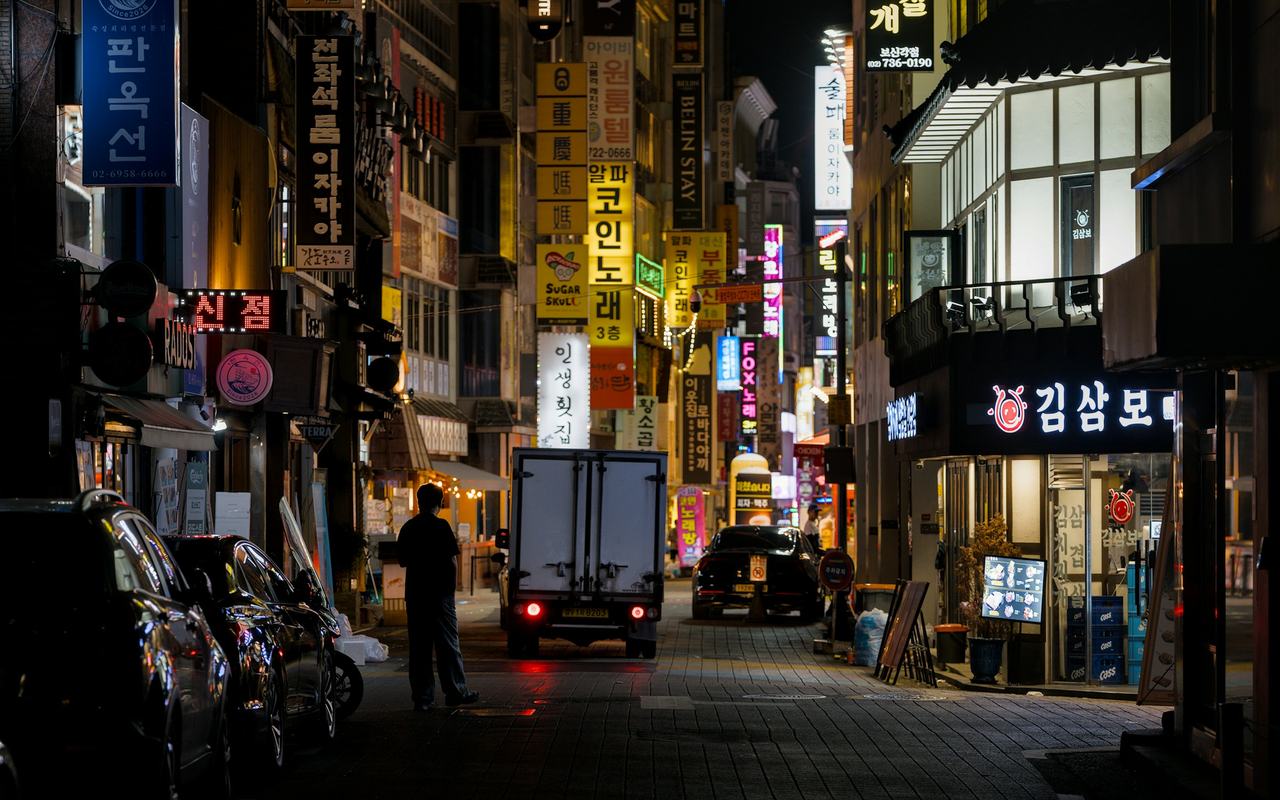
Opening photograph: A person stands in a narrow Seoul street at night under stacked signs. Photograph by Julien on Unsplash. Blog photo credits.