What to Say at a Korean Convenience Store
The convenience store phrases you need in Korean come in a short sequence. To find something, say the item plus eodi isseoyo, as in 물 어디 있어요?, “where’s the water?” To pay, put your things down and say 이거 계산해 주세요, “I’d like to pay for this.” When the clerk asks about a bag, 봉투는 괜찮아요 means “no bag, thanks.” Here is the whole visit in order, with the clerk’s lines recorded too, from Sori’s convenience store unit.
Walking in
As you come through the door, the clerk greets you:
Junho, the store clerk, says
어서 오세요.
eoseo oseyo.
Welcome.
Eoseo oseyo means “welcome.” It is a greeting, not a question. If you want to answer it, 안녕하세요 works: the course notes that annyeonghaseyo is the everyday polite hello, for anyone, at any time of day.
Finding what you need
If you cannot find something, get the clerk’s attention first, then ask where it is:
You say
저기요.
jeogiyo.
Excuse me.
To get a clerk’s or a stranger’s attention.
You ask
우유 어디 있어요?
uyu eodi isseoyo?
Where’s the milk?
어디 있어요?: where is it? For things in a shop or a room.
Junho, the store clerk, says
저쪽 냉장고에 있어요.
jeojjok naengjanggoe isseoyo.
It’s in the fridge over there.
Jeogiyo is “excuse me,” and the course notes that it is for getting a clerk’s or a stranger’s attention. Uyu eodi isseoyo asks “where’s the milk?” The course notes that eodi isseoyo? means “where is it?” and is the question for things in a shop or a room.
The clerk’s answer, jeojjok naengjanggoe isseoyo, means “it’s in the fridge over there.” Two words carry it: jeojjok, over there, and naengjanggo, the fridge. Other answers follow the same shape, a place plus isseoyo. The course’s directions lesson has oreunjjoge isseoyo, it’s on the right, and the restaurant owner uses jeogi isseoyo, it’s over there.
The same question works for anything. Swap the item at the front:
You ask
물 어디 있어요?
mul eodi isseoyo?
Where’s the water?
You ask
저기요, 라면 어디 있어요?
jeogiyo, ramyeon eodi isseoyo?
Excuse me, where’s the ramen?
Mul is water and ramyeon is ramen. The second line starts with jeogiyo, so it gets attention and asks in one go. For eating ramen or a lunch box in the store, see convenience store ramen and lunch boxes.
Paying at the counter
At the counter, put your things down and say:
You say
이거 계산해 주세요.
igeo gyesanhae juseyo.
I’d like to pay for this.
계산: the bill, paying.
Igeo gyesanhae juseyo means “I’d like to pay for this.” The course notes that gyesan is the bill, or paying. The clerk says the total, and you say how you are paying. If you want to check that cards are fine first, ask:
You ask
여기 카드 돼요?
yeogi kadeu dwaeyo?
Do you take cards here?
Junho, the store clerk, says
네, 돼요. 여기 꽂아 주세요.
ne, dwaeyo. yeogi kkoja juseyo.
Yes. Insert it here, please.
Yeogi kadeu dwaeyo is “do you take cards here?” The clerk’s ne, dwaeyo. yeogi kkoja juseyo means “yes. Insert it here, please.” For everything about card, cash and change, see how to pay by card or cash in Korean.
Sometimes the clerk has something to tell you at this point. If you hear won peulleoseu wonieyo, your item is buy one, get one free, and the clerk will tell you to go and get another. That moment has its own guide: what 1+1 means at a Korean convenience store.
Bag or no bag
While ringing you up, the clerk asks about a bag. The course notes that bags cost a little extra at a convenience store, so the clerk checks before putting your things in one.
Junho, the store clerk, asks
봉투 필요하세요?
bongtu piryohaseyo?
Do you need a bag?
You say
봉투는 괜찮아요.
bongtuneun gwaenchanayo.
No bag, thanks.
괜찮아요 here means no thanks.
You say
봉투 하나 주세요.
bongtu hana juseyo.
One bag, please.
Bongtu piryohaseyo means “do you need a bag?” Bongtu is the bag. To say no, bongtuneun gwaenchanayo: the course notes that gwaenchanayo here means no thanks. To say yes, bongtu hana juseyo, one bag, please.
The receipt and goodbye
Next comes the receipt, and then you are done:
Junho, the store clerk, asks
네. 영수증 드릴까요?
ne. yeongsujeung deurilkkayo?
Okay. Would you like the receipt?
You say
영수증은 버려 주세요.
yeongsujeungeun beoryeo juseyo.
Please throw the receipt away.
버려 주세요: please throw it away.
Junho, the store clerk, says
네, 감사합니다. 안녕히 가세요.
ne, gamsahamnida. annyeonghi gaseyo.
Okay, thank you. Goodbye.
Ne. yeongsujeung deurilkkayo means “okay. Would you like the receipt?” The course’s answer, yeongsujeungeun beoryeo juseyo, asks the clerk to throw it away; the note says beoryeo juseyo means please throw it away. If you want the receipt, say yeongsujeung juseyo instead. The clerk closes with ne, gamsahamnida. annyeonghi gaseyo, “okay, thank you. Goodbye.”
Your goodbye is the one for the person leaving:
You say
안녕히 계세요.
annyeonghi gyeseyo.
Goodbye. (You are leaving.)
Said by the one who leaves to the one who stays: stay in peace.
Annyeonghi gyeseyo is said, as the course notes, by the one who leaves to the one who stays. The clerk says annyeonghi gaseyo to you, because you are the one going.
Eating in the store
Many Korean convenience stores have tables and chairs for eating in the store, so you do not have to carry your snack outside. If you bought a lunch box, the clerk may ask dewo deurilkkayo, shall I heat it up? That exchange, along with chopsticks and the hot water for cup noodles, is in the ramen and lunch box guide linked above.
The visit in order
Here is the whole visit, the way the course runs it:
- Clerk: eoseo oseyo.
- You: jeogiyo, then the item plus eodi isseoyo. Clerk: jeojjok naengjanggoe isseoyo, or another place.
- You, at the counter: igeo gyesanhae juseyo.
- Clerk: bongtu piryohaseyo? You: bongtuneun gwaenchanayo or bongtu hana juseyo.
- Clerk: yeongsujeung deurilkkayo? You: yeongsujeungeun beoryeo juseyo or yeongsujeung juseyo.
- Clerk: annyeonghi gaseyo. You: annyeonghi gyeseyo.
Every line on this page is a recording from Sori’s course. In the app you hear each line, say it out loud and see what it heard, so the bag question does not catch you halfway through finding your card.
Every line on this page
The 16 lines above, in order, for one last listen before you go. Each one is the recording from the Sori course.
어서 오세요.eoseo oseyo.Welcome.
저기요.jeogiyo.Excuse me.
우유 어디 있어요?uyu eodi isseoyo?Where’s the milk?
저쪽 냉장고에 있어요.jeojjok naengjanggoe isseoyo.It’s in the fridge over there.
물 어디 있어요?mul eodi isseoyo?Where’s the water?
저기요, 라면 어디 있어요?jeogiyo, ramyeon eodi isseoyo?Excuse me, where’s the ramen?
이거 계산해 주세요.igeo gyesanhae juseyo.I’d like to pay for this.
여기 카드 돼요?yeogi kadeu dwaeyo?Do you take cards here?
네, 돼요. 여기 꽂아 주세요.ne, dwaeyo. yeogi kkoja juseyo.Yes. Insert it here, please.
봉투 필요하세요?bongtu piryohaseyo?Do you need a bag?
봉투는 괜찮아요.bongtuneun gwaenchanayo.No bag, thanks.
봉투 하나 주세요.bongtu hana juseyo.One bag, please.
네. 영수증 드릴까요?ne. yeongsujeung deurilkkayo?Okay. Would you like the receipt?
영수증은 버려 주세요.yeongsujeungeun beoryeo juseyo.Please throw the receipt away.
네, 감사합니다. 안녕히 가세요.ne, gamsahamnida. annyeonghi gaseyo.Okay, thank you. Goodbye.
안녕히 계세요.annyeonghi gyeseyo.Goodbye. (You are leaving.)
Common questions
How do you say “where is the water” in Korean?
Say 물 어디 있어요?, “where’s the water?” The pattern is the item plus eodi isseoyo, which the course notes is the question for things in a shop or a room.
Do convenience store bags cost money in Korea?
The course notes that bags cost a little extra at a convenience store. That is why the clerk asks bongtu piryohaseyo, do you need a bag?
How do you say “no bag” in Korean?
Say 봉투는 괜찮아요, “no bag, thanks.” The course notes that gwaenchanayo here means no thanks. For a bag, say 봉투 하나 주세요.
What does “eoseo oseyo” mean?
It means “welcome.” Clerks and restaurant owners in the course say it as you walk in. It is a greeting rather than a question. If you want to answer, annyeonghaseyo is the everyday polite hello.
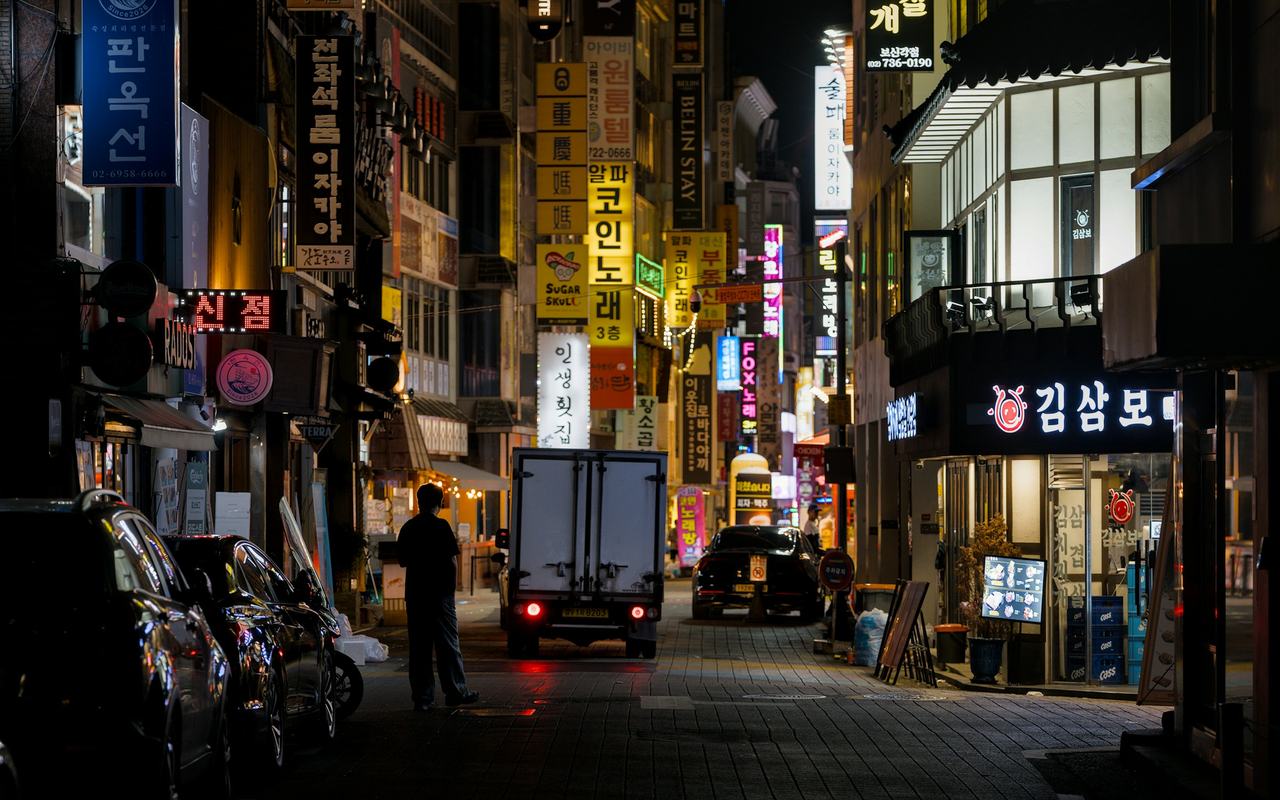
Opening photograph: A person stands in a narrow Seoul street at night under stacked signs. Photograph by Julien on Unsplash. Blog photo credits.