How to Ask About Opening Hours in Korean
To ask what time a place closes in Korean, say 몇 시에 문 닫아요? (myeot sie mun dadayo, what time do you close). The other way, and the one Tom uses at Jimin’s café in Sori’s time unit, is 여기 몇 시까지 해요? (yeogi myeot sikkaji haeyo), what time are you open until. The answer comes back as a time plus kkaji, until: 밤 열 시까지 해요, we’re open until 10 at night. Below are the questions, the answers you will hear, and the small words that tell you whether a time means morning or night.
Two ways to ask what time a place closes
The question Tom asks at the counter is short, and nothing in it is about cafés: yeogi is simply here, wherever you are standing. The course note explains its two parts. Kkaji means until, and haeyo here means to be open for business.
You ask
여기 몇 시까지 해요?
yeogi myeot sikkaji haeyo?
What time are you open until?
까지: until. 해요 here means to be open for business.
The second way uses the verb for closing the door. The course notes that 문 열다, literally to open the door, means to open, and 문 닫다 means to close. Ask with dadayo and you are asking, word for word, what time the door closes.
You ask
몇 시에 문 닫아요?
myeot sie mun dadayo?
What time do you close?
Both get the same kind of answer. The first asks how long the place runs. The second asks the closing time directly. Pick whichever comes out of your mouth more easily and use it everywhere.
Asking what time a place opens
Turn the same sentence around and you have the opening question. Swap dadayo for yeoreoyo, and the door opens instead of closing.
You ask
몇 시에 문 열어요?
myeot sie mun yeoreoyo?
What time do you open?
문 열다: to open, literally to open the door. 문 닫다: to close.
In the course scene, Tom adds achimeneun at the front, in the morning, because he already knows the closing time and now wants the other end of the day. It is the same question with one word added:
Tom, an exchange student, asks
아침에는 몇 시에 문 열어요?
achimeneun myeot sie mun yeoreoyo?
And what time do you open in the morning?
Jimin, the barista, says
아침에는 여덟 시에 열어요.
achimeneun yeodeol sie yeoreoyo.
We open at eight in the morning.
The e after myeot si is worth noticing. The course notes that 에 after a time means at, so myeot sie is at what time. You will hear it again in the answer: yeodeol sie yeoreoyo, it opens at eight.
Understanding the answer: morning, night and the hour
Here is the whole exchange from the café, the question and Jimin’s reply. Listen for the time first, then for kkaji at the end.
Tom, an exchange student, asks
여기 몇 시까지 해요?
yeogi myeot sikkaji haeyo?
What time are you open until?
Jimin, the barista, says
밤 열 시까지 해요.
bam yeol sikkaji haeyo.
Until 10 at night.
Two things in that reply help you. The first is the word before the hour. The course gives three of them: achim is morning, jeonyeok is evening and bam is night. Jimin says bam yeol si, ten at night, so there is no doubt about which ten she means.
You say
밤 열 시까지 해요.
bam yeol sikkaji haeyo.
We’re open until 10 at night.
아침: morning. 저녁: evening. 밤: night.
You say
아침 일곱 시에 열어요.
achim ilgop sie yeoreoyo.
We open at 7 in the morning.
The second is the number itself. The course notes that hours are counted in native Korean numbers: han si, du si, se si, ne si for one, two, three and four o’clock. In the answers on this page you hear ilgop si (seven), yeodeol si (eight), ahop si (nine) and yeol si (ten). These are the hour words to have ready before you ask, because the answer comes quickly and the number is the part you need. For the full set of hours and minutes, see how to tell time in Korean.
Weekend, Sunday and Monday hours
Jimin’s café opens later on the weekend. When Tom asks about the morning, she gives him the weekday time and then the weekend one in the same breath:
Jimin, the barista, says
여덟 시에 열어요. 주말에는 아홉 시에 열어요.
yeodeol sie yeoreoyo. jumareneun ahop sie yeoreoyo.
At eight. At the weekend, at nine.
The word to catch is jumareneun, on the weekend. Anything after it is the weekend time. If you only want Sunday, put the day at the front of the opening question:
You ask
일요일에는 몇 시에 문 열어요?
iryoireneun myeot sie mun yeoreoyo?
What time do you open on Sundays?
Jimin, the barista, says
네, 일요일에는 아홉 시에 열어요.
ne, iryoireneun ahop sie yeoreoyo.
Yes, on Sundays we open at nine.
To ask whether a place is open on a particular day at all, the course uses a short question with 에도. Its note says 에도 means on that day too, so the question is literally whether they are open on that day as well. It is the one to ask before you cross the city to a place on a Monday.
You ask
월요일에도 해요?
woryoiredo haeyo?
Are you open on Mondays too?
에도: on that day too.
You ask
일요일에도 해요?
iryoiredo haeyo?
Are you open on Sundays too?
A ne at the start of the reply is a yes, and a time often follows. An aniyo at the start is a no. Either way, you know before you make the trip.
The whole exchange at the counter
In the course role play, you walk into Jimin’s café and she greets you with eoseo oseyo, welcome. You ask how late they are open, she tells you, you ask about the morning, and she tells you that too. Play it through once as a listener, then try it as the customer:
Jimin, the barista, says
어서 오세요.
eoseo oseyo.
Welcome.
You ask
여기 몇 시까지 해요?
yeogi myeot sikkaji haeyo?
What time are you open until?
Jimin, the barista, says
밤 열 시까지 해요.
bam yeol sikkaji haeyo.
Until 10 at night.
When you have the answer, a polite thank you closes it:
You say
감사합니다.
gamsahamnida.
Thank you.
That is the whole job: one question, one time to catch, and a thank you. The hard part is the reply, because it comes at normal speed and the hour word is only one or two syllables. Every line on this page is a recording from Sori’s course, and in the app you hear each line, say it out loud, and see what the app heard. Rehearsing the answers until yeol si and ahop si sound like ten and nine without thinking is what makes the real exchange easy.
Every line on this page
The 17 lines above, in order, for one last listen before you go. Each one is the recording from the Sori course.
여기 몇 시까지 해요?yeogi myeot sikkaji haeyo?What time are you open until?
몇 시에 문 닫아요?myeot sie mun dadayo?What time do you close?
몇 시에 문 열어요?myeot sie mun yeoreoyo?What time do you open?
아침에는 몇 시에 문 열어요?achimeneun myeot sie mun yeoreoyo?And what time do you open in the morning?
아침에는 여덟 시에 열어요.achimeneun yeodeol sie yeoreoyo.We open at eight in the morning.
여기 몇 시까지 해요?yeogi myeot sikkaji haeyo?What time are you open until?
밤 열 시까지 해요.bam yeol sikkaji haeyo.Until 10 at night.
밤 열 시까지 해요.bam yeol sikkaji haeyo.We’re open until 10 at night.
아침 일곱 시에 열어요.achim ilgop sie yeoreoyo.We open at 7 in the morning.
여덟 시에 열어요. 주말에는 아홉 시에 열어요.yeodeol sie yeoreoyo. jumareneun ahop sie yeoreoyo.At eight. At the weekend, at nine.
일요일에는 몇 시에 문 열어요?iryoireneun myeot sie mun yeoreoyo?What time do you open on Sundays?
네, 일요일에는 아홉 시에 열어요.ne, iryoireneun ahop sie yeoreoyo.Yes, on Sundays we open at nine.
월요일에도 해요?woryoiredo haeyo?Are you open on Mondays too?
일요일에도 해요?iryoiredo haeyo?Are you open on Sundays too?
어서 오세요.eoseo oseyo.Welcome.
밤 열 시까지 해요.bam yeol sikkaji haeyo.Until 10 at night.
감사합니다.gamsahamnida.Thank you.
Common questions
How do you say “what time do you close” in Korean?
Say 몇 시에 문 닫아요? (myeot sie mun dadayo). You can also ask 여기 몇 시까지 해요? (yeogi myeot sikkaji haeyo), what time are you open until. Both get a reply with a time, often followed by kkaji, until.
What does myeot sikkaji haeyo mean?
It asks until what time a place is open. The course notes that kkaji means until and that haeyo here means to be open for business. Myeot si is what hour.
How do I ask if a shop is open on Sunday in Korean?
Ask 일요일에도 해요? (iryoiredo haeyo), are you open on Sundays too. For the opening time on a Sunday, ask 일요일에는 몇 시에 문 열어요?. The Monday version is 월요일에도 해요?.
How can I tell if the time means morning or night?
Listen for the word in front of the hour. The course gives achim for morning, jeonyeok for evening and bam for night, so bam yeol si is ten at night and achim ilgop si is seven in the morning.
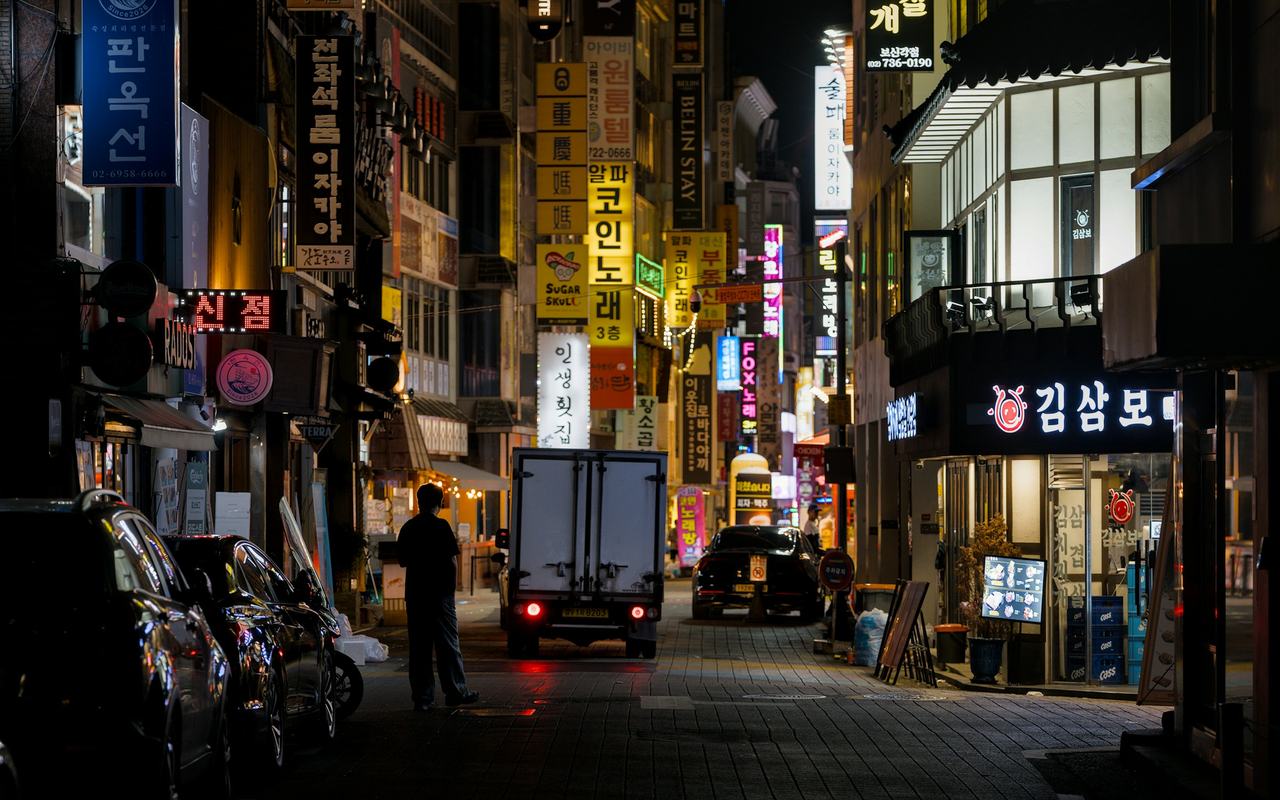
Opening photograph: A person stands in a narrow Seoul street at night under stacked signs. Photograph by Julien on Unsplash. Blog photo credits.