How to Order Street Food in Korean at a Seoul Stall
To order street food in Korean, name the food, add how many, and finish with juseyo: 떡볶이 하나 주세요 (one tteokbokki, please) or 어묵 두 개 주세요 (two fish cakes, please). In the course, the seller asks if you are eating there, and when you are done you ask the total with 다 해서 얼마예요?, how much is it all together? Hand over a note with 여기 만 원이요, here’s 10,000 won, and listen for your change. Below is the whole exchange from the course’s street food stall, both sides recorded.
Naming what you want
Three foods come up at the course’s stall, and each one uses a slightly different way of counting. Tteokbokki is ordered with hana, one. The course note describes it:
You say
떡볶이 하나 주세요.
tteokbokki hana juseyo.
One tteokbokki, please.
Spicy rice cakes, the classic street food.
Fish cakes, eomuk, are counted as things with gae. Two is du gae, three is se gae:
You say
어묵 두 개 주세요.
eomuk du gae juseyo.
Two fish cakes, please.
You say
어묵 세 개 주세요.
eomuk se gae juseyo.
Three fish cakes, please.
Kimbap has its own counter, and the course note explains it:
You say
김밥 한 줄 주세요.
gimbap han jul juseyo.
One kimbap roll, please.
줄: a line or roll, the counter for kimbap.
Why the difference? The course’s note on counting explains it: before a counter like gae, things, you use the short numbers han, du, se, ne, and with no counter you say 하나, 둘, 셋. The tteokbokki line has no counter, so it uses hana. The fish cakes have gae, so they use du and se. The kimbap has jul, so one roll is han jul.
You do not need to work this out at the stall. Learn the three lines as they are and change the number when you need to.
Ordering two things at once
Often you want more than one thing. To join two items, the course puts rang, and, after the first one. In the course, Minjun orders tteokbokki and fish cakes in one breath, and the seller asks her question:
Minjun, a friend, says
떡볶이 하나랑 어묵 두 개 주세요.
tteokbokki hanarang eomuk du gae juseyo.
One tteokbokki and two fish cakes, please.
The street food seller asks
네. 여기서 드세요?
ne. yeogiseo deuseyo?
Sure. Eating here?
The course teaches Minjun’s order as a phrase you can say yourself:
You say
떡볶이 하나랑 어묵 두 개 주세요.
tteokbokki hanarang eomuk du gae juseyo.
One tteokbokki and two fish cakes, please.
Why hanarang? The course’s café unit has a note on exactly this: irang goes after a consonant, and rang after a vowel, with hanarang as its example. Since hana ends in a vowel, it takes the short form.
Eating here or to go
The seller’s question in the exchange above is yeogiseo deuseyo?, which the course translates here as “eating here?” It is a yes or no question. In the course, Minjun answers with a plain ne, yes. If you say yes, the seller invites you to sit; if you want it to go, she packs it up:
The street food seller says
네, 여기 앉으세요.
ne, yeogi anjeuseyo.
Sure, have a seat here.
The street food seller says
네, 포장해 드릴게요.
ne, pojanghae deurilgeyo.
Sure, I’ll pack it to go.
Your two answers are the same as at a café: 먹고 갈게요, I’ll have it here, or 포장이요, to go. For more on this question and how it sounds, see for here or to go in Korean.
Asking the total and paying
When you are ready to pay, ask for one number for everything. Minjun does this straight after answering yes, and the seller gives the price:
Minjun, a friend, asks
네. 다 해서 얼마예요?
ne. da haeseo eolmayeyo?
Yes. How much is it all together?
The street food seller says
육천 원이에요.
yukcheon wonieyo.
6,000 won.
Yukcheon won is 6,000 won: yuk, six, and cheon, thousand. The course explanation for this scene confirms it. Asking for the total also saves you from adding up prices in your head, which helps when you have ordered in two or three rounds, one more fish cake at a time. Prices in won are a skill of their own; our guide on how to say prices in Korean won has more totals to practice with.
In the course’s role play, you hand over a 10,000 won note, and the seller gives you your change with the amount spoken out loud:
You say
여기 만 원이요.
yeogi man woniyo.
Here’s 10,000 won.
The street food seller says
네, 사천 원 받으세요.
ne, sacheon won badeuseyo.
Thanks, here’s 4,000 won back.
Sacheon won is 4,000 won, the difference between 10,000 and 6,000. The seller tells you the amount as she hands it over, so if you know your total, you can check the change by ear. If you want to say how you are paying before you hand anything over, the course’s line for cash is 현금으로 할게요, I’ll pay in cash.
One more, and pointing when you do not know the name
Street food is easy to want more of. To add one more of something, the course uses deo, more, with its own note:
You say
어묵 하나 더 주세요.
eomuk hana deo juseyo.
One more fish cake, please.
더: more.
The shape is the food, hana, deo, juseyo: fish cake, one, more, please. It works the same way for anything you have already ordered.
And if you do not know what something is called, point at it. The course’s line for that uses igeo, this, and the counter for things:
You say
이거 한 개 주세요.
igeo han gae juseyo.
One of these, please.
That line works at any stall where you can see the food. Point, say it, and hold up a finger if you want to be doubly clear. Our guide to ordering by pointing has more ways to use igeo.
The whole stall order, start to finish
Here is the exchange from your side, in the order it happens in the course:
- Order: 떡볶이 하나랑 어묵 두 개 주세요.
- Answer the seller’s question with ne to eat there, or 포장이요.
- Add more if you want it: 어묵 하나 더 주세요.
- Ask the total: 다 해서 얼마예요?.
- Pay: 여기 만 원이요, and listen for the change.
Every line on this page is a recording from Sori’s course. In the app you hear each line, say it out loud and see what it heard. Running through the five steps a few times before your trip is a good way to make the order come out without stopping to think.
Every line on this page
The 15 lines above, in order, for one last listen before you go. Each one is the recording from the Sori course.
떡볶이 하나 주세요.tteokbokki hana juseyo.One tteokbokki, please.
어묵 두 개 주세요.eomuk du gae juseyo.Two fish cakes, please.
어묵 세 개 주세요.eomuk se gae juseyo.Three fish cakes, please.
김밥 한 줄 주세요.gimbap han jul juseyo.One kimbap roll, please.
떡볶이 하나랑 어묵 두 개 주세요.tteokbokki hanarang eomuk du gae juseyo.One tteokbokki and two fish cakes, please.
네. 여기서 드세요?ne. yeogiseo deuseyo?Sure. Eating here?
떡볶이 하나랑 어묵 두 개 주세요.tteokbokki hanarang eomuk du gae juseyo.One tteokbokki and two fish cakes, please.
네, 여기 앉으세요.ne, yeogi anjeuseyo.Sure, have a seat here.
네, 포장해 드릴게요.ne, pojanghae deurilgeyo.Sure, I’ll pack it to go.
네. 다 해서 얼마예요?ne. da haeseo eolmayeyo?Yes. How much is it all together?
육천 원이에요.yukcheon wonieyo.6,000 won.
여기 만 원이요.yeogi man woniyo.Here’s 10,000 won.
네, 사천 원 받으세요.ne, sacheon won badeuseyo.Thanks, here’s 4,000 won back.
어묵 하나 더 주세요.eomuk hana deo juseyo.One more fish cake, please.
이거 한 개 주세요.igeo han gae juseyo.One of these, please.
Common questions
How do you order tteokbokki in Korean?
Say 떡볶이 하나 주세요, one tteokbokki, please. The course notes that tteokbokki are spicy rice cakes, the classic street food.
How do you say fish cake in Korean?
Fish cake is eomuk. Order with a count: 어묵 두 개 주세요 is two fish cakes, please, and 어묵 하나 더 주세요 is one more.
How do you ask “how much all together” in Korean?
Ask 다 해서 얼마예요?. The seller answers with the total in won, as in 육천 원이에요, 6,000 won.
How do you count kimbap in Korean?
Kimbap is counted in rolls with jul, which the course notes is a line or roll. One roll is 김밥 한 줄 주세요.
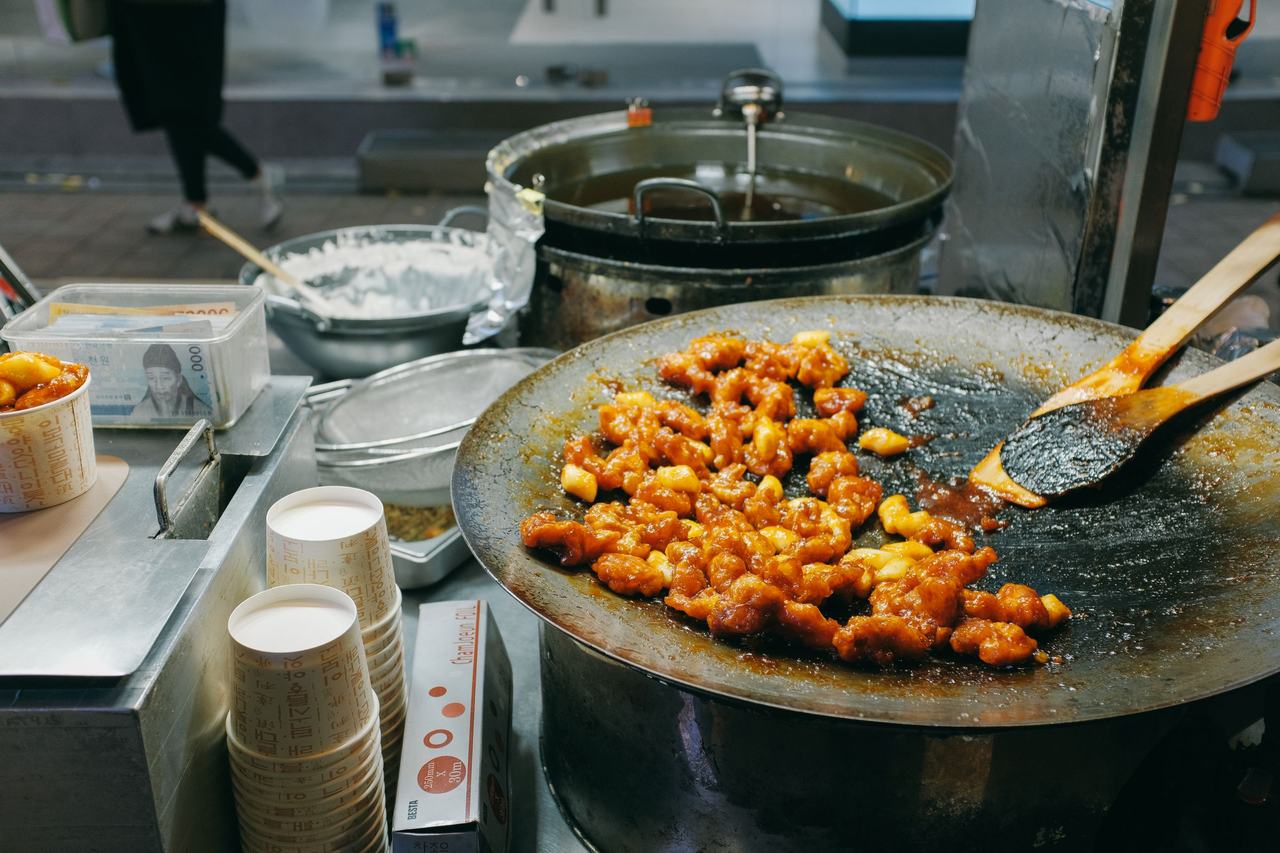
Opening photograph: Glossy, sauce-glazed fried bites sizzle in a wide pan at a Seoul street food stall beside stacks of paper cups. Photograph by Huy Phan on Pexels. Blog photo credits.