How to Order Food in Korean at a Seoul Restaurant
To order food in Korean, name the dish and add hana juseyo, “one, please”: 김치찌개 하나 주세요 gets you one kimchi stew, and 비빔밥 하나 주세요 gets you one bibimbap. Before you order, the owner asks how many are in your group, and the answer is a number plus myeongiyo, as in 두 명이요 for two people. Below is the whole arrival, from the door to the order, with every line recorded from Sori’s restaurant unit, where the owner of a small Seoul restaurant does the asking.
The first question at the door: how many of you
The owner greets you and counts your group in the same breath. The greeting is eoseo oseyo, welcome. The question is myeot buniseyo, how many of you.
The restaurant owner asks
어서 오세요. 몇 분이세요?
eoseo oseyo. myeot buniseyo?
Welcome. How many of you?
You say
두 명이요.
du myeongiyo.
Two of us.
The course notes a small detail that makes this easier to hear: 분 is the polite word for people, and you answer with 명. So the question has bun in it, and your answer has myeong.
For a group of three or four, only the number changes:
You say
세 명이요.
se myeongiyo.
Three of us.
You say
네 명이요.
ne myeongiyo.
Four of us.
The numbers here are du, se and ne. The course explains why: before a counter word like 명 (people), you count han, du, se, ne. Notice that four, ne, sounds the same as ne, yes, so say the whole line, ne myeongiyo, rather than the number alone.
If you are eating on your own, the answer is 혼자예요. There is a full guide for that in eating alone in Seoul.
Being seated and asking for the menu
Next the owner shows you where to sit with ijjogeuro anjeuseyo, have a seat over here. You can answer with a simple ne, yes, as you sit down. Once you are sitting, ask for the menu.
The restaurant owner says
이쪽으로 앉으세요.
ijjogeuro anjeuseyo.
Have a seat over here.
You say
메뉴판 좀 주세요.
menyupan jom juseyo.
Could we have the menu, please?
좀 softens a request, like please.
The restaurant owner says
네, 여기 있습니다.
ne, yeogi itseumnida.
Sure, here you are.
The menu line is worth learning whole. Menyupan is the menu, jom softens the request, and juseyo at the end asks for it. The owner’s reply, ne, yeogi itseumnida, means “sure, here you are.” The course uses the same words again when someone hands you what you asked for, so it is a good one to recognize.
When the owner asks if you are ready
After a minute or two, the owner comes back to take the order. In the course this comes as one short question:
The restaurant owner asks
주문하시겠어요?
jumunhasigesseoyo?
Are you ready to order?
Jumunhasigesseoyo is long, but you only need to catch it, not say it. It means “are you ready to order?” If you are still deciding, 잠깐만요 asks for a moment. The course notes it also works as “excuse me” when you need someone to wait.
You may also hear the shorter mwo deurilkkayo, what can I get you. It is the same question a barista asks at a Seoul café counter, and it wants the same kind of answer: the thing you want, plus juseyo.
Ordering a dish: the name plus hana juseyo
The pattern is short. Name the dish, add hana, one, and finish with juseyo. The course puts the rule plainly in its café unit: anything plus juseyo means “please give me.” Here is the exchange from the restaurant lesson, with the owner repeating the order back:
The restaurant owner asks
뭐 드릴까요?
mwo deurilkkayo?
What can I get you?
You say
김치찌개 하나 주세요.
gimchijjigae hana juseyo.
One kimchi stew, please.
The restaurant owner says
네, 김치찌개 하나요.
ne, gimchijjigae hanayo.
Okay, one kimchi stew.
That last line, ne, gimchijjigae hanayo, is the owner checking: “okay, one kimchi stew.” If you hear your dish and hanayo, you have been understood.
The course menu has two more dishes, and they work exactly the same way:
You say
된장찌개 하나 주세요.
doenjangjjigae hana juseyo.
One soybean paste stew, please.
You say
비빔밥 하나 주세요.
bibimbap hana juseyo.
One bibimbap, please.
Doenjangjjigae is soybean paste stew. Bibimbap needs no translation for most travelers. Why hana and not han? The course note on counting says that with no counter word after it, you count 하나, 둘, 셋: one, two, three. In these orders nothing follows the number except juseyo, so it is hana.
If two of you want different dishes, order each one with its own line, one after the other, and listen for each dish coming back with hanayo. If you want to point instead of reading the menu aloud, see ordering by pointing.
Kimchi stew comes with a warning in the course: the owner tells the customer it is a bit spicy and asks if that is okay. What to say then, including how to ask for it less spicy, is in how to ask for less spicy food in Korean.
The whole arrival, start to finish
Here is the sequence the way it runs in the course, with what you say at each step:
- The owner says eoseo oseyo. myeot buniseyo? You say du myeongiyo, or your own number.
- The owner says ijjogeuro anjeuseyo. You sit down.
- You ask menyupan jom juseyo. The owner says ne, yeogi itseumnida.
- The owner asks jumunhasigesseoyo? or mwo deurilkkayo? You say the dish plus hana juseyo.
- The owner repeats it: ne, gimchijjigae hanayo. You say ne.
That is five short exchanges, and you only have to produce three lines of your own: your number, the menu request and the dish. The hard part is catching the owner’s questions at full speed, especially myeot buniseyo as you walk in.
Every line on this page is a recording from Sori’s course. In the app, you hear each line, say it out loud, and see what it heard, which is a good way to make du myeongiyo come out before you have time to think.
Every line on this page
The 13 lines above, in order, for one last listen before you go. Each one is the recording from the Sori course.
어서 오세요. 몇 분이세요?eoseo oseyo. myeot buniseyo?Welcome. How many of you?
두 명이요.du myeongiyo.Two of us.
세 명이요.se myeongiyo.Three of us.
네 명이요.ne myeongiyo.Four of us.
이쪽으로 앉으세요.ijjogeuro anjeuseyo.Have a seat over here.
메뉴판 좀 주세요.menyupan jom juseyo.Could we have the menu, please?
네, 여기 있습니다.ne, yeogi itseumnida.Sure, here you are.
주문하시겠어요?jumunhasigesseoyo?Are you ready to order?
뭐 드릴까요?mwo deurilkkayo?What can I get you?
김치찌개 하나 주세요.gimchijjigae hana juseyo.One kimchi stew, please.
네, 김치찌개 하나요.ne, gimchijjigae hanayo.Okay, one kimchi stew.
된장찌개 하나 주세요.doenjangjjigae hana juseyo.One soybean paste stew, please.
비빔밥 하나 주세요.bibimbap hana juseyo.One bibimbap, please.
Common questions
How do you say “table for two” in Korean?
The course has no separate word for the table. When the owner asks myeot buniseyo, you answer with the number of people: 두 명이요, two of us. For three or four, say 세 명이요 or 네 명이요.
What does “myeot buniseyo” mean?
It means “how many of you?” and it is what you hear at the door. The course notes that 분 is the polite word for people, and that you answer with 명, as in du myeongiyo.
How do you say “one bibimbap, please” in Korean?
Say 비빔밥 하나 주세요. The same shape works for the other dishes in the course: 김치찌개 하나 주세요 for kimchi stew and 된장찌개 하나 주세요 for soybean paste stew.
How do I ask for the menu in Korean?
Say 메뉴판 좀 주세요. Menyupan is the menu, and the course notes that jom softens a request, like please.
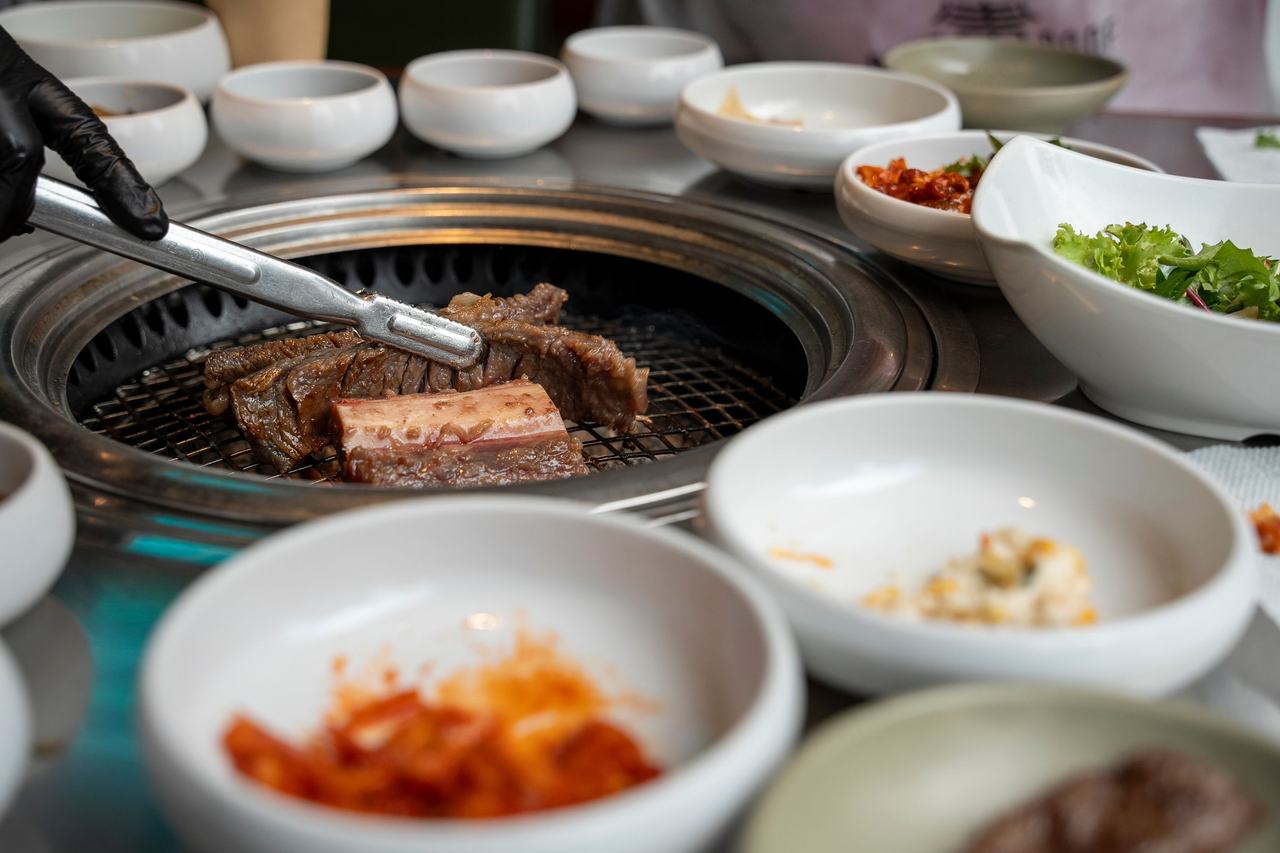
Opening photograph: Ribs sizzle on a tabletop grill surrounded by small bowls of side dishes at a Korean barbecue restaurant in Seoul. Photograph by Pincalo on Pexels. Blog photo credits.