How to Say and Understand Prices in Korean Won
Korean prices in won are built from three units: baek (100), cheon (1,000) and man (10,000), with a Sino-Korean number in front of each. So 오천 원이에요 is “it’s 5,000 won,” and 만 오천 원이에요 is “it’s 15,000 won,” literally one ten-thousand and five thousand. The key thing for English speakers is that Korean counts in ten thousands, so anything from 10,000 up starts with how many man it is: man for 10,000, iman for 20,000. When a total comes fast, say it back as a question, 만 오천 원이요?, and the cashier will confirm it.
The three building blocks: baek, cheon and man
Every price on this page is made from the same few pieces. The course gives you the two most important facts in its notes on the round numbers:
You say
천 원이에요.
cheon wonieyo.
It’s 1,000 won.
천, 백 and 만 are said without 일 in front.
You say
만 원이에요.
man wonieyo.
It’s 10,000 won.
Korean counts in ten thousands: 만 is 10,000.
So 1,000 is just cheon, not “one thousand,” and 10,000 is just man. Put a number in front of a unit to multiply it: ocheon is five thousand, iman is twenty thousand. Then add the pieces together from largest to smallest, the way you read a price tag.
The numbers in front are the Sino-Korean set. The course notes that prices in won use 일, 이, 삼, not the native numbers you use for counting cups or people. If you want the full picture of the two systems, see native vs Sino Korean numbers.
Round amounts: from 1,000 to 20,000 won
Here are the round prices from the course, smallest to largest. Listen for the unit at the end of each number, because that tells you the size of the price before you have worked out the rest:
You say
천 원이에요.
cheon wonieyo.
It’s 1,000 won.
You say
오천 원이에요.
ocheon wonieyo.
It’s 5,000 won.
Once a price reaches ten thousand, man comes first. The course’s taxi scene spells it out: the driver says man icheon, and the course explains that man is 10,000 and icheon is 2,000, so 12,000 won.
You say
만 원이에요.
man wonieyo.
It’s 10,000 won.
You say
만 이천 원이에요.
man icheon wonieyo.
It’s 12,000 won.
You say
만 오천 원이에요.
man ocheon wonieyo.
It’s 15,000 won.
You say
이만 원이에요.
iman wonieyo.
It’s 20,000 won.
Notice that 20,000 is iman, two ten-thousands. In English you think “twenty thousand,” but in Korean there is no word for twenty in it at all. That is the shift to practice: from 10,000 up, count how many man there are first.
Prices with hundreds: 4,500, 7,800 and 12,500
Real totals are not always round. In the course, both the café and the convenience store give totals with hundreds in them, and those prices get long. The café unit uses this one for a coffee:
You say
사천오백 원이에요.
sacheonobaek wonieyo.
It’s 4,500 won.
Break it into pieces: sa four, cheon thousand, o five, baek hundred. Four thousand five hundred. At the convenience store, Junho, the clerk, gives a longer one for Jimin’s snacks:
Junho, the store clerk, says
칠천팔백 원입니다.
chilcheonpalbaek wonimnida.
That’s 7,800 won.
That is chilcheon, seven thousand, and palbaek, eight hundred: 7,800 won. And at the café, in the role play, the barista adds up a total with all three units in it:
Jimin, the barista, says
네, 만 이천오백 원이에요.
ne, man icheonobaek wonieyo.
Okay, that’s 12,500 won.
Man, icheon, obaek: 10,000 plus 2,000 plus 500. If you only catch the first word, you still know the total is between ten and twenty thousand, which is often enough to hand over the right note.
Three ways a price can end
Listen to the end of each total in the course and you will hear three different endings. They all mean the same thing, “that’s this much,” so you do not need to understand the difference to pay. You only need to recognize where the number stops.
The most common one in the course is wonieyo, as in the lines above. The convenience store clerk uses wonimnida, as in chilcheonpalbaek wonimnida. And the taxi driver at the end of a ride says won nawatseumnida, which the course translates simply as “that’s”:
The taxi driver says
네, 만 사천 원 나왔습니다.
ne, man sacheon won nawatseumnida.
Okay. That’s 14,000 won.
Bigger prices follow the same pattern. In the clothes shop, Daeun gives the price of a sweater, with samman, three ten-thousands, and gucheon, nine thousand:
Daeun, the shop assistant, says
삼만 구천 원이에요.
samman gucheon wonieyo.
It’s 39,000 won.
Checking the price and asking the total
When a number goes by too fast, do not guess. The course gives you a simple way to check: say the price back to the cashier with a question in your voice.
You ask
만 오천 원이요?
man ocheon woniyo?
15,000 won?
Saying the price back to check it.
In the course’s taxi scene, it works like this. The driver gives the fare, you check it, and he confirms:
The taxi driver says
만 오천 원이에요.
man ocheon wonieyo.
15,000 won.
You ask
만 오천 원이요?
man ocheon woniyo?
15,000 won?
The taxi driver says
네, 만 오천 원이요.
ne, man ocheon woniyo.
Yes, 15,000 won.
If you are buying several things and want one number, ask for the total. This is the line Minjun uses at the street food stall:
You ask
다 해서 얼마예요?
da haeseo eolmayeyo?
How much is it all together?
The last number you hear is your change. At the stall, the total is 6,000 won. You hand over a 10,000 won note with the line below, and the seller hands back the difference with a price in the same form, followed by badeuseyo. The course translates her line as “here’s 4,000 won back”:
You say
여기 만 원이요.
yeogi man woniyo.
Here’s 10,000 won.
The street food seller says
네, 사천 원 받으세요.
ne, sacheon won badeuseyo.
Thanks, here’s 4,000 won back.
Sacheon won is 4,000 won, which is exactly what you expected back. Hearing it confirmed is a good habit to build, because you can check the change without counting it out at the counter.
Every line on this page is a recording from Sori’s course. In the app you hear each line, say it out loud and see what it heard. Saying prices yourself is a good way to start hearing them: once man ocheon has come out of your own mouth a few times, it is much easier to catch when a cashier says it.
Every line on this page
The 17 lines above, in order, for one last listen before you go. Each one is the recording from the Sori course.
천 원이에요.cheon wonieyo.It’s 1,000 won.
만 원이에요.man wonieyo.It’s 10,000 won.
오천 원이에요.ocheon wonieyo.It’s 5,000 won.
만 이천 원이에요.man icheon wonieyo.It’s 12,000 won.
만 오천 원이에요.man ocheon wonieyo.It’s 15,000 won.
이만 원이에요.iman wonieyo.It’s 20,000 won.
사천오백 원이에요.sacheonobaek wonieyo.It’s 4,500 won.
칠천팔백 원입니다.chilcheonpalbaek wonimnida.That’s 7,800 won.
네, 만 이천오백 원이에요.ne, man icheonobaek wonieyo.Okay, that’s 12,500 won.
네, 만 사천 원 나왔습니다.ne, man sacheon won nawatseumnida.Okay. That’s 14,000 won.
삼만 구천 원이에요.samman gucheon wonieyo.It’s 39,000 won.
만 오천 원이요?man ocheon woniyo?15,000 won?
만 오천 원이에요.man ocheon wonieyo.15,000 won.
네, 만 오천 원이요.ne, man ocheon woniyo.Yes, 15,000 won.
다 해서 얼마예요?da haeseo eolmayeyo?How much is it all together?
여기 만 원이요.yeogi man woniyo.Here’s 10,000 won.
네, 사천 원 받으세요.ne, sacheon won badeuseyo.Thanks, here’s 4,000 won back.
Common questions
How do you say 10,000 won in Korean?
Say 만 원이에요. The course notes that Korean counts in ten thousands and that 만, ten thousand, is said without 일 in front.
What does man mean in Korean prices?
Man is 10,000. Prices of ten thousand won or more are counted in man: 만 오천 원이에요 is one man and five thousand, 15,000 won, and iman, two man, is 20,000.
How do you ask how much something is in Korean?
Ask 얼마예요?, or point and ask 이거 얼마예요?, how much is this? For several things at once, ask 다 해서 얼마예요?.
How do I check a price I did not catch?
Say the price back as a question, as in 만 오천 원이요?. The course notes that this is how you check a price, and the cashier will confirm it or correct you.
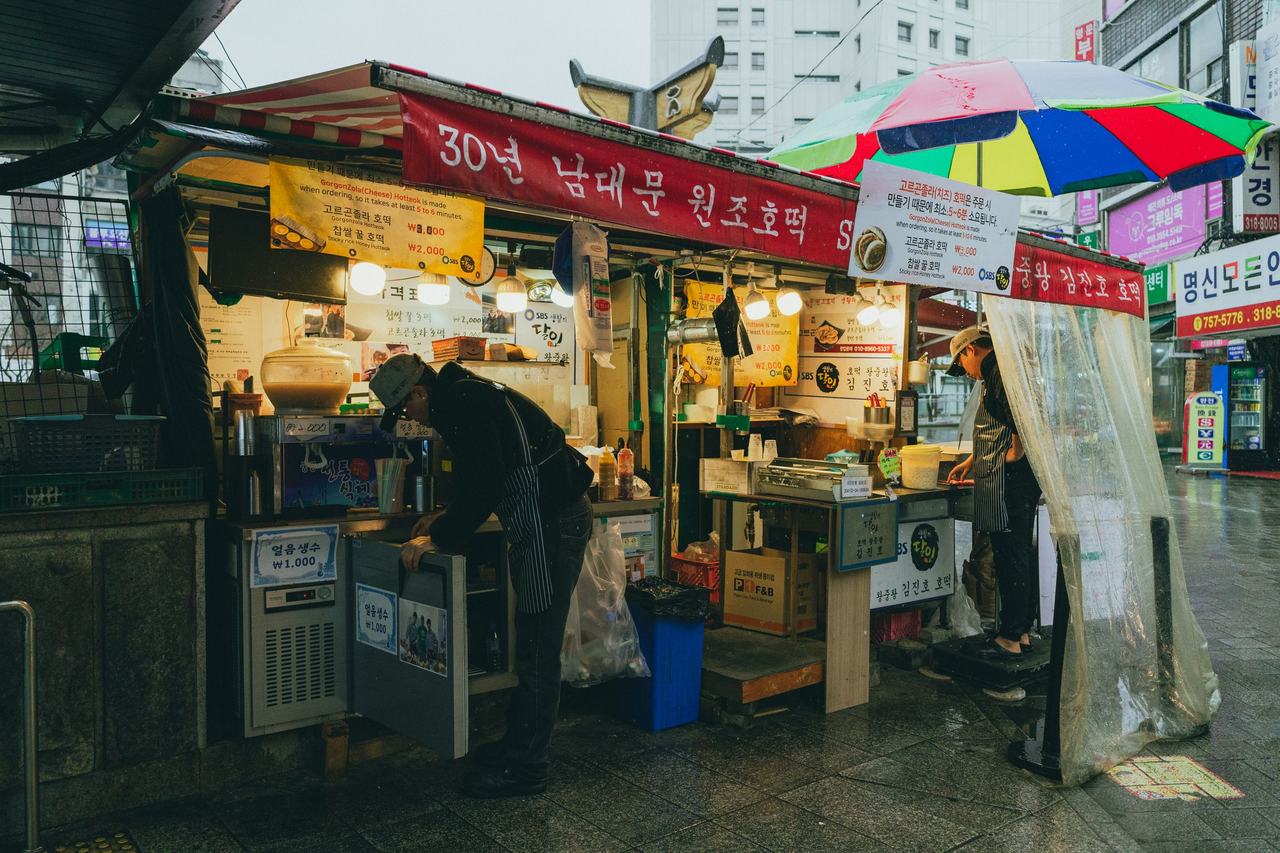
Opening photograph: Vendors work at a covered street food stall under a red banner on a rainy market street in Seoul. Photograph by Theodore Nguyen on Pexels. Blog photo credits.