What to Say After a Meal in Korea
Jal meogeotseumnida means “thank you for the meal.” The course calls it a set phrase, said as you leave a restaurant, or to whoever paid: 잘 먹었습니다. You will see it spelled a few different ways in English letters, and this page uses the spelling the app shows. Below is everything else that tends to be said at the end of a meal in the course, too: how to say the food was delicious, what the owner asks you, and the replies, all with recordings from Sori’s restaurant unit.
What jal meogeotseumnida means and when to say it
The phrase is a fixed expression, and you say it as it is. The course’s note sets out the two moments it belongs to:
You say
잘 먹었습니다.
jal meogeotseumnida.
Thank you for the meal.
A set phrase: said as you leave a restaurant, or to whoever paid.
The first moment is leaving a restaurant. In the course’s restaurant scene, the customer walks up to the counter and opens with it, before asking for the bill:
Minjun, a friend, says
잘 먹었습니다. 계산해 주세요.
jal meogeotseumnida. gyesanhae juseyo.
Thank you for the meal. The bill, please.
Gyesanhae juseyo, after it, is “I’d like to pay, please.” Putting the two together is a natural way to finish a meal: thanks first, then the bill.
The second moment is when someone else has paid. If a Korean friend or coworker treats you, jal meogeotseumnida is what you say to them. It is the same phrase, with the same meaning: thank you for the meal.
Saying the food is delicious
While you are still eating, the word for delicious is short:
You say
맛있어요.
masisseoyo.
It’s delicious.
Masisseoyo means “it’s delicious.” It is a good word to have ready if the owner passes your table, or if a friend asks what you think of a dish. The past version, masisseosseoyo, it was delicious, comes in the next section as the answer to the owner’s question.
When the owner asks “did you enjoy your meal?”
At the counter, the owner may ask how the meal was. Here is the exchange from the course’s role play, with the customer’s answer and the owner’s reply:
The restaurant owner asks
맛있게 드셨어요?
masitge deusyeosseoyo?
Did you enjoy your meal?
You say
네, 정말 맛있었어요.
ne, jeongmal masisseosseoyo.
Yes, it was really good.
The restaurant owner says
다행이에요.
dahaengieyo.
I’m glad.
Masitge deusyeosseoyo means “did you enjoy your meal?” The answer, ne, jeongmal masisseosseoyo, is “yes, it was really good.” Jeongmal means really. The owner’s dahaengieyo means “I’m glad.” In another unit, the course uses the same word for “that’s a relief,” and notes that 다행 is good fortune, said when a worry turns out well.
The difference between this section and the last is simple. While you eat, the food is delicious: masisseoyo. Once you have finished, it was really good: jeongmal masisseosseoyo.
“Enjoy” from the person serving you
You hear masit at the start of another line, the one staff say as they hand food over. In the course, the convenience store clerk says it with your chopsticks:
Junho, the store clerk, says
여기 있습니다. 맛있게 드세요.
yeogi itseumnida. masitge deuseyo.
Here you are. Enjoy.
Yeogi itseumnida means “here you are,” and masitge deuseyo means “enjoy.” The polite thank-you is the natural reply: the course notes that gamsahamnida is a set phrase, the polite thank you, for anyone.
You say
감사합니다.
gamsahamnida.
Thank you.
A set phrase: the polite thank you, for anyone.
The goodbye at the counter
After you pay, the owner sees you off. In the course, it sounds like this:
The restaurant owner says
감사합니다. 또 오세요.
gamsahamnida. tto oseyo.
Thank you. Come again.
You say
안녕히 계세요.
annyeonghi gyeseyo.
Goodbye. (You are leaving.)
Said by the one who leaves to the one who stays: stay in peace.
Gamsahamnida. Tto oseyo means “thank you, come again.” You answer with annyeonghi gyeseyo, the goodbye for the person leaving. The course explains that it is said by the one who leaves to the one who stays. If you are not sure which goodbye is which, see how to say goodbye in Korean. Saying jal meogeotseumnida on the way out works here too, since the course notes it is said as you leave a restaurant.
If someone asks whether you like Korean food
Over a meal with Korean friends or coworkers, you may be asked this, and the course has the question along with two easy answers:
You ask
한국 음식 좋아해요?
hanguk eumsik joahaeyo?
Do you like Korean food?
You say
네, 정말 좋아해요.
ne, jeongmal joahaeyo.
Yes, I do, very much.
You say
매운 음식 좋아해요.
maeun eumsik joahaeyo.
I like spicy food.
Hanguk eumsik joahaeyo asks “do you like Korean food?” The course notes that the same words ask and answer: with a question mark it is “do you like it?” and without, “I like it.” Ne, jeongmal joahaeyo is “yes, I do, very much,” and maeun eumsik joahaeyo is “I like spicy food.” For more on likes and dislikes, see how to talk about what you like in Korean.
The end of a meal in four lines
If you learn only four lines for the end of a meal, make it these:
- Masisseoyo: it’s delicious, while you eat.
- Ne, jeongmal masisseosseoyo: yes, it was really good, when the owner asks.
- Jal meogeotseumnida: thank you for the meal, as you leave or to whoever paid.
- Annyeonghi gyeseyo: goodbye, as the one leaving.
Every line on this page is a recording from Sori’s course. In the app you hear each line, say it out loud and see what it heard, which helps most with the long one, jal meogeotseumnida.
Every line on this page
The 13 lines above, in order, for one last listen before you go. Each one is the recording from the Sori course.
잘 먹었습니다.jal meogeotseumnida.Thank you for the meal.
잘 먹었습니다. 계산해 주세요.jal meogeotseumnida. gyesanhae juseyo.Thank you for the meal. The bill, please.
맛있어요.masisseoyo.It’s delicious.
맛있게 드셨어요?masitge deusyeosseoyo?Did you enjoy your meal?
네, 정말 맛있었어요.ne, jeongmal masisseosseoyo.Yes, it was really good.
다행이에요.dahaengieyo.I’m glad.
여기 있습니다. 맛있게 드세요.yeogi itseumnida. masitge deuseyo.Here you are. Enjoy.
감사합니다.gamsahamnida.Thank you.
감사합니다. 또 오세요.gamsahamnida. tto oseyo.Thank you. Come again.
안녕히 계세요.annyeonghi gyeseyo.Goodbye. (You are leaving.)
한국 음식 좋아해요?hanguk eumsik joahaeyo?Do you like Korean food?
네, 정말 좋아해요.ne, jeongmal joahaeyo.Yes, I do, very much.
매운 음식 좋아해요.maeun eumsik joahaeyo.I like spicy food.
Common questions
What does jal meogeotseumnida mean?
It means “thank you for the meal.” The course calls it a set phrase, said as you leave a restaurant, or to whoever paid. Hear it and say it with 잘 먹었습니다.
When do you say jal meogeotseumnida?
At the end, not the start. The course gives two moments: as you leave a restaurant, and to whoever paid for your meal. In the course’s restaurant scene, the customer says it at the counter before asking for the bill.
How do you say “it was delicious” in Korean?
Say 네, 정말 맛있었어요, “yes, it was really good.” It is the answer when the owner asks masitge deusyeosseoyo, did you enjoy your meal. While you are still eating, say 맛있어요, it’s delicious.
What does masitge deuseyo mean?
It means “enjoy.” In the course, the convenience store clerk says it while handing over chopsticks for a lunch box. A simple gamsahamnida, thank you, is the reply.
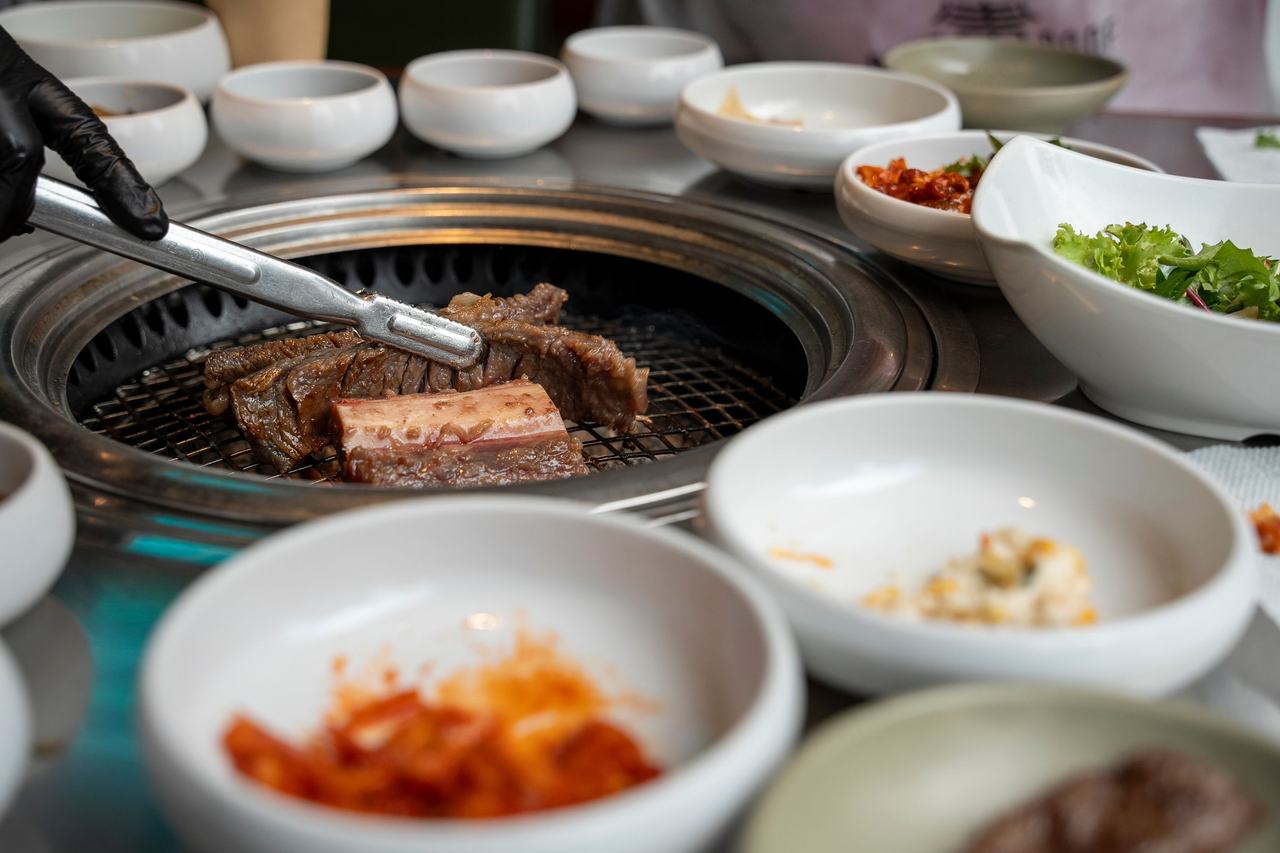
Opening photograph: Ribs sizzle on a tabletop grill surrounded by small bowls of side dishes at a Korean barbecue restaurant in Seoul. Photograph by Pincalo on Pexels. Blog photo credits.