Asking for Water and Side Dishes in Korean
To ask for more side dishes in Korean, say 반찬 좀 더 주세요, “some more side dishes, please.” For more kimchi, it is 김치 좀 더 주세요. The course notes that 반찬, the side dishes, are free and refilled when you ask. Water works the same way, 물 좀 주세요, but be ready for a common answer: mureun selpeuyeyo, “water’s self-service.” Here is every mid-meal request from Sori’s restaurant unit, with the owner’s replies recorded too.
Getting the owner’s attention
Many Korean restaurants have a small call bell on the table for signaling staff, so look for one first. If there is no bell, you call out. In the course, the customer starts the request with yeogiyo, which the course translates here as “excuse me,” and then says what they need in the same breath:
You say
여기요, 물 좀 주세요.
yeogiyo, mul jom juseyo.
Excuse me, some water, please.
The restaurant owner asks
네, 뭐 필요하세요?
ne, mwo piryohaseyo?
Yes, what do you need?
The owner’s reply, ne, mwo piryohaseyo, means “yes, what do you need?” You may skip that step entirely if you say the whole request at once, as in the line above. There is more on the two attention words in yeogiyo vs jeogiyo.
Asking for water, and what “water is self” means
The basic request is short. The course’s own note on it already tells you what to expect back:
You say
물 좀 주세요.
mul jom juseyo.
Some water, please.
Water is often self-service: 물은 셀프예요.
The restaurant owner says
물은 셀프예요. 저기 정수기에 있어요.
mureun selpeuyeyo. jeogi jeongsugie isseoyo.
Water’s self-service. It’s at the water dispenser over there.
Mureun selpeuyeyo means water is self-service. Selpeu is the English word “self,” said the Korean way. The owner then points you to the jeongsugi, which the course explains is the water dispenser, over there. In the role play the owner says a shorter version, without naming the dispenser:
The restaurant owner says
물은 셀프예요. 저기 있어요.
mureun selpeuyeyo. jeogi isseoyo.
Water’s self-service. It’s over there.
Jeogi isseoyo is “it’s over there.” If you hear selpeu, there is nothing more to say than ne, and you go and get it yourself. Self-service water and utensils are common in Korean restaurants, so it is worth looking around for a dispenser and a utensil box before you wait for staff.
More side dishes and more kimchi
This is the request the course is clearest about: side dishes are free and refilled when you ask. The pattern is the item, then jom deo juseyo. The course notes that jom softens a request, like please, and that deo means more.
You say
반찬 좀 더 주세요.
banchan jom deo juseyo.
Some more side dishes, please.
반찬, the side dishes, are free and refilled when you ask.
You say
김치 좀 더 주세요.
gimchi jom deo juseyo.
Some more kimchi, please.
Here is the moment in the restaurant scene. The customer has just been told water is self-service, takes it in stride, and asks for more side dishes:
Jimin, the barista, says
아, 네. 그리고 반찬 좀 더 주세요.
a, ne. geurigo banchan jom deo juseyo.
Oh, okay. And some more side dishes, please.
The restaurant owner says
네, 갖다 드릴게요.
ne, gatda deurilgeyo.
Sure, I’ll bring some.
A, ne is “oh, okay.” Geurigo is “and.” The owner’s answer, ne, gatda deurilgeyo, means “sure, I’ll bring some.” When you hear gatda deurilgeyo, your refill is on its way.
Napkins and another pair of chopsticks
Two small requests use the same building blocks. For napkins, the word is not the English one:
You say
휴지 좀 주세요.
hyuji jom juseyo.
Some napkins, please.
휴지: tissue, what Koreans call napkins at the table.
You say
젓가락 하나 더 주세요.
jeotgarak hana deo juseyo.
Another pair of chopsticks, please.
Hyuji, as the course notes, means tissue, and it is what Koreans call napkins at the table. For chopsticks, jeotgarak hana deo juseyo asks for one more pair: hana is one and deo is more, so the line is literally “chopsticks, one more, please.” It is the line to use when a friend joins you or a pair ends up on the floor.
If chopsticks and spoons sit in a box on the table or by the dispenser, you can of course just take them. The line is for when there are none in sight.
When the owner asks if you need anything else
After bringing something, the owner may check whether there is more. The role play asks it like this:
The restaurant owner asks
또 필요한 거 있으세요?
tto piryohan geo isseuseyo?
Anything else?
You say
괜찮아요.
gwaenchanayo.
It’s okay.
Also no thanks, or I’m fine.
Tto piryohan geo isseuseyo means “anything else?” If you are fine, the course gives you an easy answer, gwaenchanayo. Its note says it also means “no thanks” or “I’m fine,” which is exactly what you want here. If you do want something, name it with jom juseyo or jom deo juseyo, and the owner’s ne, gatda deurilgeyo tells you it is coming.
When it arrives, a thank-you rounds it off. The course’s note on 감사합니다 calls it a set phrase, the polite thank you, for anyone, so it is the safe choice with a restaurant owner you have just met.
The short list for the table
Most of what you need mid-meal comes down to one pattern: the thing, then jom juseyo or jom deo juseyo. Keep these five in mind:
- Water: mul jom juseyo, and listen for selpeu.
- More side dishes: banchan jom deo juseyo.
- More kimchi: gimchi jom deo juseyo.
- Napkins: hyuji jom juseyo.
- Another pair of chopsticks: jeotgarak hana deo juseyo.
Every line on this page is a recording from Sori’s course. In the app you hear each line, say it out loud and see what it heard, which helps with the one part that is hard to fake: catching the owner’s reply when it comes back quickly. When you are done eating, the next step is paying and splitting the bill.
Every line on this page
The 13 lines above, in order, for one last listen before you go. Each one is the recording from the Sori course.
여기요, 물 좀 주세요.yeogiyo, mul jom juseyo.Excuse me, some water, please.
네, 뭐 필요하세요?ne, mwo piryohaseyo?Yes, what do you need?
물 좀 주세요.mul jom juseyo.Some water, please.
물은 셀프예요. 저기 정수기에 있어요.mureun selpeuyeyo. jeogi jeongsugie isseoyo.Water’s self-service. It’s at the water dispenser over there.
물은 셀프예요. 저기 있어요.mureun selpeuyeyo. jeogi isseoyo.Water’s self-service. It’s over there.
반찬 좀 더 주세요.banchan jom deo juseyo.Some more side dishes, please.
김치 좀 더 주세요.gimchi jom deo juseyo.Some more kimchi, please.
아, 네. 그리고 반찬 좀 더 주세요.a, ne. geurigo banchan jom deo juseyo.Oh, okay. And some more side dishes, please.
네, 갖다 드릴게요.ne, gatda deurilgeyo.Sure, I’ll bring some.
휴지 좀 주세요.hyuji jom juseyo.Some napkins, please.
젓가락 하나 더 주세요.jeotgarak hana deo juseyo.Another pair of chopsticks, please.
또 필요한 거 있으세요?tto piryohan geo isseuseyo?Anything else?
괜찮아요.gwaenchanayo.It’s okay.
Common questions
Are side dishes free in Korean restaurants?
The course says so in its note: 반찬, the side dishes, are free and refilled when you ask. To ask for a refill, say 반찬 좀 더 주세요, or name the dish, as in 김치 좀 더 주세요.
What does “mureun selpeuyeyo” mean?
It means “water’s self-service.” Selpeu is the English word “self.” In the course, the owner then points to the water dispenser, the jeongsugi, or simply says jeogi isseoyo, “it’s over there.”
How do you say “napkin” in Korean?
At the table, the word is hyuji, which means tissue. The course notes that this is what Koreans call napkins at the table. Ask with 휴지 좀 주세요.
How do you call a waiter in a Korean restaurant?
Look for a call bell on the table first, since many restaurants have one. Otherwise, start your request with yeogiyo, as in 여기요, 물 좀 주세요, “excuse me, some water, please.”
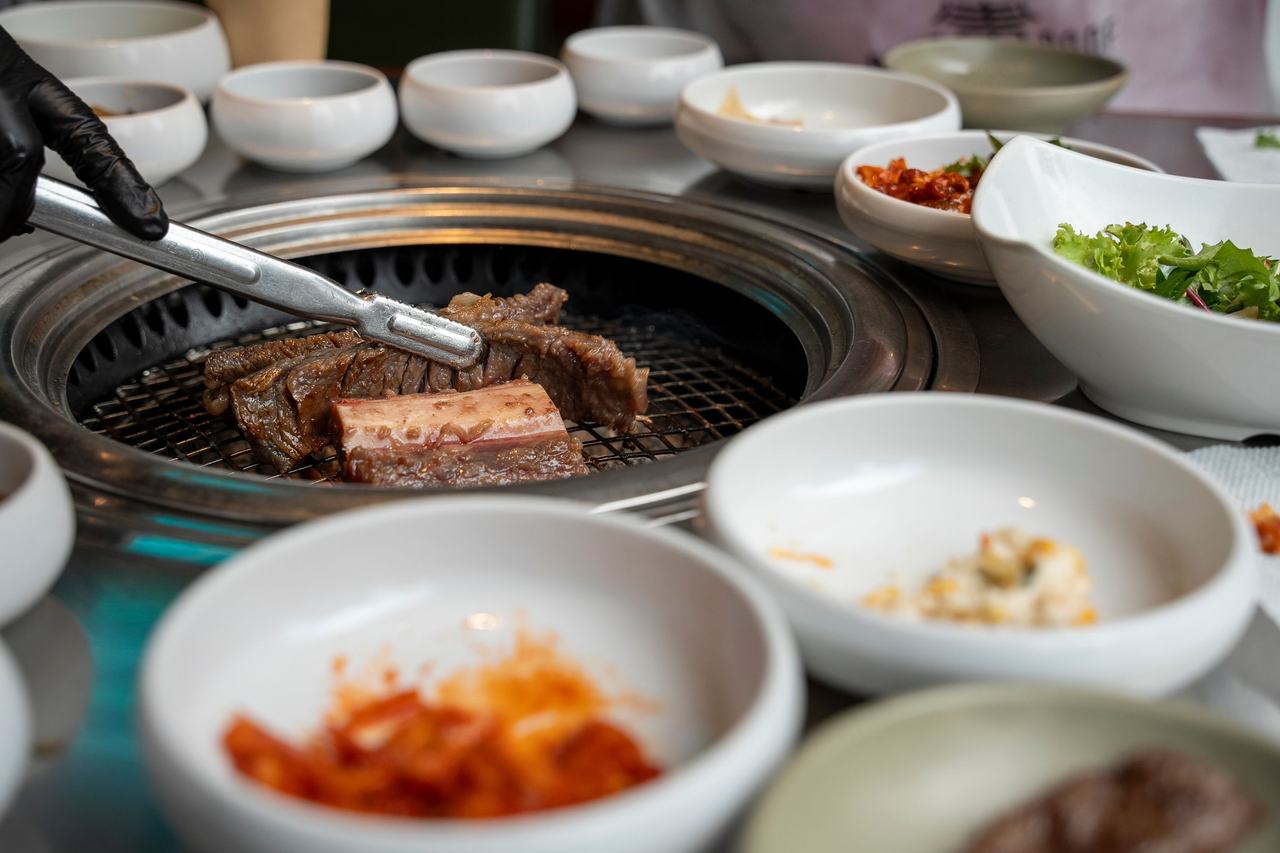
Opening photograph: Ribs sizzle on a tabletop grill surrounded by small bowls of side dishes at a Korean barbecue restaurant in Seoul. Photograph by Pincalo on Pexels. Blog photo credits.