Trying On Clothes in Korean: Sizes and Fitting Rooms
To ask “can I try this on?” in Korean, hold up the item and say 입어 봐도 돼요?. For shoes the verb changes, so it is 이 신발 신어 봐도 돼요?, “can I try these shoes on?” Once you have tried it, the size lines are short: 좀 작아요 for “it’s a bit small,” and 더 큰 사이즈 있어요? for “do you have a bigger size?” Here is the whole fitting room sequence from Sori’s shopping unit, with the shop assistant’s questions and answers recorded too.
Asking to try it on
The line asks permission, may I try?, so hold the item up or point at it as you ask:
You ask
입어 봐도 돼요?
ibeo bwado dwaeyo?
Can I try it on?
입다: to wear. -어 봐도 돼요?: may I try?
Daeun, the shop assistant, says
네, 탈의실은 저쪽이에요.
ne, taruisireun jeojjogieyo.
Sure, the fitting room is over there.
Ibeo bwado dwaeyo means “can I try it on?” The course notes that 입다 means to wear, and that the ending means “may I try?” In the course scene, the customer says igeo first: igeo ibeo bwado dwaeyo, can I try this on? The dwaeyo at the end is the same word you use to ask whether a shop takes cards. The course notes that dwaeyo? asks whether something works or is allowed.
The assistant’s answer, ne, taruisireun jeojjogieyo, is “sure, the fitting room is over there.” 탈의실 is the fitting room and jeojjok is over there. If you hear jeojjok, look where the assistant is pointing.
Shoes take a different verb
The course points out that shoes take a different verb from clothes:
You ask
이 신발 신어 봐도 돼요?
i sinbal sineo bwado dwaeyo?
Can I try these shoes on?
Shoes take 신다, not 입다.
I sinbal sineo bwado dwaeyo means “can I try these shoes on?” The course notes that shoes take 신다, not 입다. So ibeo bwado dwaeyo is for a sweater or a pair of trousers, and sineo bwado dwaeyo is for shoes. Sinbal means shoes. The rest of the line, bwado dwaeyo, stays the same.
How’s the size?
After you come out of the fitting room, the assistant checks:
Daeun, the shop assistant, asks
사이즈 괜찮으세요?
saijeu gwaenchaneuseyo?
How’s the size?
You say
좀 작아요.
jom jagayo.
It’s a bit small.
You say
좀 커요.
jom keoyo.
It’s a bit big.
You say
잘 맞아요.
jal majayo.
It fits well.
Saijeu gwaenchaneuseyo means “how’s the size?” Saijeu is simply “size.” There are three answers in the course. Jom jagayo is “it’s a bit small.” Jom keoyo is “it’s a bit big.” Jal majayo is “it fits well.” The jom in the first two means “a bit,” as the course notes elsewhere. In the course scene, the customer puts the problem and the request together in one breath: 좀 작아요. 더 큰 사이즈 있어요?, it’s a bit small, do you have a bigger size?
Asking for a bigger or smaller size
Next, ask for the size you need. The word deo, more, comes first:
You ask
더 큰 사이즈 있어요?
deo keun saijeu isseoyo?
Do you have a bigger size?
Daeun, the shop assistant, says
네, 한 사이즈 큰 걸로 갖다 드릴게요.
ne, han saijeu keun geollo gatda deurilgeyo.
Yes, I’ll bring you one size up.
Deo keun saijeu isseoyo means “do you have a bigger size?” The assistant’s answer, ne, han saijeu keun geollo gatda deurilgeyo, is “yes, I’ll bring you one size up.” Listen for gatda deurilgeyo, I’ll bring it: it means the assistant is going to fetch it, so stay by the fitting room.
The smaller version swaps one word:
You ask
더 작은 사이즈 있어요?
deo jageun saijeu isseoyo?
Do you have a smaller size?
Deo jageun saijeu isseoyo means “do you have a smaller size?” Keun and jageun are the same words you use for a large or small coffee in the course’s café unit: keun saijeu and jageun saijeu. If you already ordered a large coffee in Seoul, you know these.
The assistant’s other questions
The assistant may speak first, before you say anything about the size. The course has two of these questions:
Daeun, the shop assistant, asks
마음에 드세요?
maeume deuseyo?
Do you like it?
You say
마음에 들어요.
maeume deureoyo.
I like it.
Literally: it enters my heart.
Daeun, the shop assistant, asks
다른 사이즈 보여 드릴까요?
dareun saijeu boyeo deurilkkayo?
Shall I show you another size?
You say
네.
ne.
Yes.
Also okay, sure, and the answer when someone calls your name.
Maeume deuseyo means “do you like it?” The answer is maeume deureoyo, I like it, which the course notes literally means it enters my heart. Dareun saijeu boyeo deurilkkayo means “shall I show you another size?” A simple ne, yes, is all you need for that. The course notes that ne also means okay or sure.
If the size is fine and you do not want another, gwaenchanayo, no thanks, is the course’s polite no. When you are deciding, the assistant may also ask eotteoseyo, how is it? Either jal majayo or maeume deureoyo answers it.
From fitting room to checkout
Here is the fitting room sequence in order:
- You: igeo ibeo bwado dwaeyo? (or, for shoes, i sinbal sineo bwado dwaeyo?)
- Assistant: ne, taruisireun jeojjogieyo.
- Assistant: saijeu gwaenchaneuseyo? You: jom jagayo, jom keoyo or jal majayo.
- You: deo keun saijeu isseoyo? or deo jageun saijeu isseoyo?
- Assistant: ne, han saijeu keun geollo gatda deurilgeyo.
- You, when it fits: jal majayo.
If you cannot try something on, for example because it is a gift, ask before you pay: 이거 교환돼요?, can I exchange this? In the course, the answer is yes, if you bring the receipt.
When it fits and you have decided, the buying part is in Korean phrases for clothes shopping in Seoul: igeollo halgeyo, I’ll take this one, and the assistant ringing it up. Every line on this page is a recording from Sori’s course. In the app you hear each line, say it out loud and see what it heard, which helps with the two verbs, ibeo and sineo, that only differ at the start.
Every line on this page
The 14 lines above, in order, for one last listen before you go. Each one is the recording from the Sori course.
입어 봐도 돼요?ibeo bwado dwaeyo?Can I try it on?
네, 탈의실은 저쪽이에요.ne, taruisireun jeojjogieyo.Sure, the fitting room is over there.
이 신발 신어 봐도 돼요?i sinbal sineo bwado dwaeyo?Can I try these shoes on?
사이즈 괜찮으세요?saijeu gwaenchaneuseyo?How’s the size?
좀 작아요.jom jagayo.It’s a bit small.
좀 커요.jom keoyo.It’s a bit big.
잘 맞아요.jal majayo.It fits well.
더 큰 사이즈 있어요?deo keun saijeu isseoyo?Do you have a bigger size?
네, 한 사이즈 큰 걸로 갖다 드릴게요.ne, han saijeu keun geollo gatda deurilgeyo.Yes, I’ll bring you one size up.
더 작은 사이즈 있어요?deo jageun saijeu isseoyo?Do you have a smaller size?
마음에 드세요?maeume deuseyo?Do you like it?
마음에 들어요.maeume deureoyo.I like it.
다른 사이즈 보여 드릴까요?dareun saijeu boyeo deurilkkayo?Shall I show you another size?
네.ne.Yes.
Common questions
How do you say “can I try this on” in Korean?
Say 입어 봐도 돼요?, “can I try it on?” The course notes that 입다 means to wear. For shoes, say 이 신발 신어 봐도 돼요? instead, because shoes take 신다.
How do you say “it’s a bit small” in Korean?
Say 좀 작아요, “it’s a bit small.” If it is big, say 좀 커요, “it’s a bit big.” When it is right, say 잘 맞아요, “it fits well.”
How do you ask for a bigger size in Korean?
Say 더 큰 사이즈 있어요?, “do you have a bigger size?” For smaller, say 더 작은 사이즈 있어요?. In the course, the assistant replies that they will bring you one size up.
How do you say “fitting room” in Korean?
In the course, the fitting room is 탈의실. The assistant tells you where it is with ne, taruisireun jeojjogieyo, “sure, the fitting room is over there.”
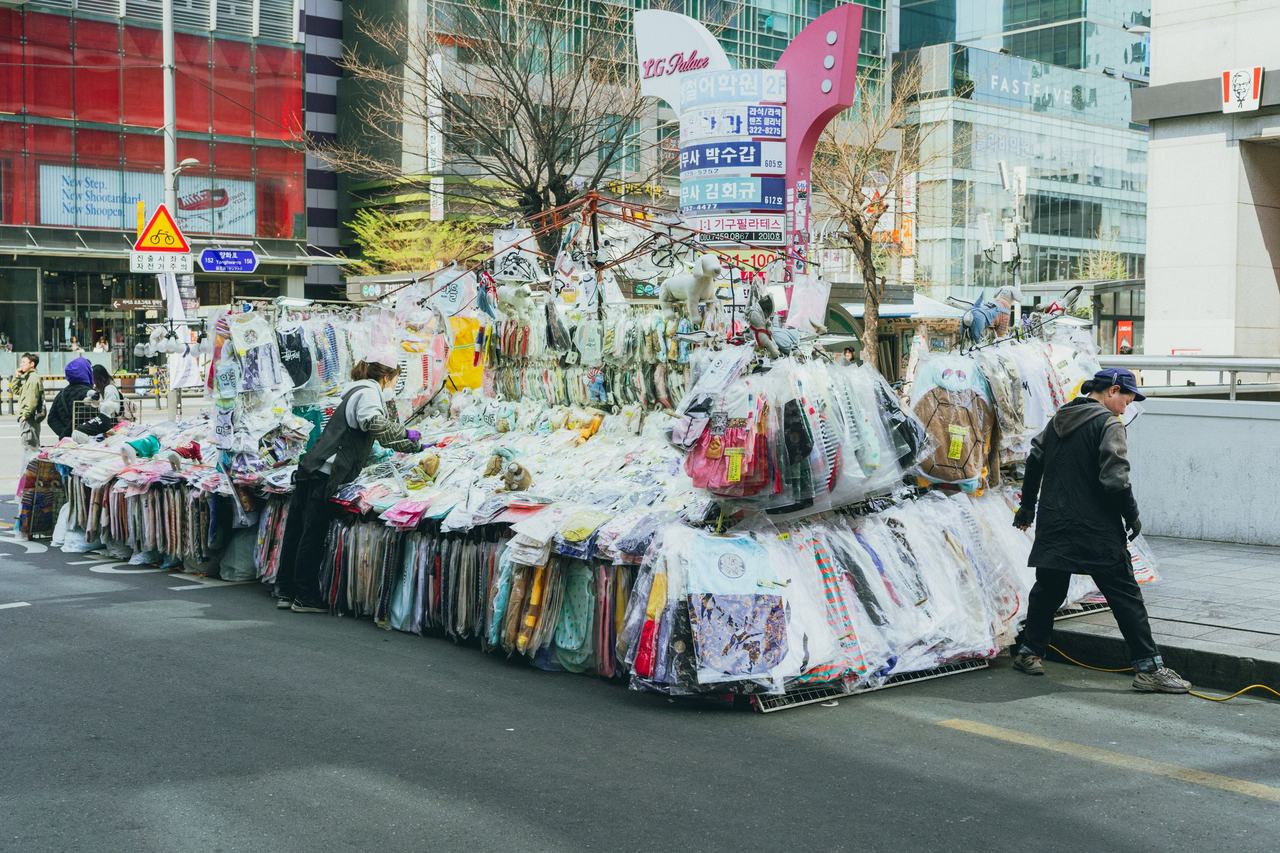
Opening photograph: Vendors tend a street stall heaped with bagged clothing on a sunny Seoul street. Photograph by Theodore Nguyen on Pexels. Blog photo credits.