Korean Phrases for Clothes Shopping in Seoul
For clothes shopping in Korean, three lines carry most of the visit: 이거 얼마예요?, “how much is this?”, then 다른 색 있어요?, “do you have it in another color?”, and finally 이걸로 할게요, “I’ll take this one.” Around them, the shop assistant will welcome you, tell you the price, offer colors and ring you up. Here is that whole visit, from browsing to buying, with every line recorded from Sori’s shopping unit, set in a Seoul clothes shop where the assistant is looking after a customer choosing a sweater.
The welcome and the price
As you come in, the assistant greets you and lets you look:
Daeun, the shop assistant, says
어서 오세요. 천천히 보세요.
eoseo oseyo. cheoncheonhi boseyo.
Welcome. Take your time.
Eoseo oseyo is “welcome,” and cheoncheonhi boseyo means “take your time.” It is an invitation to browse. When something catches your eye, hold it up and ask:
You ask
이거 얼마예요?
igeo eolmayeyo?
How much is this?
Daeun, the shop assistant, says
삼만 구천 원이에요.
samman gucheon wonieyo.
It’s 39,000 won.
Igeo eolmayeyo means “how much is this?” Igeo is this. The assistant’s answer, samman gucheon wonieyo, is “it’s 39,000 won.” Listen for man, which the course notes is 10,000: samman is 30,000 and gucheon is 9,000. For more on hearing prices, see how to say and understand prices in Korean won.
In the course, the assistant also adds yojeum jeil jal naganeun geoyeyo, “it’s our best seller right now.” It is not a question, but it is nice to recognize.
Asking for another color
If you like the piece but not the color, ask what else there is:
You ask
다른 색 있어요?
dareun saek isseoyo?
Do you have it in another color?
색: color.
Daeun, the shop assistant, says
네, 검은색하고 흰색 있어요.
ne, geomeunsaekago hinsaek isseoyo.
Yes, we have black and white.
Dareun saek isseoyo means “do you have it in another color?” The course notes that saek means color. The assistant answers ne, geomeunsaekago hinsaek isseoyo, “yes, we have black and white.” The course explanation picks out the two color words: geomeunsaek, black, and hinsaek, white.
If you already know the color you want, ask for it directly. The course’s line for black is 검은색 있어요?, “do you have it in black?” The pattern is the color plus isseoyo.
Which color shall I show you?
Once the assistant has named the colors, you may be asked to choose:
Daeun, the shop assistant, asks
어떤 색으로 보여 드릴까요?
eotteon saegeuro boyeo deurilkkayo?
Which color shall I show you?
You say
흰색으로 보여 주세요.
hinsaegeuro boyeo juseyo.
Could I see the white one?
보여 주세요: please show me.
You say
파란색으로 보여 주세요.
paransaegeuro boyeo juseyo.
Could I see the blue one?
Eotteon saegeuro boyeo deurilkkayo means “which color shall I show you?” Your answer is the color plus euro boyeo juseyo. The course notes that boyeo juseyo means please show me. So hinsaegeuro boyeo juseyo is “could I see the white one?” and paransaegeuro boyeo juseyo is “could I see the blue one?” The three colors in the course are 검은색, black, 흰색, white, and 파란색, blue.
To check the price of one particular color, ask about it by name:
You ask
흰색은 얼마예요?
hinsaegeun eolmayeyo?
How much is the white one?
Hinsaegeun eolmayeyo means “how much is the white one?”
Deciding: I like it, I’ll take this one
Once you have tried it or held it up, the assistant checks how it is:
Daeun, the shop assistant, asks
어떠세요?
eotteoseyo?
How is it?
You say
마음에 들어요.
maeume deureoyo.
I like it.
Literally: it enters my heart.
You say
이걸로 할게요.
igeollo halgeyo.
I’ll take this one.
이걸로: this one, out of the ones you were shown.
Eotteoseyo means “how is it?” Maeume deureoyo means “I like it,” and the course’s note gives its literal meaning: it enters my heart. Igeollo halgeyo means “I’ll take this one.” The assistant may also ask maeume deuseyo, do you like it?, as happens by the fitting room in the course. Your answer is the same maeume deureoyo, I like it. The course notes that igeollo means this one, out of the ones you were shown, which is exactly the situation when you have looked at several colors.
If you have decided on a color instead, name it:
You say
검은색으로 할게요.
geomeunsaegeuro halgeyo.
I’ll take the black one.
Daeun, the shop assistant, says
네, 계산 도와드릴게요.
ne, gyesan dowadeurilgeyo.
Great, I’ll ring it up for you.
Geomeunsaegeuro halgeyo means “I’ll take the black one.” The assistant’s reply, ne, gyesan dowadeurilgeyo, means “great, I’ll ring it up for you.” Then you hear the total, samman gucheon wonimnida in the course, and you pay. For card, cash and the card reader, see how to pay by card or cash in Korean.
Before you pay: can I exchange this?
If you are buying a gift or are unsure of the size, it is worth asking about exchanges before you leave:
You ask
이거 교환돼요?
igeo gyohwandwaeyo?
Can I exchange this?
Daeun, the shop assistant, says
네, 영수증 가지고 오시면 돼요.
ne, yeongsujeung gajigo osimyeon dwaeyo.
Yes, if you bring the receipt.
Igeo gyohwandwaeyo means “can I exchange this?” The assistant answers ne, yeongsujeung gajigo osimyeon dwaeyo, “yes, if you bring the receipt.” So keep the receipt. The course also has the refund version, 이거 환불돼요?, “can I get a refund on this?”
The clothes shop visit in order
- Assistant: eoseo oseyo. cheoncheonhi boseyo.
- You: igeo eolmayeyo? Assistant: the price.
- You: dareun saek isseoyo? Assistant: the colors they have.
- Assistant: eotteon saegeuro boyeo deurilkkayo? You: hinsaegeuro boyeo juseyo, or another color.
- Assistant: eotteoseyo? You: maeume deureoyo. igeollo halgeyo.
- Assistant: ne, gyesan dowadeurilgeyo.
If you want to try something on first, the fitting room and size questions are in can I try this on in Korean. Every line on this page is a recording from Sori’s course. In the app you hear each line, say it out loud and see what it heard, which helps with the color words, since they all end the same way.
Every line on this page
The 16 lines above, in order, for one last listen before you go. Each one is the recording from the Sori course.
어서 오세요. 천천히 보세요.eoseo oseyo. cheoncheonhi boseyo.Welcome. Take your time.
이거 얼마예요?igeo eolmayeyo?How much is this?
삼만 구천 원이에요.samman gucheon wonieyo.It’s 39,000 won.
다른 색 있어요?dareun saek isseoyo?Do you have it in another color?
네, 검은색하고 흰색 있어요.ne, geomeunsaekago hinsaek isseoyo.Yes, we have black and white.
어떤 색으로 보여 드릴까요?eotteon saegeuro boyeo deurilkkayo?Which color shall I show you?
흰색으로 보여 주세요.hinsaegeuro boyeo juseyo.Could I see the white one?
파란색으로 보여 주세요.paransaegeuro boyeo juseyo.Could I see the blue one?
흰색은 얼마예요?hinsaegeun eolmayeyo?How much is the white one?
어떠세요?eotteoseyo?How is it?
마음에 들어요.maeume deureoyo.I like it.
이걸로 할게요.igeollo halgeyo.I’ll take this one.
검은색으로 할게요.geomeunsaegeuro halgeyo.I’ll take the black one.
네, 계산 도와드릴게요.ne, gyesan dowadeurilgeyo.Great, I’ll ring it up for you.
이거 교환돼요?igeo gyohwandwaeyo?Can I exchange this?
네, 영수증 가지고 오시면 돼요.ne, yeongsujeung gajigo osimyeon dwaeyo.Yes, if you bring the receipt.
Common questions
How do you say “do you have another color” in Korean?
Say 다른 색 있어요?, “do you have it in another color?” The course notes that saek means color. For a specific color, ask it directly, as in 검은색 있어요?.
How do you say “I’ll take it” in Korean?
Say 이걸로 할게요, “I’ll take this one.” The course notes that igeollo means this one, out of the ones you were shown. For a color, say it with euro halgeyo, as in 검은색으로 할게요.
What does “cheoncheonhi boseyo” mean?
It means “take your time.” A shop assistant says it with eoseo oseyo, welcome, as you come in, to let you browse.
How do you say black, white and blue in Korean?
In the course, black is geomeunsaek, white is hinsaek and blue is 파란색. Use them with boyeo juseyo to see an item in that color: 흰색으로 보여 주세요 means “could I see the white one?”
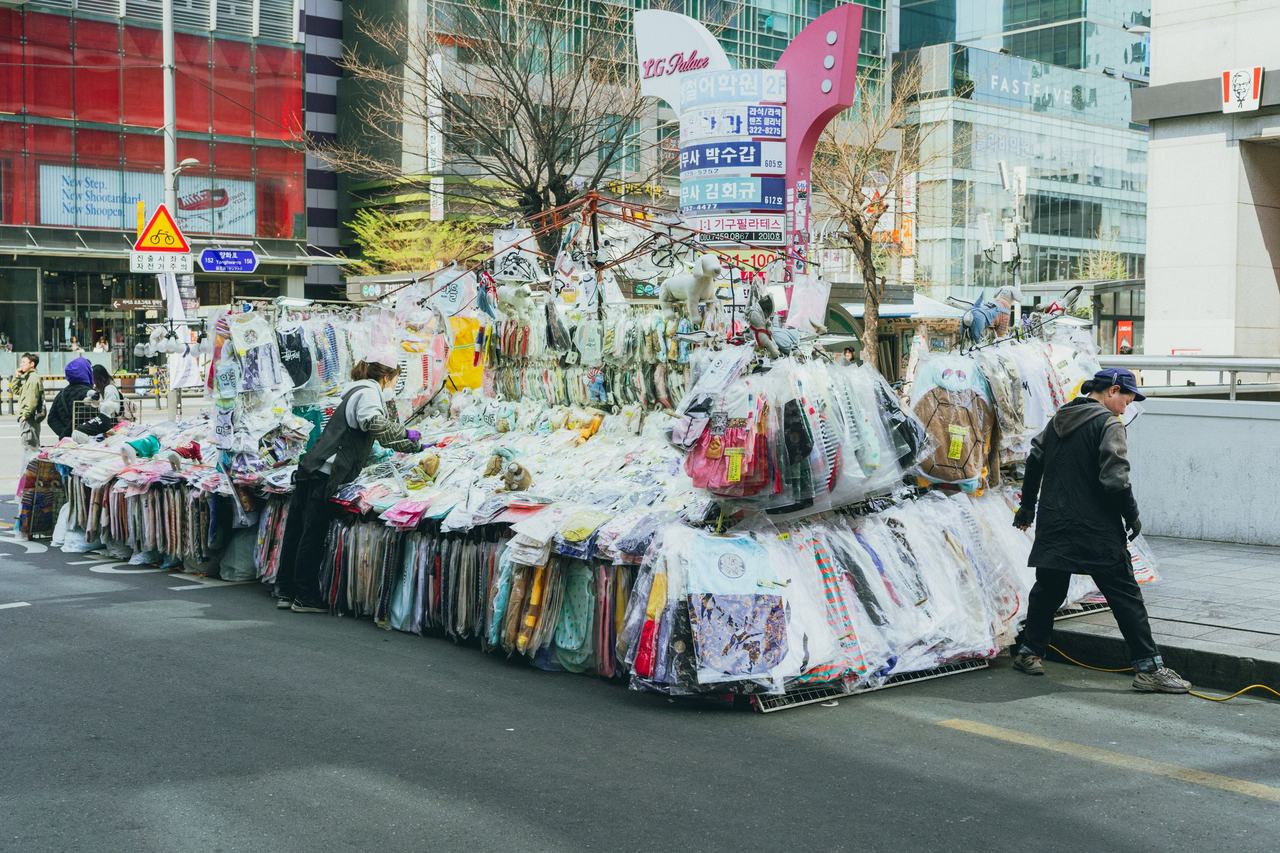
Opening photograph: Vendors tend a street stall heaped with bagged clothing on a sunny Seoul street. Photograph by Theodore Nguyen on Pexels. Blog photo credits.