How to Ask for a Discount at a Korean Market
To ask for a discount in Korean, say 좀 깎아 주세요, “could you give me a discount?” The course’s note says how haggling starts: first 너무 비싸요, “it’s too expensive,” then jom kkakka juseyo. It also notes that this is for a market stall, not a shop with price tags. And be ready for an answer you may not expect: in the course, the seller does not lower the price but throws in one more pair instead. Here is the whole negotiation from Sori’s shopping unit, at a sock stall in a Seoul market, with both sides recorded.
Where haggling fits, and what to call the seller
The course is specific about where this belongs. Its note on the discount line says it is for a market stall, not a shop with price tags. In a clothes shop where every item is labeled, you ask the price and decide. At a stall, there is room to ask for a little off.
The course also has a word on addressing the seller. In the scene, the customer opens with 할머니, grandma:
Tom, an exchange student, asks
할머니, 이 양말 얼마예요?
halmeoni, i yangmal eolmayeyo?
Ma’am, how much are these socks?
The course explains that 할머니 is a warm way to address an older woman at a market stall, and that 사장님 is the neutral choice. If you are unsure, the neutral one is the safe pick.
Asking the price
The first step is the price. The course’s line names the item, socks, so you can swap in whatever you are holding:
You ask
이 양말 얼마예요?
i yangmal eolmayeyo?
How much are these socks?
The market seller says
다섯 켤레에 만 원이에요.
daseot kyeollee man wonieyo.
Five pairs for 10,000 won.
I yangmal eolmayeyo means “how much are these socks?” Yangmal is socks. The seller’s answer, daseot kyeollee man wonieyo, means “five pairs for 10,000 won.” In the course, the price comes by the bundle, and the course explanation picks the phrase out: 다섯 켤레에 만 원, five pairs for 10,000 won. Listen for the count first, then the price.
Too expensive, and a discount please
Now the two lines that make up the ask. The course’s note on the first one gives you the order:
You say
너무 비싸요.
neomu bissayo.
It’s too expensive.
How haggling starts: 너무 비싸요, then 좀 깎아 주세요.
You say
좀 깎아 주세요.
jom kkakka juseyo.
Could you give me a discount?
For a market stall, not a shop with price tags.
Neomu bissayo means “it’s too expensive.” Jom kkakka juseyo means “could you give me a discount?” The jom softens the request, as the course notes elsewhere: it works like please. Said together, warmly, the two lines are the whole negotiation from your side.
There is a plain version of the first line too. Without neomu, it is simply “it’s expensive”:
You say
비싸요.
bissayo.
It’s expensive.
How the seller answers: an extra pair instead
This is the part worth hearing before you go. In the scene, the seller does not lower the price. She gives more for the same money:
The market seller says
그럼 한 켤레 더 줄게요.
geureom han kyeolle deo julgeyo.
Then I’ll throw in one more pair.
The market seller says
진짜 싼 거예요.
jinjja ssan geoyeyo.
That’s a real bargain.
The market seller says
여섯 켤레에 만 원이에요.
yeoseot kyeollee man wonieyo.
Six pairs for 10,000 won.
Geureom han kyeolle deo julgeyo means “then I’ll throw in one more pair.” Deo is more. In the role play, the seller adds jinjja ssan geoyeyo, “that’s a real bargain,” and restates the deal: yeoseot kyeollee man wonieyo, six pairs for 10,000 won. The course explanation sums it up: instead of a lower price, she gives him 한 켤레 더, one more pair.
So when you ask for a discount, listen for deo in the answer. In the course, deo in her answer means the price stays the same and you get more. That is still a discount, just measured in socks.
Taking the deal and paying
If the offer works for you, close it:
You say
그럼 살게요.
geureom salgeyo.
Then I’ll take them.
The market seller says
고마워요. 또 와요.
gomawoyo. tto wayo.
Thanks. Come again.
Geureom salgeyo means “then I’ll take them.” Geureom is “then,” the same word the seller used to start her offer. The seller’s gomawoyo. tto wayo means “thanks. Come again.”
To pay, say how. If you want to pay in cash, the course’s line is:
You say
현금으로 할게요.
hyeongeumeuro halgeyo.
I’ll pay in cash.
Hyeongeumeuro halgeyo means “I’ll pay in cash.” If you want card instead, how to pay by card or cash in Korean has the lines.
Two words to have ready
Two short adjectives cover most of what you might say about a price:
You say
싸요.
ssayo.
It’s cheap.
Ssayo means “it’s cheap,” and bissayo means “it’s expensive.” On its own, bissayo is a plain comment on the price. With neomu in front, it becomes the opening of a haggle, as the course’s note puts it. You can hear ssa, cheap, in the seller’s jinjja ssan geoyeyo, a real bargain. If prices in won are still new to you, see how to say and understand prices in Korean won.
The sock stall negotiation in order
- You: halmeoni, i yangmal eolmayeyo? (or i yangmal eolmayeyo? on its own)
- Seller: daseot kyeollee man wonieyo.
- You: neomu bissayo, then jom kkakka juseyo.
- Seller: geureom han kyeolle deo julgeyo, or yeoseot kyeollee man wonieyo.
- You: geureom salgeyo.
- Seller: gomawoyo. tto wayo.
Every line on this page is a recording from Sori’s course. In the app you hear each line, say it out loud and see what it heard. The recordings also let you hear the tone of jom kkakka juseyo before you try it yourself. For the clothes shop side of shopping, where prices are on tags, see Korean phrases for clothes shopping in Seoul.
Every line on this page
The 13 lines above, in order, for one last listen before you go. Each one is the recording from the Sori course.
할머니, 이 양말 얼마예요?halmeoni, i yangmal eolmayeyo?Ma’am, how much are these socks?
이 양말 얼마예요?i yangmal eolmayeyo?How much are these socks?
다섯 켤레에 만 원이에요.daseot kyeollee man wonieyo.Five pairs for 10,000 won.
너무 비싸요.neomu bissayo.It’s too expensive.
좀 깎아 주세요.jom kkakka juseyo.Could you give me a discount?
비싸요.bissayo.It’s expensive.
그럼 한 켤레 더 줄게요.geureom han kyeolle deo julgeyo.Then I’ll throw in one more pair.
진짜 싼 거예요.jinjja ssan geoyeyo.That’s a real bargain.
여섯 켤레에 만 원이에요.yeoseot kyeollee man wonieyo.Six pairs for 10,000 won.
그럼 살게요.geureom salgeyo.Then I’ll take them.
고마워요. 또 와요.gomawoyo. tto wayo.Thanks. Come again.
현금으로 할게요.hyeongeumeuro halgeyo.I’ll pay in cash.
싸요.ssayo.It’s cheap.
Common questions
How do you say “can you give me a discount” in Korean?
Say 좀 깎아 주세요, “could you give me a discount?” The course notes that haggling starts with 너무 비싸요, it’s too expensive, followed by jom kkakka juseyo.
Can you bargain in Korea?
The course limits it to one place: its note on the discount line says it is for a market stall, not a shop with price tags. In the course’s market scene, the seller answers with an extra pair rather than a lower price.
How do you say “too expensive” in Korean?
Say 너무 비싸요, “it’s too expensive.” Without neomu, too, it is 비싸요, “it’s expensive.”
What should I call a market seller in Korea?
The course explains that 할머니, grandma, is a warm way to address an older woman at a market stall, and that 사장님 is the neutral choice.
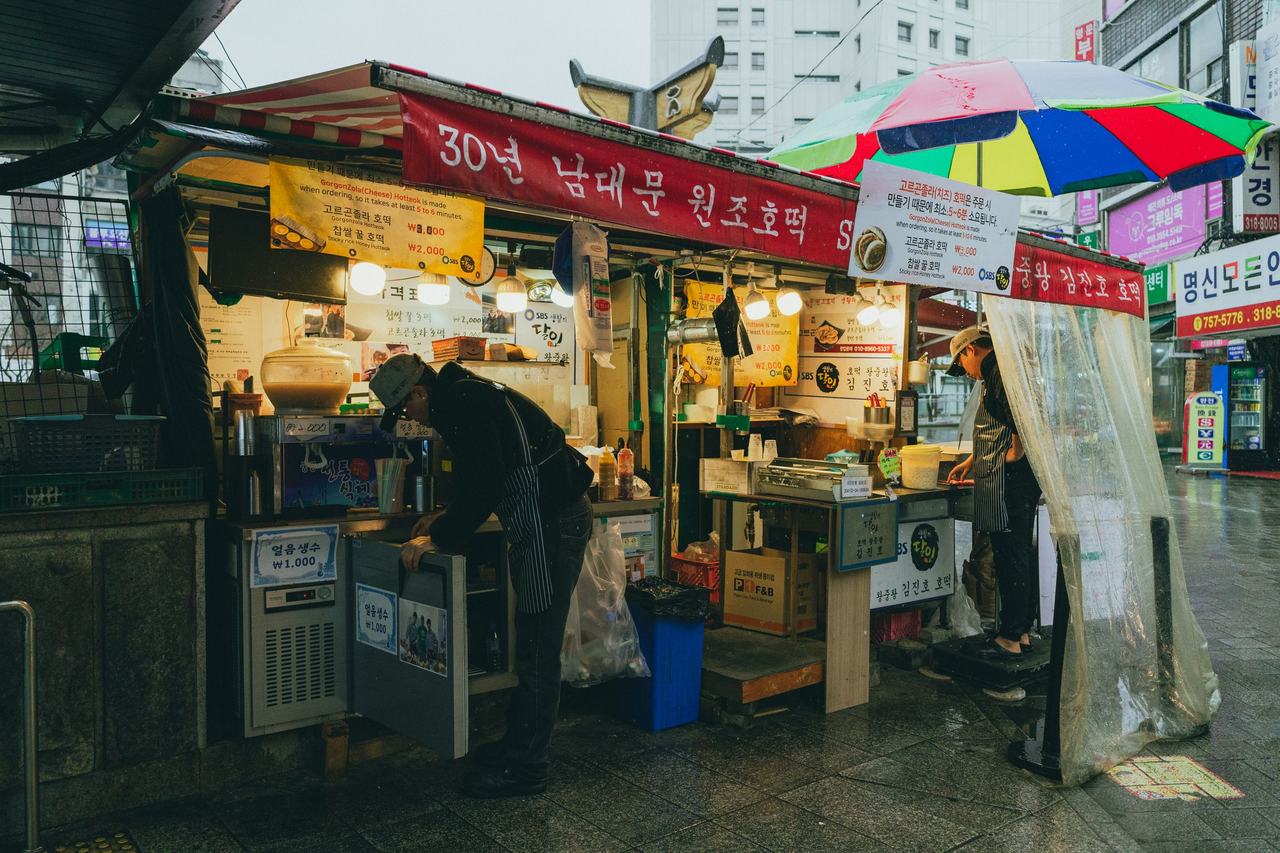
Opening photograph: Vendors work at a covered street food stall under a red banner on a rainy market street in Seoul. Photograph by Theodore Nguyen on Pexels. Blog photo credits.