How to Give Your Address in Korean
To give your address in Korean, say the apartment complex first, then the building number with dong, then the flat number with ho, and end with yeyo: 한강아파트 백삼 동 오백이 호예요 (hangangapateu baeksam dong obaegi hoyeyo, Hangang Apartments, building 103, flat 502). The question that comes before it is 주소가 어떻게 되세요? (jusoga eotteoke doeseyo, what’s your address). Below is the question, the order, how the numbers are read, and what you will hear back, from Sori’s phone unit, where Tom orders chicken to his apartment.
The address question you will hear
The course note on the question tells you how to answer it: the answer ends in ieyo or yeyo.
You ask
주소가 어떻게 되세요?
jusoga eotteoke doeseyo?
What’s your address?
What you are asked. The answer ends in 이에요 or 예요.
In the course, the chicken shop asks it as soon as Tom has ordered. Here it is in context, with the opening line from Tom that sets up the whole call:
Tom, an exchange student, says
배달 주문하려고요. 후라이드 한 마리 주세요.
baedal jumunharyeogoyo. huraideu han mari juseyo.
I’d like to order for delivery. One fried chicken, please.
The chicken shop owner asks
네, 주소가 어떻게 되세요?
ne, jusoga eotteoke doeseyo?
Sure. What’s the address?
Ne at the start is just sure, and jusoga eotteoke doeseyo is what’s the address. Once you hear jusoga, the address is what they need from you next.
If you are the one calling, two course lines lead up to the question. The first says why you are calling, and its note explains the parts: baedal is delivery, and the ending means I’d like to, or I’m calling to. The second checks that the shop delivers to you at all, and its note points out that on the phone, 거기, there, is the place you are calling.
You say
배달 주문하려고요.
baedal jumunharyeogoyo.
I’d like to order for delivery.
-려고요: I’m calling to, I’d like to. 배달: delivery.
You ask
거기 배달돼요?
geogi baedaldwaeyo?
Do you deliver?
On the phone, 거기 (there) is the place you are calling.
The order: complex, building, flat
The course note on Tom’s answer gives the shape of an apartment address: the building with dong, then the flat with ho, both in Sino-Korean numbers. The name of the complex comes first.
You say
한강아파트 백삼 동 오백이 호예요.
hangangapateu baeksam dong obaegi hoyeyo.
Hangang Apartments, building 103, flat 502.
An apartment address: the building with 동, then the flat with 호, both in Sino-Korean numbers.
Here is Tom saying it in the course scene:
Tom, an exchange student, says
한강아파트 백삼 동 오백이 호예요.
hangangapateu baeksam dong obaegi hoyeyo.
Hangang Apartments, building 103, flat 502.
Break it into three pieces and it is easy to hold in your head:
- Hangangapateu: the complex, Hangang Apartments.
- Baeksam dong: building 103.
- Obaegi ho: flat 502, with yeyo on the end.
Your own address goes in the same three slots. Say the name of your complex, then your building number and dong, then your flat number and ho.
Reading the numbers
The course note says both numbers use Sino-Korean numbers, the same set the course uses for prices in won: il, i, sam and so on. In the course examples they are read as whole numbers, not digit by digit.
So 103 is baeksam: baek, a hundred, and sam, three. And 502 is obaegi: o, five, then baek, then i, two. The course note on prices adds that baek and cheon are said without il in front, so a hundred is just baek, not one hundred.
The course’s second address has bigger numbers to practice on:
You say
한강아파트 백오 동 천이백삼 호예요.
hangangapateu baego dong cheonibaeksam hoyeyo.
Hangang Apartments, building 105, flat 1203.
Baego dong is building 105, and cheonibaeksam ho is flat 1203: cheon, a thousand, ibaek, two hundred, and sam, three. If you can say your own building and flat numbers smoothly, the rest of the address is just a name. For both sets of numbers side by side, see native vs Sino-Korean numbers.
When the shop repeats it back
After you give the address, listen. In the course role play, the shop says the numbers back to check them:
The chicken shop owner asks
주소가 어떻게 되세요?
jusoga eotteoke doeseyo?
What’s the address?
The chicken shop owner says
네, 백삼 동 오백이 호요.
ne, baeksam dong obaegi hoyo.
Okay, building 103, flat 502.
Ne, baeksam dong obaegi hoyo is okay, building 103, flat 502. This is your chance to catch a mistake. If the numbers are right, a ne confirms it. If they are wrong, start with aniyo and say the right number again, the same way the course corrects a wrong order: no, then the right answer.
The repeat is also a good listening test. Because the numbers come back to you at normal speed, you hear what your own address sounds like in a Korean voice. Learn to recognize it, and you will catch it when a rider or a driver says it too.
Where to leave it: the door or the security office
When the rider arrives, the question may be what to do with the food. The course has three answers. To have it left outside your door:
You say
문 앞에 놔 주세요.
mun ape nwa juseyo.
Please leave it at the door.
놔 주세요: please put it, short for 놓아 주세요. Delivery apps offer it as a request: 문 앞에 두고 가 주세요.
The note adds that delivery apps offer the same thing as a request you can choose, 문 앞에 두고 가 주세요, so you may see the words written as well as hear them. To have it left at the guard’s office:
You say
경비실에 맡겨 주세요.
gyeongbisire matgyeo juseyo.
Please leave it with the security office.
경비실: the guard’s office of an apartment complex. It takes parcels; many won’t take food.
Read that note before you use it: 경비실, the guard’s office of an apartment complex, takes parcels, but many won’t take food. And if you are home and want to meet the rider downstairs:
You say
지금 내려갈게요.
jigeum naeryeogalgeyo.
I’m coming down now.
For the full call when a rider rings, see what to say when a Korean delivery rider calls, and for the order before it, how to order fried chicken delivery in Korean.
Every line on this page is a recording from Sori’s course. In the app you hear each line, say it out loud, and see what the app heard. An address is the one line here worth making your own: once you can say Tom’s without stopping, put your own complex, building and flat into the same shape and say it until it comes out in one go.
Every line on this page
The 13 lines above, in order, for one last listen before you go. Each one is the recording from the Sori course.
주소가 어떻게 되세요?jusoga eotteoke doeseyo?What’s your address?
배달 주문하려고요. 후라이드 한 마리 주세요.baedal jumunharyeogoyo. huraideu han mari juseyo.I’d like to order for delivery. One fried chicken, please.
네, 주소가 어떻게 되세요?ne, jusoga eotteoke doeseyo?Sure. What’s the address?
배달 주문하려고요.baedal jumunharyeogoyo.I’d like to order for delivery.
거기 배달돼요?geogi baedaldwaeyo?Do you deliver?
한강아파트 백삼 동 오백이 호예요.hangangapateu baeksam dong obaegi hoyeyo.Hangang Apartments, building 103, flat 502.
한강아파트 백삼 동 오백이 호예요.hangangapateu baeksam dong obaegi hoyeyo.Hangang Apartments, building 103, flat 502.
한강아파트 백오 동 천이백삼 호예요.hangangapateu baego dong cheonibaeksam hoyeyo.Hangang Apartments, building 105, flat 1203.
주소가 어떻게 되세요?jusoga eotteoke doeseyo?What’s the address?
네, 백삼 동 오백이 호요.ne, baeksam dong obaegi hoyo.Okay, building 103, flat 502.
문 앞에 놔 주세요.mun ape nwa juseyo.Please leave it at the door.
경비실에 맡겨 주세요.gyeongbisire matgyeo juseyo.Please leave it with the security office.
지금 내려갈게요.jigeum naeryeogalgeyo.I’m coming down now.
Common questions
How do you say your address in Korean?
Say the complex, then the building number with dong, then the flat number with ho, ending in yeyo or ieyo, as in 한강아파트 백삼 동 오백이 호예요, Hangang Apartments, building 103, flat 502.
What do dong and ho mean in a Korean apartment address?
The course notes that dong marks the building and ho marks the flat. Both numbers are said in Sino-Korean numbers, as in baeksam dong obaegi ho, building 103, flat 502.
What does jusoga eotteoke doeseyo mean?
What’s your address. The course notes that it is what you are asked, and that the answer ends in ieyo or yeyo.
How do you say apartment numbers like 1203 in Korean?
As a whole Sino-Korean number. The course’s example is cheonibaeksam ho, flat 1203, in 한강아파트 백오 동 천이백삼 호예요.
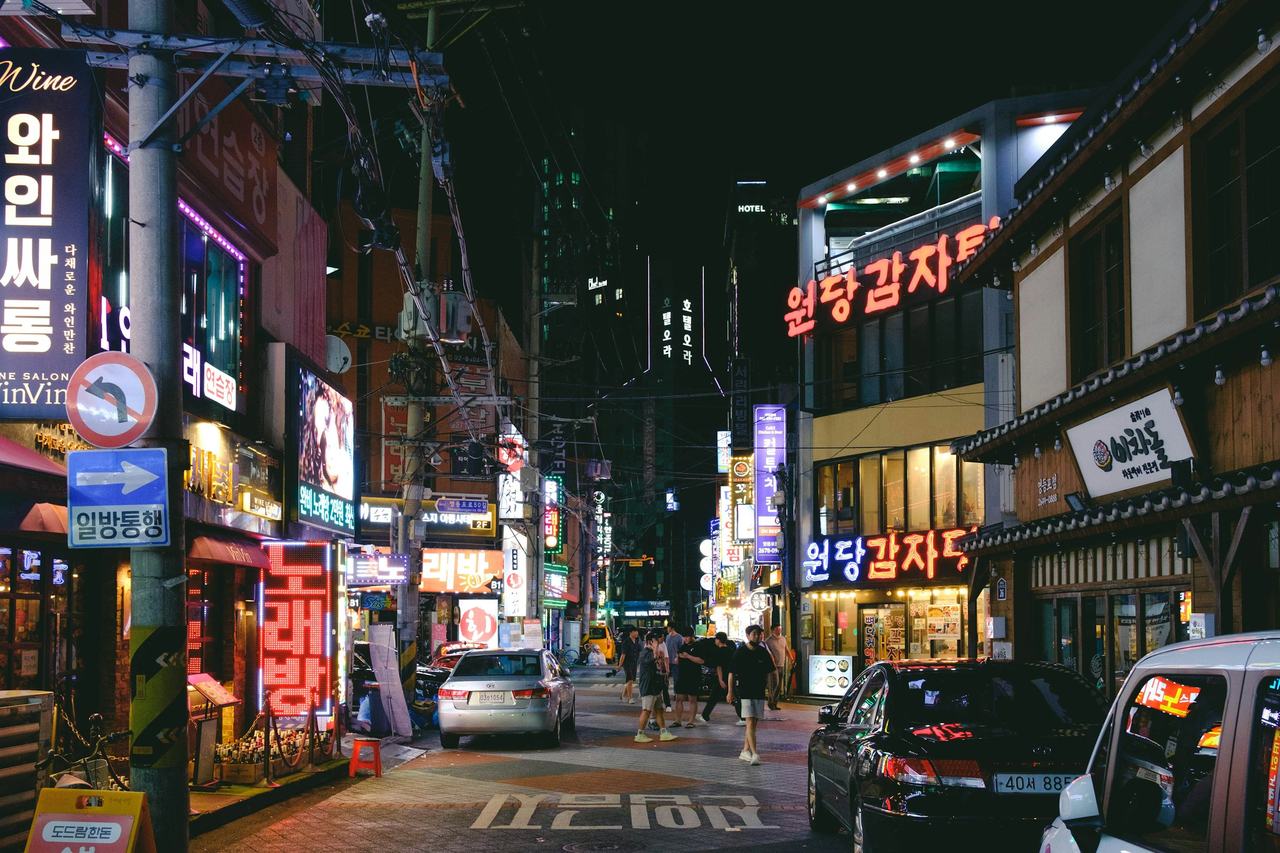
Opening photograph: A silver taxi drives past shops and pedestrians on a busy Seoul street. Photograph by Rüveyda Akkaya on Pexels. Blog photo credits.