How to Talk About What You Like in Korean
To talk about hobbies in Korean, ask 취미가 뭐예요? (chwimiga mwoyeyo, what are your hobbies) and answer with what you like plus joahaeyo: 저는 영화 보는 거 좋아해요 (jeoneun yeonghwa boneun geo joahaeyo, I like watching films). To say you do not really like something, use 별로 안 좋아해요 (byeollo an joahaeyo), and to agree, 저도요 (jeodoyo, me too). Below is each piece with recordings from Sori’s making friends unit, set at a language exchange meetup and a first chat with a new friend.
The hobby question and how to answer it
The course note calls this a good first question with someone new. Chwimi is hobby, and the question is simply what is your hobby.
You ask
취미가 뭐예요?
chwimiga mwoyeyo?
What are your hobbies?
취미: hobby. A good first question with someone new.
In the course, Seoyeon asks Tom at a language exchange meetup, and his answer shows the easiest way to reply: what he likes doing, plus joahaeyo.
Tom, an exchange student, says
저는 영화 보는 거 좋아해요.
jeoneun yeonghwa boneun geo joahaeyo.
I like watching films.
You can also answer with the word hobby itself. This line names the hobby directly, deungsan, hiking:
You say
제 취미는 등산이에요.
je chwimineun deungsanieyo.
My hobby is hiking.
The course notes elsewhere that 등산 literally means climbing a mountain, and that the hills around Seoul make it a favorite weekend outing. If hiking is your thing, this is the line for it.
Liking doing something, or liking a thing
The course note on Tom’s answer gives the one distinction you need. To say you like doing something, put neun geo after the activity and then joahaeyo. To say you like a thing, put the noun straight in front of joahaeyo.
You say
저는 영화 보는 거 좋아해요.
jeoneun yeonghwa boneun geo joahaeyo.
I like watching films.
-는 거 좋아해요: I like doing. With a noun alone: 영화 좋아해요, I like films.
The same shape gives 저는 음악 듣는 거 좋아해요, I like listening to music: the activity changes, neun geo joahaeyo stays. Compare a noun on its own, which Tom uses next:
You say
한국 영화 좋아해요.
hangung nyeonghwa joahaeyo.
I like Korean films.
Hangung nyeonghwa joahaeyo is just I like Korean films. Both shapes are correct. The noun version is shorter, so it is the one to reach for when you are thinking on your feet.
“Do you like it?” “Yes, I do”
Here is the part that makes this topic easy. The course note says the same words ask and answer: joahaeyo asked as a question is do you like it, and joahaeyo as a statement is I like it.
You ask
운동 좋아해요?
undong joahaeyo?
Do you like exercise?
The same words ask and answer: 좋아해요? do you like it? 좋아해요. I like it.
You say
네, 좋아해요.
ne, joahaeyo.
Yes, I do.
So to answer yes, add ne and repeat the word. To say you like it a lot, add jeongmal, really:
You say
네, 정말 좋아해요.
ne, jeongmal joahaeyo.
Yes, I do, very much.
The soft “not really”
Saying you do not like something can feel blunt. The course gives a softer way, and its note is clear about the difference: byeollo an means not really, and it is softer than an joahaeyo, I don’t like it.
You say
별로 안 좋아해요.
byeollo an joahaeyo.
I don’t really like it.
별로 안: not really. Softer than 안 좋아해요, I don’t like it.
To say which thing, put it in front. The course’s example is coffee:
You say
커피는 별로 안 좋아해요.
keopineun byeollo an joahaeyo.
I don’t really like coffee.
In the course dialogue, Minjun uses it about exercise after Jimin says she does yoga. Listen to how he praises her first and then says it about himself:
Minjun, a friend, says
와, 멋있어요. 저는 운동은 별로 안 좋아해요.
wa, meosisseoyo. jeoneun undongeun byeollo an joahaeyo.
Wow, that’s great. I don’t really like exercise.
Wa, meosisseoyo is wow, that’s great. Then jeoneun undongeun byeollo an joahaeyo, I don’t really like exercise. The conversation carries straight on.
Questions visitors get asked: Korean food and spicy food
As a visitor, you may well be asked about Korean food, and the course has the question:
You ask
한국 음식 좋아해요?
hanguk eumsik joahaeyo?
Do you like Korean food?
Because the same words ask and answer, you already know how to say yes: ne, joahaeyo, or ne, jeongmal joahaeyo if you mean it. The course also has a line for the follow-up about heat:
You say
매운 음식 좋아해요.
maeun eumsik joahaeyo.
I like spicy food.
Maeun eumsik joahaeyo is I like spicy food. If the honest answer is not really, byeollo an joahaeyo works here too, and if you are about to order and want less heat, see how to ask for less spicy food in Korean.
Me too, and keeping it going
When someone says they like something you like, the answer is three syllables. The course note explains that 도 means too:
You say
저도요.
jeodoyo.
Me too.
도: too, also.
To keep the conversation going, ask what kind. The course note says museun means what kind of:
You ask
무슨 영화 좋아해요?
museun nyeonghwa joahaeyo?
What kind of films do you like?
무슨: what kind of.
And if someone asks what you usually do, as Jimin does with 그럼 주말에 보통 뭐 해요?, so what do you usually do on the weekend, the course has a reply with botong, usually:
You say
보통 영화 봐요.
botong yeonghwa bwayo.
I usually watch films.
The same jeodo can also start a whole sentence. When Jimin hears that answer, she says 저도 영화 좋아해요, I like films too: jeodo, me too, at the front, then the rest.
Here is more of the first chat between Minjun and Jimin from the course; his not really line is shown above. She likes exercise, he does not really, and she turns the question back to him:
Minjun, a friend, asks
지민 씨는 운동 좋아해요?
jimin ssineun undong joahaeyo?
Do you like exercise, Jimin?
Jimin, the barista, says
네, 좋아해요. 요즘 요가 해요.
ne, joahaeyo. yojeum yoga haeyo.
Yes, I do. I’m doing yoga these days.
Jimin, the barista, asks
그럼 뭐 좋아해요?
geureom mwo joahaeyo?
Then what do you like?
Minjun, a friend, says
저는 게임 좋아해요.
jeoneun geim joahaeyo.
I like games.
Geureom mwo joahaeyo is then what do you like. It is a good line to remember, because it turns any not really into a new topic.
The whole toolkit fits in four lines:
- An activity plus neun geo joahaeyo: I like doing it.
- A thing plus joahaeyo: I like it, or, as a question, do you like it.
- Byeollo an joahaeyo: I don’t really like it.
- Jeodoyo: me too. If the chat goes well, the next step is an invitation, covered in how to invite someone out in Korean.
Every line on this page is a recording from Sori’s course. In the app you hear each line, say it out loud, and see what the app heard. Rehearse the questions as well as your answers, so chwimiga mwoyeyo and hanguk eumsik joahaeyo sound familiar the first time someone asks you.
Every line on this page
The 20 lines above, in order, for one last listen before you go. Each one is the recording from the Sori course.
취미가 뭐예요?chwimiga mwoyeyo?What are your hobbies?
저는 영화 보는 거 좋아해요.jeoneun yeonghwa boneun geo joahaeyo.I like watching films.
제 취미는 등산이에요.je chwimineun deungsanieyo.My hobby is hiking.
저는 영화 보는 거 좋아해요.jeoneun yeonghwa boneun geo joahaeyo.I like watching films.
한국 영화 좋아해요.hangung nyeonghwa joahaeyo.I like Korean films.
운동 좋아해요?undong joahaeyo?Do you like exercise?
네, 좋아해요.ne, joahaeyo.Yes, I do.
네, 정말 좋아해요.ne, jeongmal joahaeyo.Yes, I do, very much.
별로 안 좋아해요.byeollo an joahaeyo.I don’t really like it.
커피는 별로 안 좋아해요.keopineun byeollo an joahaeyo.I don’t really like coffee.
와, 멋있어요. 저는 운동은 별로 안 좋아해요.wa, meosisseoyo. jeoneun undongeun byeollo an joahaeyo.Wow, that’s great. I don’t really like exercise.
한국 음식 좋아해요?hanguk eumsik joahaeyo?Do you like Korean food?
매운 음식 좋아해요.maeun eumsik joahaeyo.I like spicy food.
저도요.jeodoyo.Me too.
무슨 영화 좋아해요?museun nyeonghwa joahaeyo?What kind of films do you like?
보통 영화 봐요.botong yeonghwa bwayo.I usually watch films.
지민 씨는 운동 좋아해요?jimin ssineun undong joahaeyo?Do you like exercise, Jimin?
네, 좋아해요. 요즘 요가 해요.ne, joahaeyo. yojeum yoga haeyo.Yes, I do. I’m doing yoga these days.
그럼 뭐 좋아해요?geureom mwo joahaeyo?Then what do you like?
저는 게임 좋아해요.jeoneun geim joahaeyo.I like games.
Common questions
How do you ask “what are your hobbies” in Korean?
Ask 취미가 뭐예요? (chwimiga mwoyeyo). The course notes that it is a good first question with someone new.
How do you say “I don’t really like it” in Korean?
별로 안 좋아해요 (byeollo an joahaeyo). The course notes that byeollo an means not really and is softer than an joahaeyo, I don’t like it. Put the thing in front, as in 커피는 별로 안 좋아해요.
How do you say “me too” in Korean?
저도요 (jeodoyo). The course notes that 도 means too, also.
How do you say “I like Korean food” in Korean?
The course question is 한국 음식 좋아해요? (hanguk eumsik joahaeyo). Its note on a similar line says the same words ask and answer, so said as a statement it means I like Korean food.
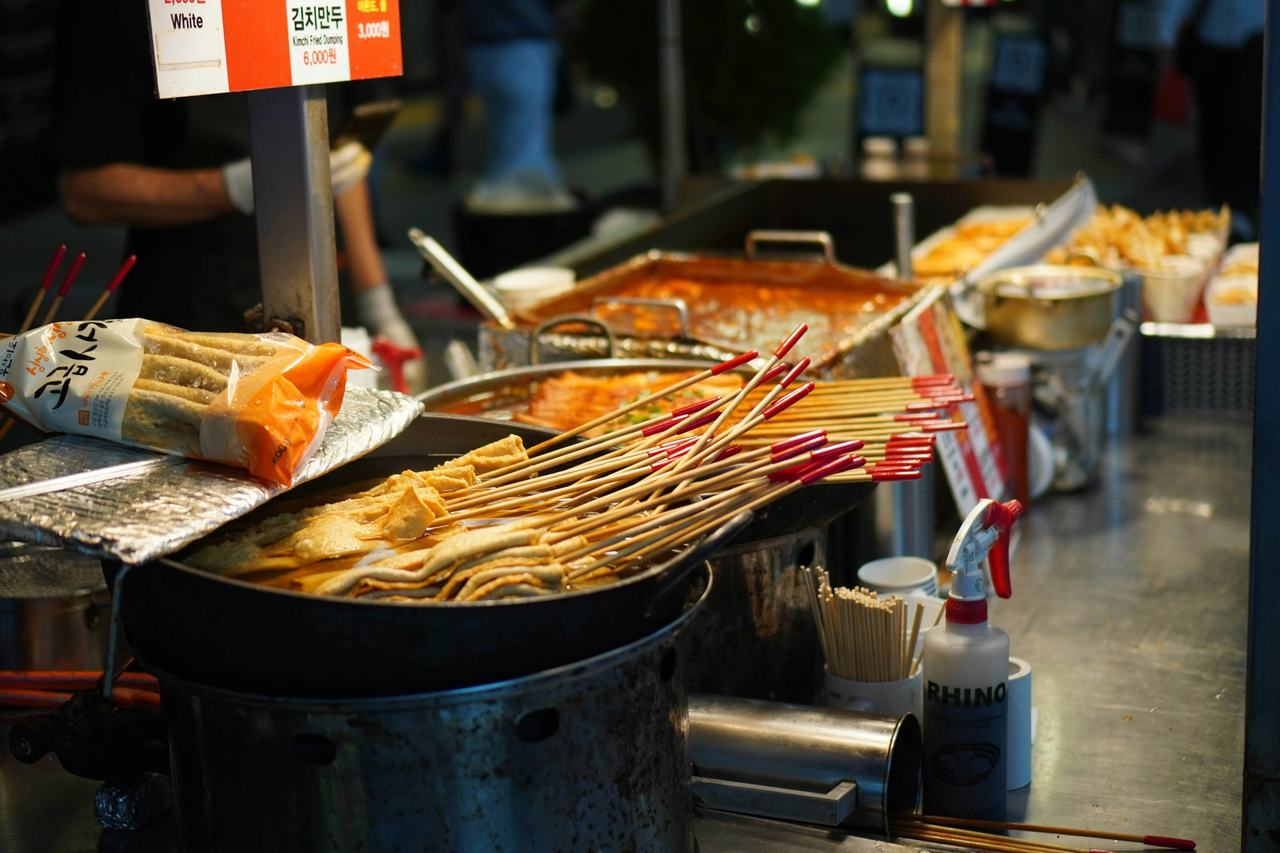
Opening photograph: Fish cake skewers simmering at a street food stall in Myeongdong, Seoul. Photograph by Irfan Syahmi on Unsplash. Blog photo credits.