How to Answer the Phone in Korean
To answer the phone in Korean, say 여보세요? (yeoboseyo, hello). The course notes that this is the phone hello, used three ways: to answer, to start when someone picks up, and when the line goes quiet. After that, the caller says who they are, you check whether now is a good time with 지금 통화 괜찮아요? (jigeum tonghwa gwaenchanayo), and if the line is bad, you say 이따가 다시 전화할게요 (I’ll call you back later). Below is each step from Sori’s phone unit, with both sides of the call recorded.
Yeoboseyo: the phone hello and its three uses
You already know annyeonghaseyo, the everyday hello. On the phone, the course uses a different word, and its note lists when:
You ask
여보세요?
yeoboseyo?
Hello? (on the phone)
On the phone: to answer, to start when someone picks up, and when the line goes quiet.
So yeoboseyo is what you say when you pick up, what you say when you have called someone and they answer, and what you say when the line goes silent and you want to know if they are still there. In the course, Seoyeon picks up a call from Minjun with it:
Seoyeon, a coworker, asks
여보세요?
yeoboseyo?
Hello?
In every course line it is asked as a question, yeoboseyo?, and that question is what you will hear when you call someone.
Saying who is calling
The caller answers yeoboseyo with their own yeoboseyo, then names the person they want and says who they are. Minjun does all of that in one breath:
Minjun, a friend, says
여보세요, 서연 씨? 저 민준이에요.
yeoboseyo, seoyeon ssi? jeo minjunieyo.
Hello, Seoyeon? It’s Minjun.
Yeoboseyo, Seoyeon ssi? checks he has the right person, and jeo minjunieyo is it’s Minjun. The ending on the name follows the rule the course teaches for introductions: after a name that ends in a consonant, say ieyo, and after a vowel, say yeyo. Put your own name in the same place and you have your caller line.
When you call a business, the other side can sound different. In the course, the chicken shop picks up with its name:
The chicken shop owner says
네, 행복치킨입니다.
ne, haengbokchikinimnida.
Hello, Haengbok Chicken.
Ne, haengbokchikinimnida is hello, Haengbok Chicken. When you hear a name with imnida on the end, you know who you have reached, and you can go straight to what you want. For what to say next on a call like that, see how to order fried chicken delivery in Korean.
Checking it is a good time to talk
If you are the caller, the course gives you a way to check that the other person can talk. The course note explains that tonghwa means a phone call, so the question is literally whether a call is okay right now:
You ask
지금 통화 괜찮아요?
jigeum tonghwa gwaenchanayo?
Is now a good time to talk?
통화: a phone call.
You can put it straight after the hello, or ask whether they are busy instead:
You ask
여보세요? 지금 통화 괜찮아요?
yeoboseyo? jigeum tonghwa gwaenchanayo?
Hello? Is now a good time to talk?
You ask
여보세요? 지금 바빠요?
yeoboseyo? jigeum bappayo?
Hello? Are you busy right now?
Here is a detail worth noticing in the answers. In the course role play, Minjun answers both questions with gwaenchanayo, it’s fine, but the first word changes. To is now a good time, he says yes:
Minjun, a friend, asks
네, 괜찮아요. 무슨 일이에요?
ne, gwaenchanayo. museun nirieyo?
Yes, it’s fine. What’s up?
To are you busy, he says no:
Minjun, a friend, asks
아니요, 괜찮아요. 무슨 일이에요?
aniyo, gwaenchanayo. museun nirieyo?
No, it’s fine. What’s up?
Both mean go ahead. Ne or aniyo answers the question you asked, and gwaenchanayo tells you it is fine to talk. Museun nirieyo at the end is what’s up, his invitation for you to say why you called.
When the line is bad
On a bad line, the course has one clear sentence:
You say
잘 안 들려요.
jal an deullyeoyo.
I can’t hear you very well.
Jal an deullyeoyo is I can’t hear you very well. In the course, it is Seoyeon who cannot hear, because she is on the subway. In the role play, Minjun says it to you, starting with yeoboseyo again, the third use from the note, checking whether you are still there:
Minjun, a friend, says
여보세요? 잘 안 들려요.
yeoboseyo? jal an deullyeoyo.
Hello? I can’t hear you very well.
In the course, that is the moment to end the call and try again later.
Ending the call: call you back, talk later
The course note on this line breaks it into its parts: ittaga is in a little while, and dasi is again.
You say
이따가 다시 전화할게요.
ittaga dasi jeonhwahalgeyo.
I’ll call you back later.
이따가: in a little while. 다시: again.
In the course, Minjun says it once he knows Seoyeon cannot hear, and she answers with an apology and a short goodbye:
Minjun, a friend, says
그럼 이따가 다시 전화할게요.
geureom ittaga dasi jeonhwahalgeyo.
Then I’ll call you back later.
Seoyeon, a coworker, says
네, 미안해요. 이따 통화해요.
ne, mianhaeyo. itta tonghwahaeyo.
Okay, sorry. Talk later.
Ne, mianhaeyo. Itta tonghwahaeyo is okay, sorry, talk later. Tonghwahaeyo has tonghwa, the phone call, in it. It is the line to remember for any call you need to end quickly, and in the role play, Minjun says it back to you:
Minjun, a friend, says
네, 이따 통화해요.
ne, itta tonghwahaeyo.
Okay, talk later.
Who calls you, and what you will hear
Not every call will be from a friend. The course has one more caller: a delivery rider at your door. He starts the same way, with yeoboseyo, the second use from the note, then gets straight to the point:
The delivery rider asks
여보세요? 배달 왔습니다. 지금 집에 계세요?
yeoboseyo? baedal watseumnida. jigeum jibe gyeseyo?
Hello? Your delivery’s here. Are you at home?
Baedal watseumnida is your delivery’s here, and jigeum jibe gyeseyo is are you at home. A ne answers it if you are in. For what to say back, see what to say when a Korean delivery rider calls.
Every line on this page is a recording from Sori’s course. In the app you hear each line, say it out loud, and see what the app heard. Phone calls are harder than face to face, because there is nothing to look at, so it is worth playing the other side’s lines here until museun nirieyo and jal an deullyeoyo are easy to catch.
Every line on this page
The 16 lines above, in order, for one last listen before you go. Each one is the recording from the Sori course.
여보세요?yeoboseyo?Hello? (on the phone)
여보세요?yeoboseyo?Hello?
여보세요, 서연 씨? 저 민준이에요.yeoboseyo, seoyeon ssi? jeo minjunieyo.Hello, Seoyeon? It’s Minjun.
네, 행복치킨입니다.ne, haengbokchikinimnida.Hello, Haengbok Chicken.
지금 통화 괜찮아요?jigeum tonghwa gwaenchanayo?Is now a good time to talk?
여보세요? 지금 통화 괜찮아요?yeoboseyo? jigeum tonghwa gwaenchanayo?Hello? Is now a good time to talk?
여보세요? 지금 바빠요?yeoboseyo? jigeum bappayo?Hello? Are you busy right now?
네, 괜찮아요. 무슨 일이에요?ne, gwaenchanayo. museun nirieyo?Yes, it’s fine. What’s up?
아니요, 괜찮아요. 무슨 일이에요?aniyo, gwaenchanayo. museun nirieyo?No, it’s fine. What’s up?
잘 안 들려요.jal an deullyeoyo.I can’t hear you very well.
여보세요? 잘 안 들려요.yeoboseyo? jal an deullyeoyo.Hello? I can’t hear you very well.
이따가 다시 전화할게요.ittaga dasi jeonhwahalgeyo.I’ll call you back later.
그럼 이따가 다시 전화할게요.geureom ittaga dasi jeonhwahalgeyo.Then I’ll call you back later.
네, 미안해요. 이따 통화해요.ne, mianhaeyo. itta tonghwahaeyo.Okay, sorry. Talk later.
네, 이따 통화해요.ne, itta tonghwahaeyo.Okay, talk later.
여보세요? 배달 왔습니다. 지금 집에 계세요?yeoboseyo? baedal watseumnida. jigeum jibe gyeseyo?Hello? Your delivery’s here. Are you at home?
Common questions
How do you say hello on the phone in Korean?
여보세요? (yeoboseyo). The course notes that it is used on the phone to answer, to start when someone picks up, and when the line goes quiet.
What is the difference between yeoboseyo and annyeonghaseyo?
Annyeonghaseyo is the everyday polite hello, which the course notes is for anyone at any time of day. Yeoboseyo is the hello the course uses on the phone.
How do you say “I’ll call you back” in Korean?
이따가 다시 전화할게요 (ittaga dasi jeonhwahalgeyo), I’ll call you back later. The course notes that ittaga is in a little while and dasi is again.
How do you say “I can’t hear you” in Korean?
잘 안 들려요 (jal an deullyeoyo), I can’t hear you very well. In the course, Minjun says it after another yeoboseyo.
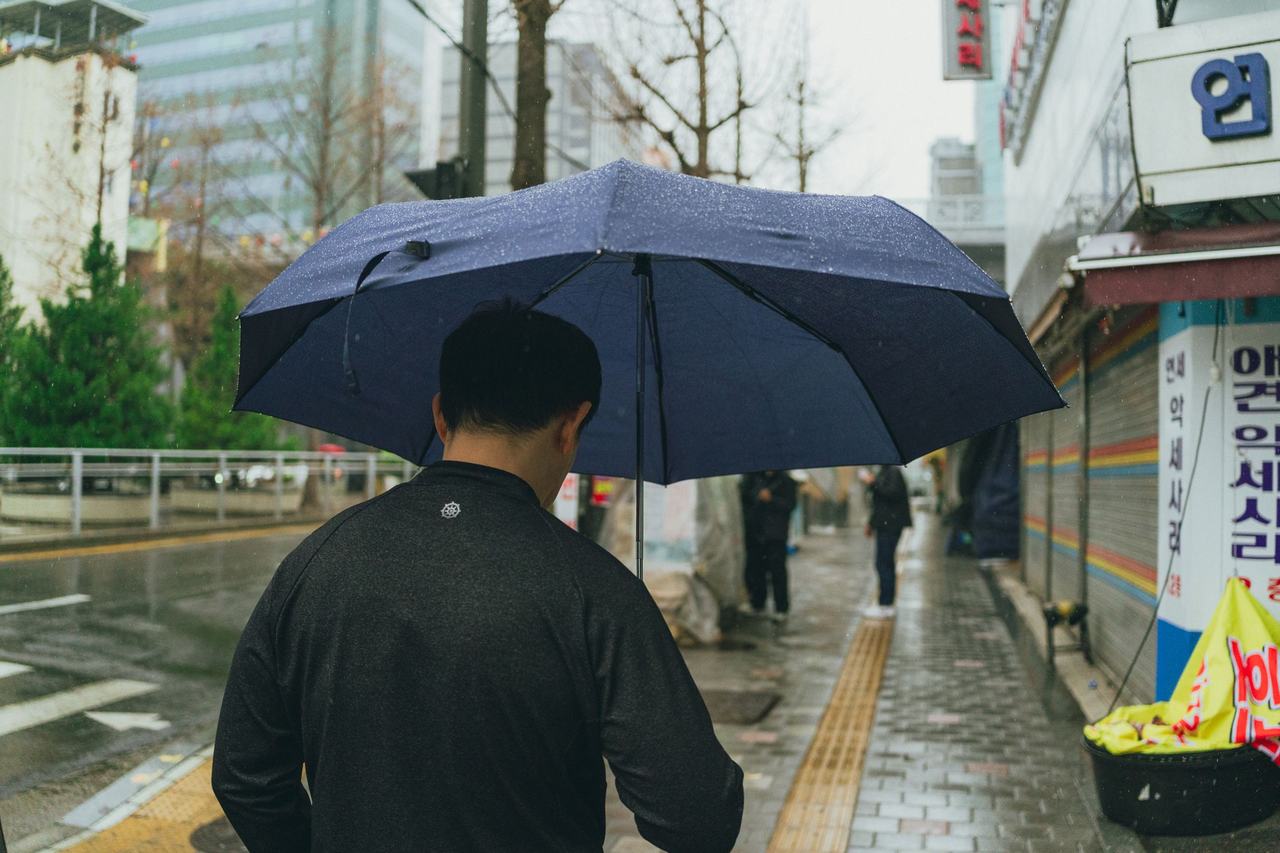
Opening photograph: A man under a navy umbrella walks down a wet sidewalk in Seoul on a rainy day. Photograph by Theodore Nguyen on Pexels. Blog photo credits.