How to Order Fried Chicken Delivery in Korean
To order chicken delivery in Korean, call the shop and say 배달 주문하려고요, “I’d like to order for delivery,” then name your chicken by the whole bird: 후라이드 한 마리 주세요 for one fried chicken, or 반반 한 마리 주세요 for half and half. The shop will then ask three things: what you would like, your address and how you will pay, and you can ask how long it will take. Here is that whole call from Sori’s phone unit, with the chicken shop owner’s side recorded too.
When the shop picks up
The shop answers with ne and its name. In the course, the shop is called Haengbok Chicken:
The chicken shop owner says
네, 행복치킨입니다.
ne, haengbokchikinimnida.
Hello, Haengbok Chicken.
Ne, haengbokchikinimnida means “hello, Haengbok Chicken.” Your shop’s name will be different, but the shape is the same: ne, then the name. Your first line tells them why you are calling. If you are not sure the shop delivers to you, ask first:
You ask
거기 배달돼요?
geogi baedaldwaeyo?
Do you deliver?
On the phone, 거기 (there) is the place you are calling.
You say
배달 주문하려고요.
baedal jumunharyeogoyo.
I’d like to order for delivery.
-려고요: I’m calling to, I’d like to. 배달: delivery.
Geogi baedaldwaeyo asks “do you deliver?” The course notes that on the phone, geogi, there, is the place you are calling. Baedal jumunharyeogoyo is “I’d like to order for delivery.” The course notes that baedal is delivery and that the ryeogoyo ending means “I’m calling to” or “I’d like to.” If the line is bad, the course’s phone unit has 잘 안 들려요, I can’t hear you very well, which is worth having ready for a busy kitchen.
Fried, seasoned or half and half
Next the shop asks what you would like. Chicken is ordered by the whole bird, so every order ends in han mari juseyo, one chicken, please.
The chicken shop owner asks
네, 뭐 드릴까요?
ne, mwo deurilkkayo?
Sure, what would you like?
You say
후라이드 한 마리 주세요.
huraideu han mari juseyo.
One fried chicken, please.
마리: the counter for animals, and for whole chickens. 후라이드 is plain fried; 양념 comes in a sweet, spicy sauce. Menus write 후라이드; the dictionary spelling is 프라이드.
The course packs a lot into the note on this line. Mari is the counter for animals, and for whole chickens. Huraideu is plain fried, and yangnyeom comes in a sweet, spicy sauce. Menus write 후라이드, even though the dictionary spelling is different. Here are the other two orders:
You say
양념 한 마리 주세요.
yangnyeom han mari juseyo.
One seasoned chicken, please.
You say
반반 한 마리 주세요.
banban han mari juseyo.
One half and half, please.
반반: half plain fried, half seasoned, the classic order.
Banban means half and half: half plain fried, half seasoned. The course calls it the classic order. If you cannot decide, it is the easy answer.
Giving your address
The shop’s next question is where to bring it. This is the line to recognize, because you cannot avoid it:
The shop asks
주소가 어떻게 되세요?
jusoga eotteoke doeseyo?
What’s your address?
What you are asked. The answer ends in 이에요 or 예요.
You say
한강아파트 백삼 동 오백이 호예요.
hangangapateu baeksam dong obaegi hoyeyo.
Hangang Apartments, building 103, flat 502.
An apartment address: the building with 동, then the flat with 호, both in Sino-Korean numbers.
Jusoga eotteoke doeseyo means “what’s your address?” The answer in the course is an apartment address: Hangang Apartments, building 103, flat 502. As the note says, you give the building number with dong and then the flat with ho, both in Sino-Korean numbers, and the answer ends in yeyo. Use your own building and flat in the same shape. The shop reads it back to check:
The chicken shop owner says
네, 백삼 동 오백이 호요.
ne, baeksam dong obaegi hoyo.
Okay, building 103, flat 502.
Ne, baeksam dong obaegi hoyo is “okay, building 103, flat 502.” If the numbers you hear back are yours, say ne. For more on how addresses and their numbers sound, see how to give your address in Korean.
How you will pay
Then comes payment. The shop asks, and the course’s note explains the answer:
The shop asks
결제는 어떻게 하시겠어요?
gyeoljeneun eotteoke hasigesseoyo?
How would you like to pay?
What the shop asks. 결제: payment. On a phone order you pay the rider when the food comes.
You say
카드로 할게요.
kadeuro halgeyo.
I’ll pay by card.
Gyeoljeneun eotteoke hasigesseoyo means “how would you like to pay?” It sounds long, but you only need to catch gyeolje at the start. The course notes that gyeolje is payment, and that on a phone order you pay the rider when the food comes. So you are telling the shop how you will pay at the door. Say kadeuro halgeyo for card, or 현금으로 할게요, I’ll pay in cash.
How long it will take
Before you hang up, ask about timing:
You ask
배달 얼마나 걸려요?
baedal eolmana geollyeoyo?
How long will the delivery take?
The chicken shop owner says
지금 주문이 많아서 사십 분 정도 걸려요.
jigeum jumuni manaseo sasip bun jeongdo geollyeoyo.
We’re busy right now, so about forty minutes.
Tom, an exchange student, says
네, 괜찮아요.
ne, gwaenchanayo.
Okay, that’s fine.
The chicken shop owner says
감사합니다. 금방 갖다 드릴게요.
gamsahamnida. geumbang gatda deurilgeyo.
Thank you. We’ll bring it over soon.
Baedal eolmana geollyeoyo asks “how long will the delivery take?” The shop’s answer has two parts: jigeum jumuni manaseo, “we have a lot of orders right now,” and sasip bun jeongdo geollyeoyo, “it will take about forty minutes.” The number is what matters. The course notes that minutes take Sino-Korean numbers, so listen for 이십 분, 삼십 분 or 사십 분: twenty, thirty or forty minutes. If you hear a number you can live with, you are done.
Ne, gwaenchanayo is “okay, that’s fine.” The shop closes with gamsahamnida. geumbang gatda deurilgeyo, “thank you, we’ll bring it over soon.”
The whole call, start to finish
Here is the call in order, with your lines in the right place:
- Shop: ne, haengbokchikinimnida. You: baedal jumunharyeogoyo.
- Shop: ne, mwo deurilkkayo? You: banban han mari juseyo, or fried or seasoned.
- Shop: jusoga eotteoke doeseyo? You: your building with dong, your flat with ho.
- Shop: gyeoljeneun eotteoke hasigesseoyo? You: kadeuro halgeyo or hyeongeumeuro halgeyo.
- You: baedal eolmana geollyeoyo? Shop: about so many minutes. You: ne, gwaenchanayo.
Phone calls are harder than counters because you cannot point and the shop cannot see your face. That makes it worth rehearsing the shop’s three questions until you know them on first hearing. Every line on this page is a recording from Sori’s course, and in the app you hear each one, say it out loud and see what it heard. When the food arrives and the rider calls you, what to say when a delivery rider calls has the next conversation.
Every line on this page
The 16 lines above, in order, for one last listen before you go. Each one is the recording from the Sori course.
네, 행복치킨입니다.ne, haengbokchikinimnida.Hello, Haengbok Chicken.
거기 배달돼요?geogi baedaldwaeyo?Do you deliver?
배달 주문하려고요.baedal jumunharyeogoyo.I’d like to order for delivery.
네, 뭐 드릴까요?ne, mwo deurilkkayo?Sure, what would you like?
후라이드 한 마리 주세요.huraideu han mari juseyo.One fried chicken, please.
양념 한 마리 주세요.yangnyeom han mari juseyo.One seasoned chicken, please.
반반 한 마리 주세요.banban han mari juseyo.One half and half, please.
주소가 어떻게 되세요?jusoga eotteoke doeseyo?What’s your address?
한강아파트 백삼 동 오백이 호예요.hangangapateu baeksam dong obaegi hoyeyo.Hangang Apartments, building 103, flat 502.
네, 백삼 동 오백이 호요.ne, baeksam dong obaegi hoyo.Okay, building 103, flat 502.
결제는 어떻게 하시겠어요?gyeoljeneun eotteoke hasigesseoyo?How would you like to pay?
카드로 할게요.kadeuro halgeyo.I’ll pay by card.
배달 얼마나 걸려요?baedal eolmana geollyeoyo?How long will the delivery take?
지금 주문이 많아서 사십 분 정도 걸려요.jigeum jumuni manaseo sasip bun jeongdo geollyeoyo.We’re busy right now, so about forty minutes.
네, 괜찮아요.ne, gwaenchanayo.Okay, that’s fine.
감사합니다. 금방 갖다 드릴게요.gamsahamnida. geumbang gatda deurilgeyo.Thank you. We’ll bring it over soon.
Common questions
How do you say “half and half” chicken in Korean?
Say 반반 한 마리 주세요, “one half and half, please.” The course notes that banban is half plain fried, half seasoned, and calls it the classic order.
What is the difference between huraideu and yangnyeom chicken?
The course notes that huraideu is plain fried and yangnyeom comes in a sweet, spicy sauce. Order them with 후라이드 한 마리 주세요 or 양념 한 마리 주세요.
What does “jusoga eotteoke doeseyo” mean?
It means “what’s your address?” It is the shop’s question after you order. Answer with your building number and dong, then your flat number and ho, as in 한강아파트 백삼 동 오백이 호예요.
Do you pay when you order chicken by phone in Korea?
Not on the call itself. The course notes that on a phone order you pay the rider when the food comes. The shop asks how you will pay, and you answer 카드로 할게요 or 현금으로 할게요.
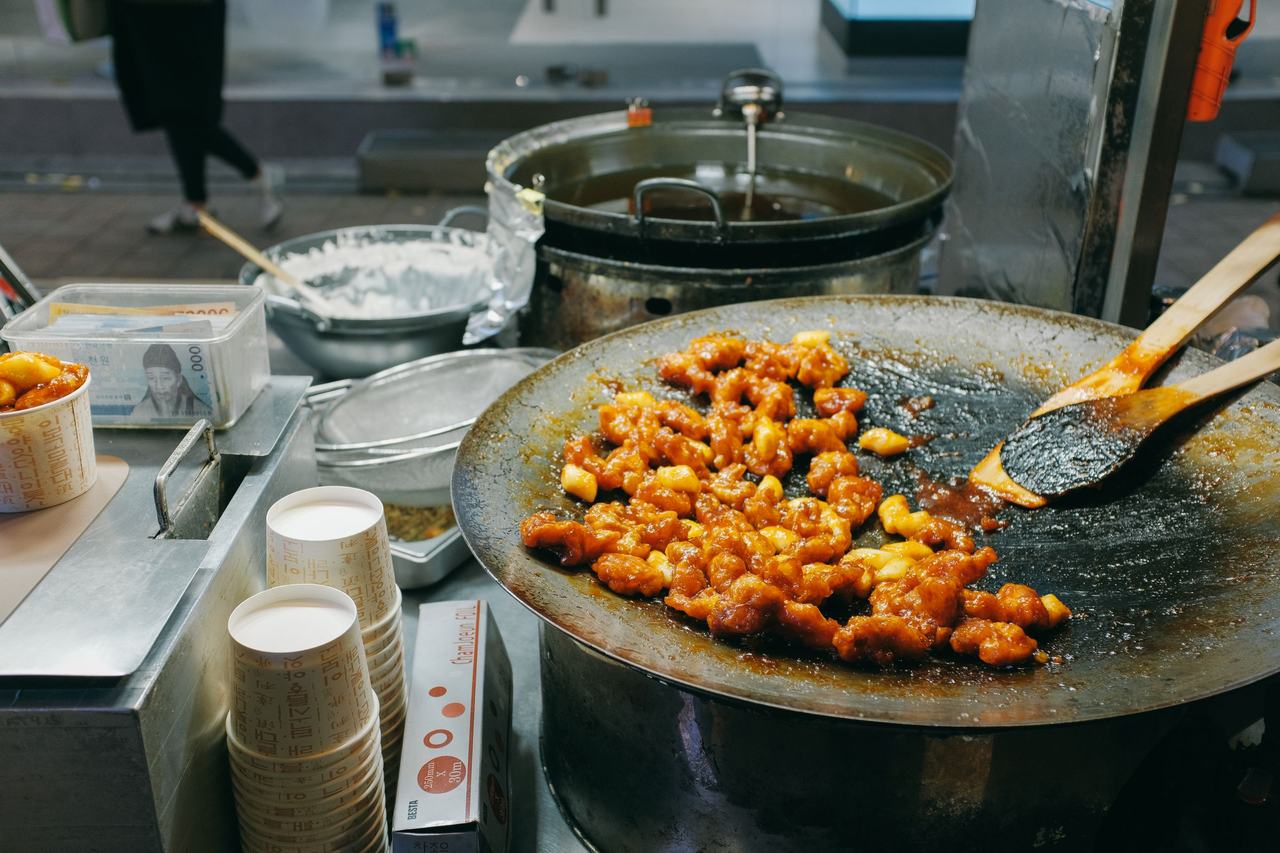
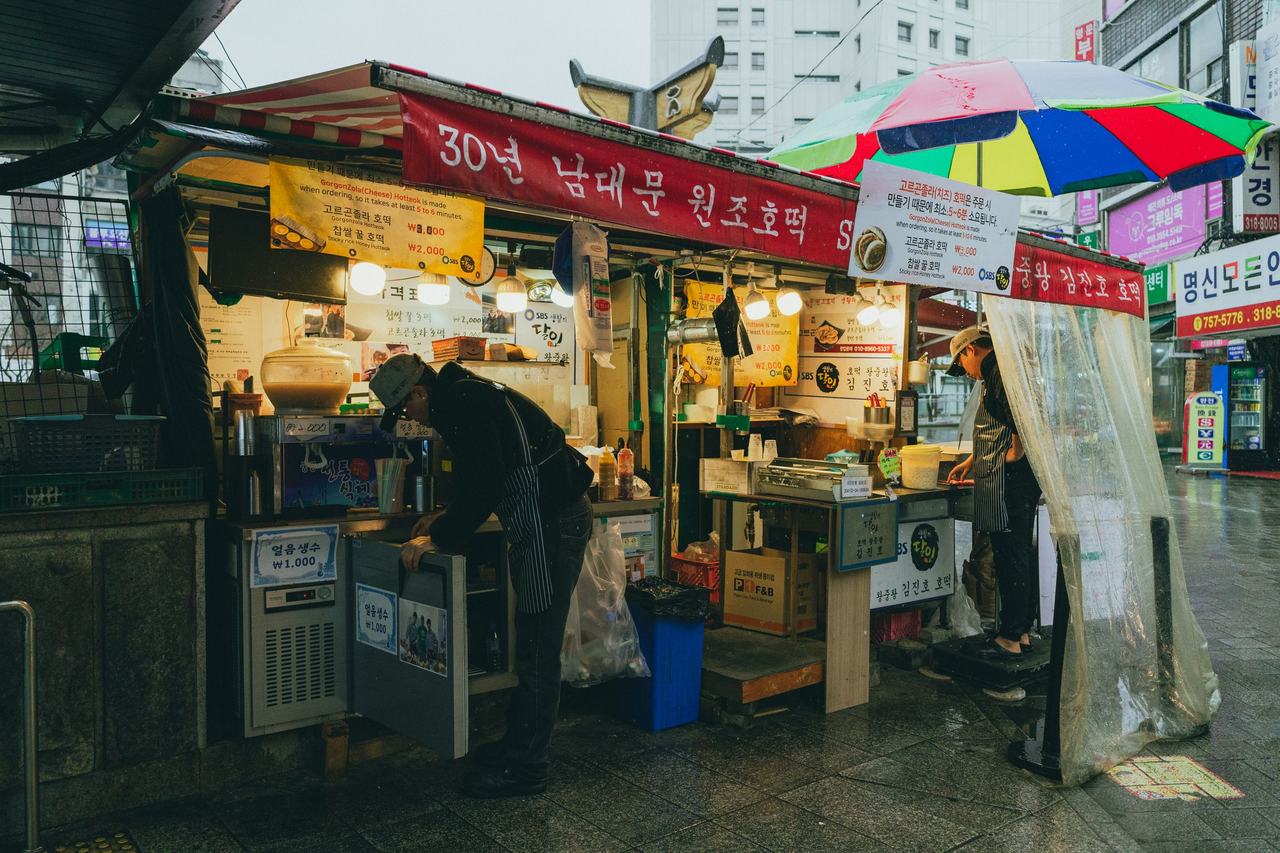
Opening photograph: Glossy, sauce-glazed fried bites sizzle in a wide pan at a Seoul street food stall beside stacks of paper cups. Photograph by Huy Phan on Pexels. Blog photo credits.