What to Say When a Korean Delivery Rider Calls
To ask a delivery rider to leave it at the door in Korean, say 문 앞에 놔 주세요, “please leave it at the door.” If the rider has just asked whether you are home and you are not, you can say it all at once: 아니요, 지금 밖이에요. 문 앞에 놔 주세요, “no, I’m out right now, please leave it at the door.” The part to prepare for is the rider’s first sentence. This page breaks it down and gives you four answers, all recorded from Sori’s phone unit, where an app order that is already paid arrives at an apartment.
The rider’s opening line
The call starts the way most phone calls in the course start:
You ask
여보세요?
yeoboseyo?
Hello? (on the phone)
On the phone: to answer, to start when someone picks up, and when the line goes quiet.
Yeoboseyo is “hello?” on the phone. The course notes that it is used to answer, to start when someone picks up, and when the line goes quiet. Then the rider says three things in a row:
The delivery rider asks
여보세요? 배달 왔습니다. 지금 집에 계세요?
yeoboseyo? baedal watseumnida. jigeum jibe gyeseyo?
Hello? Your delivery’s here. Are you at home?
Taken apart, it is easier than it sounds:
- Yeoboseyo: hello?
- Baedal watseumnida: your delivery’s here. Baedal is delivery.
- Jigeum jibe gyeseyo: are you at home?
The course explanation puts the question plainly: he asks 지금 집에 계세요?, are you at home? Everything you say next is an answer to that question.
If you are out: leave it at the door
When you are not home, start with where you are, then say what to do:
You say
지금 밖이에요.
jigeum bakkieyo.
I’m out right now.
The delivery rider asks
그럼 어떻게 할까요?
geureom eotteoke halkkayo?
Then what shall I do with it?
You say
문 앞에 놔 주세요.
mun ape nwa juseyo.
Please leave it at the door.
놔 주세요: please put it, short for 놓아 주세요. Delivery apps offer it as a request: 문 앞에 두고 가 주세요.
The delivery rider says
네, 문 앞에 두고 갈게요.
ne, mun ape dugo galgeyo.
Okay, I’ll leave it at the door.
Jigeum bakkieyo means “I’m out right now.” The rider asks geureom eotteoke halkkayo, “then what shall I do with it?” You answer mun ape nwa juseyo, “please leave it at the door.” The course notes that nwa juseyo, please put it, is short for a longer form, and that delivery apps offer the same request in writing: 문 앞에 두고 가 주세요. The rider confirms with ne, mun ape dugo galgeyo, “okay, I’ll leave it at the door.” When you hear mun ape, at the door, in the rider’s reply, you have been understood.
If you would rather skip the back and forth, the course has the whole answer as one line:
You say
아니요, 지금 밖이에요. 문 앞에 놔 주세요.
aniyo, jigeum bakkieyo. mun ape nwa juseyo.
No, I’m out right now. Please leave it at the door.
Aniyo, no, comes first, because the question was “are you at home?”
If you are home: I’m coming down
If you are home but the rider is downstairs, the answer is short:
You say
지금 내려갈게요.
jigeum naeryeogalgeyo.
I’m coming down now.
Jigeum naeryeogalgeyo means “I’m coming down now.” Say ne, yes, first to answer “are you at home?” and then this line. If it will take you a minute to get down, 잠깐만요, one moment please, is the course’s line for asking someone to wait.
Leaving it with the security office
If you are staying in an apartment complex, the course has a line for its guard’s office:
You say
경비실에 맡겨 주세요.
gyeongbisire matgyeo juseyo.
Please leave it with the security office.
경비실: the guard’s office of an apartment complex. It takes parcels; many won’t take food.
Gyeongbisire matgyeo juseyo means “please leave it with the security office.” Read the course’s note before you use it for food, though: 경비실, the guard’s office of an apartment complex, takes parcels, but many won’t take food. For a meal, the door is usually the better answer. Keep this line for parcels, or for when the rider suggests it.
The photo message and saying thank you
After leaving your food, the rider in the course says one more thing:
The delivery rider says
사진 찍어서 보내 드릴게요.
sajin jjigeoseo bonae deurilgeyo.
I’ll take a photo and send it to you.
You say
감사합니다.
gamsahamnida.
Thank you.
A set phrase: the polite thank you, for anyone.
Sajin jjigeoseo bonae deurilgeyo means “I’ll take a photo and send it to you.” In the course, that means a picture of your order at the door arrives on your phone. Because the order in this scene was paid in the app already, there is no payment to sort out on the call. A gamsahamnida ends it. The course notes it is a set phrase, the polite thank you, for anyone.
If you cannot hear the rider
If the line is noisy or the rider talks fast, the course’s phone unit has the line for that:
You say
잘 안 들려요.
jal an deullyeoyo.
I can’t hear you very well.
Jal an deullyeoyo means “I can’t hear you very well.” Use it, then listen again for the two words that matter most: jibe, at home, in the question, and mun ape, at the door, in the rider’s reply.
The four answers side by side
When the rider asks jigeum jibe gyeseyo, pick one:
- Out: jigeum bakkieyo, then mun ape nwa juseyo.
- Out, all in one: aniyo, jigeum bakkieyo. mun ape nwa juseyo.
- Home: ne, then jigeum naeryeogalgeyo.
- Parcel for the guard’s office: gyeongbisire matgyeo juseyo.
Every line on this page is a recording from Sori’s course. In the app you hear each line, say it out loud and see what it heard, which matters here more than anywhere: on a phone call you have no menu to point at and no gestures to fall back on. If you are ordering by phone in the first place, how to order fried chicken delivery in Korean covers the call to the shop, and how to answer the phone in Korean covers calls in general.
Every line on this page
The 12 lines above, in order, for one last listen before you go. Each one is the recording from the Sori course.
여보세요?yeoboseyo?Hello? (on the phone)
여보세요? 배달 왔습니다. 지금 집에 계세요?yeoboseyo? baedal watseumnida. jigeum jibe gyeseyo?Hello? Your delivery’s here. Are you at home?
지금 밖이에요.jigeum bakkieyo.I’m out right now.
그럼 어떻게 할까요?geureom eotteoke halkkayo?Then what shall I do with it?
문 앞에 놔 주세요.mun ape nwa juseyo.Please leave it at the door.
네, 문 앞에 두고 갈게요.ne, mun ape dugo galgeyo.Okay, I’ll leave it at the door.
아니요, 지금 밖이에요. 문 앞에 놔 주세요.aniyo, jigeum bakkieyo. mun ape nwa juseyo.No, I’m out right now. Please leave it at the door.
지금 내려갈게요.jigeum naeryeogalgeyo.I’m coming down now.
경비실에 맡겨 주세요.gyeongbisire matgyeo juseyo.Please leave it with the security office.
사진 찍어서 보내 드릴게요.sajin jjigeoseo bonae deurilgeyo.I’ll take a photo and send it to you.
감사합니다.gamsahamnida.Thank you.
잘 안 들려요.jal an deullyeoyo.I can’t hear you very well.
Common questions
How do you say “leave it at the door” in Korean?
Say 문 앞에 놔 주세요, “please leave it at the door.” The course notes that delivery apps offer the same request in writing as 문 앞에 두고 가 주세요.
What does “baedal watseumnida” mean?
It means “your delivery’s here.” In the course, the rider says it at the start of the call, followed by jigeum jibe gyeseyo, are you at home?
How do you say “I’m coming down” in Korean?
Say 지금 내려갈게요, “I’m coming down now.” Start with ne, yes, if the rider has just asked whether you are home.
Can I ask a delivery rider to leave food with the security office?
You can ask with 경비실에 맡겨 주세요, but the course notes that the 경비실, the guard’s office of an apartment complex, takes parcels and that many won’t take food. For a meal, ask the rider to leave it at the door.
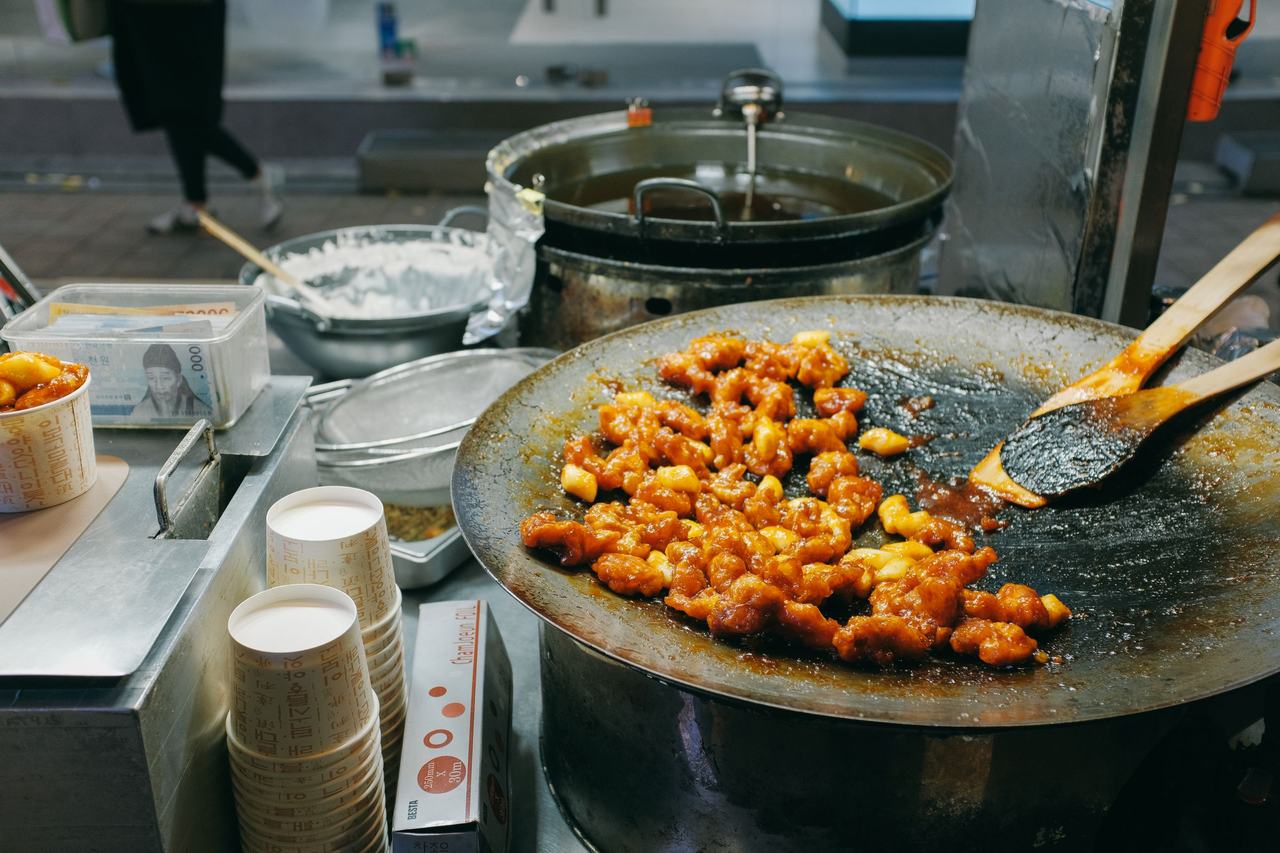
Opening photograph: Glossy, sauce-glazed fried bites sizzle in a wide pan at a Seoul street food stall beside stacks of paper cups. Photograph by Huy Phan on Pexels. Blog photo credits.