Native vs Sino Korean Numbers for Prices and Counting
Korean uses two sets of numbers, and which one you need depends on what you are counting. Sino-Korean numbers (일, 이, 삼) are for prices in won, minutes, subway exit numbers and apartment addresses: 오천 원이에요 is “it’s 5,000 won.” Native Korean numbers (하나, 둘, 셋, shortened to han, du, se, ne before a counter) are for counting things, cups and people, and for the hour on a clock: 이거 한 개 주세요 is “one of these, please.” Below, each use is shown with a recorded example from the course.
The short answer: which numbers for which job
Here is the course’s split, by task rather than by grammar. Every item on this list comes from a course note or line on this page.
- Prices in won: Sino-Korean.
- Minutes: Sino-Korean.
- Subway exit numbers: Sino-Korean.
- Apartment building and flat numbers: Sino-Korean.
- Things, cups and people: native Korean.
- Kimbap rolls and whole chickens: native Korean.
- The hour on a clock: native Korean.
- How many times a day: native Korean.
A rough guide that fits most items above: if you are counting how many things, cups or people there are, you want native numbers, but minutes always take Sino-Korean. If you are reading out a price, an exit or an address, you want Sino-Korean. The clock, as you will see, uses both.
Prices in won: Sino-Korean
In the course, prices are where Sino-Korean numbers come up most. The course note on counting says it directly: prices in won use 일, 이, 삼. Here are two prices from the course:
You say
오천 원이에요.
ocheon wonieyo.
It’s 5,000 won.
You say
만 오천 원이에요.
man ocheon wonieyo.
It’s 15,000 won.
The second line hides a trap for English speakers. Korean counts in ten thousands, so 15,000 is man ocheon, one ten-thousand and five thousand. The course also notes that 천, 백 and 만 are said without 일 in front, so 1,000 is just cheon and 10,000 just man. For the full listening guide to totals, see how to say prices in Korean won.
Minutes, exits and addresses: Sino-Korean
Minutes use the same set. When someone tells you how far a station is, or a delivery shop tells you how long your food will take, you hear Sino-Korean numbers:
Seoyeon, a coworker, says
아니요, 가까워요. 걸어서 오 분이에요.
aniyo, gakkawoyo. georeoseo o bunieyo.
No, it’s close. It’s five minutes on foot.
You say
사십 분 정도 걸려요.
sasip bun jeongdo geollyeoyo.
About forty minutes.
Minutes take Sino-Korean numbers: 이십 분, 삼십 분, 사십 분.
Subway exits are numbers you read off a sign, and the course notes they use the same set. That matters when you arrange to meet someone at an exit, as the course’s friends do at Gangnam Station:
You ask
몇 번 출구예요?
myeot beon chulguyeyo?
Which exit is it?
출구: exit. Exit numbers are said with 일, 이, 삼: 십일 번 출구 is exit 11.
You say
칠 번 출구예요.
chil beon chulguyeyo.
It’s exit 7.
Apartment addresses follow the pattern too. The course’s example is a delivery order by phone, where both the building and the flat are read out in Sino-Korean numbers:
You say
한강아파트 백삼 동 오백이 호예요.
hangangapateu baeksam dong obaegi hoyeyo.
Hangang Apartments, building 103, flat 502.
An apartment address: the building with 동, then the flat with 호, both in Sino-Korean numbers.
Things, cups and people: native Korean
When you count how many of something you want, switch to native numbers. The course’s note on this line is the clearest summary of the whole system:
You say
이거 한 개 주세요.
igeo han gae juseyo.
One of these, please.
Count with 한, 두, 세, 네 before counters like 개 (things), 잔 (cups) and 명 (people); with no counter, say 하나, 둘, 셋. Prices in 원 use 일, 이, 삼 instead: 삼천 원, 이만 원.
So han gae is one thing, du jan two cups and se myeong three people. When there is no counter, the note says to use the full form instead, which is why a street food order like 떡볶이 하나 주세요 uses hana, one, rather than han. The word after the number, the counter, tells the other person what you are counting. Here are two of them at work, at a café and at a restaurant door:
You say
물 두 잔 주세요.
mul du jan juseyo.
Two glasses of water, please.
잔: cups and glasses.
You say
세 명이에요.
se myeongieyo.
There are three of us.
명: people.
Some foods have their own counters, and they take native numbers as well. A kimbap roll is counted with jul, and a whole fried chicken with mari:
You say
김밥 한 줄 주세요.
gimbap han jul juseyo.
One kimbap roll, please.
줄: a line or roll, the counter for kimbap.
You say
후라이드 한 마리 주세요.
huraideu han mari juseyo.
One fried chicken, please.
If you do not know the counter, the course’s general line for things, igeo han gae juseyo, is a good fallback when you can point. Our guide to ordering by pointing has more on that.
Native hours, Sino minutes: the time and times a day
The clock is where the two systems meet in one sentence. The course explains it in its time unit: hours take native numbers, minutes take Sino-Korean ones. Listen for both in a quarter past two:
You say
두 시 십오 분이에요.
du si sibo bunieyo.
It’s a quarter past two.
Native hour, Sino-Korean minutes: 두 시, then 십오 분.
Du si uses native two for the hour, and sibo bun uses Sino-Korean fifteen for the minutes. It feels odd at first, but every time in the course follows the same rule, so once you have one, you have them all. More times, including half past, are in our guide to telling time in Korean.
The last native use comes from the pharmacy. When the pharmacist tells you how often to take your medicine, the number of times is native:
You say
하루에 세 번 드세요.
harue se beon deuseyo.
Take it three times a day.
What the pharmacist says. 번: times. 드세요: please take, the polite word for others; about yourself say 먹어요.
Compare it with the exit numbers above. Both use beon, but se beon here is three times, with a native three, while sibil beon chulgu is exit 11, with Sino-Korean eleven. In the course, counting how many times uses native numbers, and an exit number uses Sino-Korean.
Every line on this page is a recording from Sori’s course. In the app you hear each line, say it out loud and see what it heard, which is a good way to make the switch between se and sam without stopping to think.
Every line on this page
The 14 lines above, in order, for one last listen before you go. Each one is the recording from the Sori course.
오천 원이에요.ocheon wonieyo.It’s 5,000 won.
만 오천 원이에요.man ocheon wonieyo.It’s 15,000 won.
아니요, 가까워요. 걸어서 오 분이에요.aniyo, gakkawoyo. georeoseo o bunieyo.No, it’s close. It’s five minutes on foot.
사십 분 정도 걸려요.sasip bun jeongdo geollyeoyo.About forty minutes.
몇 번 출구예요?myeot beon chulguyeyo?Which exit is it?
칠 번 출구예요.chil beon chulguyeyo.It’s exit 7.
한강아파트 백삼 동 오백이 호예요.hangangapateu baeksam dong obaegi hoyeyo.Hangang Apartments, building 103, flat 502.
이거 한 개 주세요.igeo han gae juseyo.One of these, please.
물 두 잔 주세요.mul du jan juseyo.Two glasses of water, please.
세 명이에요.se myeongieyo.There are three of us.
김밥 한 줄 주세요.gimbap han jul juseyo.One kimbap roll, please.
후라이드 한 마리 주세요.huraideu han mari juseyo.One fried chicken, please.
두 시 십오 분이에요.du si sibo bunieyo.It’s a quarter past two.
하루에 세 번 드세요.harue se beon deuseyo.Take it three times a day.
Common questions
When do you use native Korean numbers?
For counting things, cups and people, for foods with their own counters like kimbap rolls and chickens, for the hour on a clock and for how many times. The course’s example is 이거 한 개 주세요.
When do you use Sino-Korean numbers?
For prices in won, minutes, subway exit numbers and apartment building and flat numbers. The course notes each of these, for example that exit numbers are said with 일, 이, 삼.
Why is 2:15 said with two number systems?
Because the course’s rule is native numbers for the hour and Sino-Korean numbers for the minutes. So 2:15 is 두 시 십오 분이에요: native two, Sino-Korean fifteen.
How do you say 10,000 won in Korean?
Say 만 원이에요. The course notes that Korean counts in ten thousands and that 만 is 10,000, said without 일 in front.
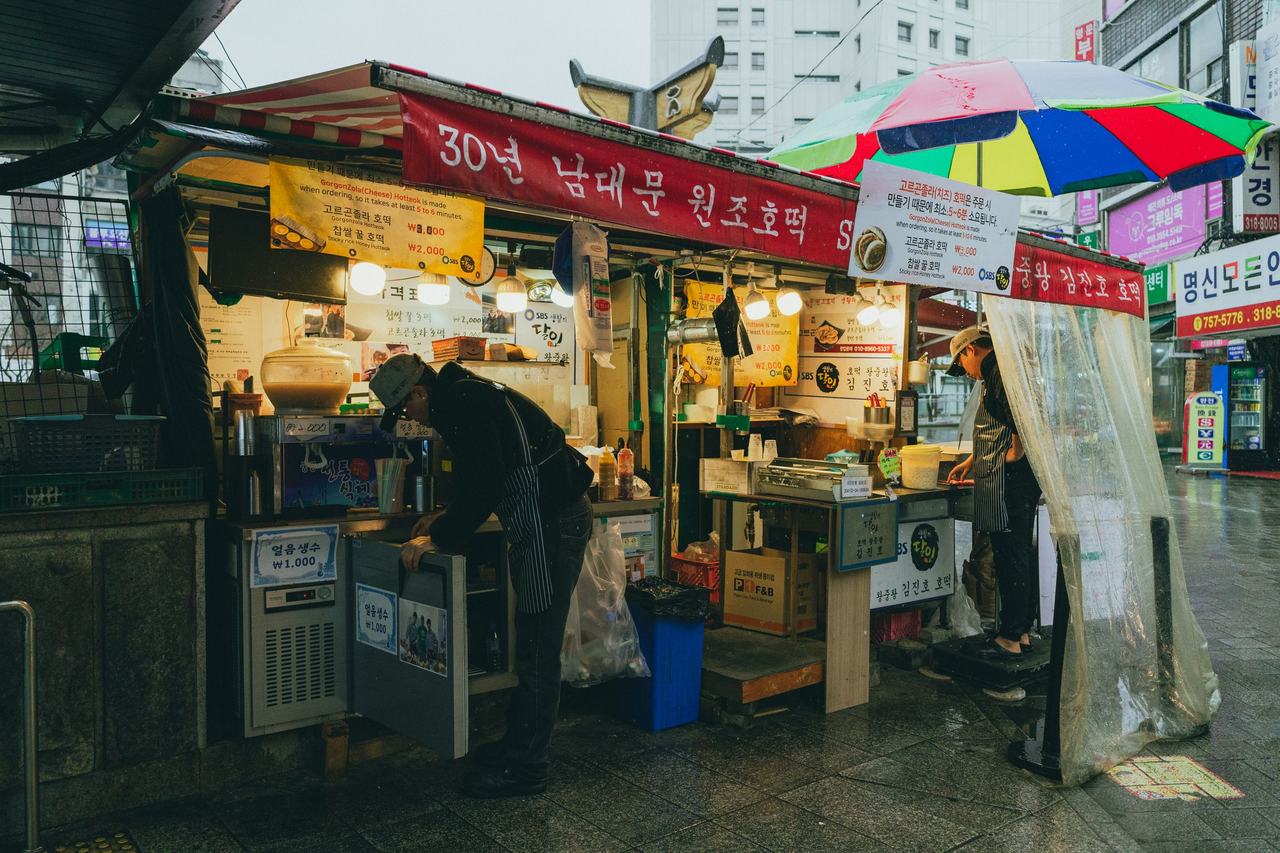
Opening photograph: Vendors work at a covered street food stall under a red banner on a rainy market street in Seoul. Photograph by Theodore Nguyen on Pexels. Blog photo credits.