What to Say When the Ticket Gate Won’t Open in Tokyo
When a ticket gate in Tokyo beeps and shuts on you, step aside and go to the attendant’s window beside the gates, and say すみません、改札が通れません (excuse me, I can’t get through the gate). The attendant checks your card. In Koe’s scene at Shinjuku the problem is a low balance, and you hear 残高が足りませんね (there isn’t enough on your card), then directions to the fare adjustment machine, where you add money and try the gate again. Below is that whole exchange, with a recording of every line from Koe’s getting-around unit.
The moment the gate shuts
First, find the attendant. The course note tells you where:
You say
すみません、改札が通れません。
Sumimasen, kaisatsu ga tōremasen.
Excuse me, I can’t get through the gate.
改札 is the ticket gate. When it shuts on you, the attendant’s window, or an intercom, is beside it.
改札 is the ticket gate, and 通れません means you can’t get through. With すみません in front, it is the whole explanation. You do not need to describe the beep or guess at the reason. In the course, the attendant checks the card and tells you what is wrong.
If there is an intercom rather than a person, the same line works into the speaker.
Not enough on your card: what the attendant says
Suica is a prepaid, rechargeable contactless card. You put money on it, and each ride takes some off. It also works as electronic money in shops, especially convenience stores, and at many station vending machines and lockers, so those purchases come out of the same balance as your rides. When the balance cannot cover the fare, the gate stops you. In Koe’s scene, Murakami-san, the station attendant, checks the card and says:
Murakami-san, the station attendant, says
残高が足りませんね。
Zandaka ga tarimasen ne.
There isn’t enough on your card.
The key word is 残高, which the course explains is the balance. 足りません means there isn’t enough. It is a routine problem with a routine fix, and the next line tells you what to do.
If you did not catch it, ask again:
You say
すみません、もう一度お願いします。
Sumimasen, mō ichido onegai shimasu.
Sorry, could you say that again?
もう一回 is a little more casual, and fine too.
Being sent to the fare adjustment machine
Next comes the instruction. In the course, she sends you to a machine inside the gates:
Murakami-san, the station attendant, says
あちらの精算機でチャージしてください。
Achira no seisanki de chāji shite kudasai.
Please add money at the fare adjustment machine over there.
Two words carry this sentence. 精算機 is the fare adjustment machine, and チャージ is adding money to a card. あちら is over there, so look where the attendant points. If you lose sight of it, these two lines find it again:
You ask
精算機はどこですか?
Seisanki wa doko desu ka?
Where’s the fare adjustment machine?
The 精算機 stands inside the gates: it adds money to a card that’s short, or settles a paper ticket that didn’t cover the ride.
You ask
チャージはどこでできますか?
Chāji wa doko de dekimasu ka?
Where can I add money to my card?
チャージ, charge, is adding money to an IC card. Every ticket machine does it, and so does the fare adjustment machine inside the gates.
The course notes explain the difference. The 精算機 stands inside the gates: it adds money to a card that’s short, or settles a paper ticket that didn’t cover the ride. チャージ happens at every ticket machine as well, but when you are already stuck inside the gates, the fare adjustment machine is the one you can reach.
Add money at the machine, then walk back to the gate.
Touch here: trying the gate again
When you come back, the attendant may show you where the card goes:
Murakami-san, the station attendant, says
ICカードはこちらにタッチしてください。
IC kādo wa kochira ni tatchi shite kudasai.
Touch your IC card here.
こちらにタッチしてください means touch it here. The course uses the English loan タッチ, so you may recognize it as soon as you hear it. Touch the card where she shows you and walk through.
Then close the exchange the way the course teaches:
You say
分かりました。ありがとうございます。
Wakarimashita. Arigatō gozaimasu.
Got it. Thank you.
That is the whole fix: one line from you at the window, three lines from the attendant, and a thank-you.
A paper ticket, or a lost one
Not everyone rides on an IC card. If you bought a paper ticket that did not cover the whole ride, the 精算機 settles that too, as the course note says. If you cannot see it, ask with the same 精算機はどこですか?.
If the ticket is gone altogether, tell the attendant directly:
You say
切符をなくしました。
Kippu o nakushimashita.
I’ve lost my ticket.
切符 is a paper ticket, and なくしました means I’ve lost it. Say it at the attendant’s window, and the attendant will take it from there.
Out of the gate: finding the right exit
Once you are through, there is often one more question. Big stations have many exits, and the course notes that Shinjuku has more than a dozen, named by compass point. In Koe’s scene, right after the gate, you ask for the East Exit:
You ask
東口はどちらですか?
Higashiguchi wa dochira desu ka?
Which way is the East Exit?
Big stations have many exits, named by compass point: 東口 is the East Exit. Shinjuku has more than a dozen.
Murakami-san, the station attendant, says
東口はあちらです。
Higashiguchi wa achira desu.
The East Exit is that way.
東口 is the East Exit, and あちら comes back once more: that way. For more on asking the way above ground, see how to ask for directions in Japanese. For buying a card and keeping it topped up, see how to buy and charge a Suica.
Getting ready for thirty seconds at the gate
A closed gate feels much bigger than it is, because it happens with a crowd behind you. The Japanese is small: すみません、改札が通れません to start, 精算機はどこですか? or チャージはどこでできますか? if you get lost on the way to the machine, and 分かりました。ありがとうございます at the end. The attendant’s three lines are the part to practice, because they come fast and you need to act on them.
Every line on this page is a recording from Koe’s course. In the app you hear each line, say it out loud, and see what it heard. Play Murakami-san’s lines a few times before your trip, until 残高, 精算機 and タッチ jump out of the sentence, and a beeping gate will be a short detour instead of a panic.
Every line on this page
The 11 lines above, in order, for one last listen before you go. Each one is the recording from the Koe course.
すみません、改札が通れません。Sumimasen, kaisatsu ga tōremasen.Excuse me, I can’t get through the gate.
残高が足りませんね。Zandaka ga tarimasen ne.There isn’t enough on your card.
すみません、もう一度お願いします。Sumimasen, mō ichido onegai shimasu.Sorry, could you say that again?
あちらの精算機でチャージしてください。Achira no seisanki de chāji shite kudasai.Please add money at the fare adjustment machine over there.
精算機はどこですか?Seisanki wa doko desu ka?Where’s the fare adjustment machine?
チャージはどこでできますか?Chāji wa doko de dekimasu ka?Where can I add money to my card?
ICカードはこちらにタッチしてください。IC kādo wa kochira ni tatchi shite kudasai.Touch your IC card here.
分かりました。ありがとうございます。Wakarimashita. Arigatō gozaimasu.Got it. Thank you.
切符をなくしました。Kippu o nakushimashita.I’ve lost my ticket.
東口はどちらですか?Higashiguchi wa dochira desu ka?Which way is the East Exit?
東口はあちらです。Higashiguchi wa achira desu.The East Exit is that way.
Common questions
What should I do if the ticket gate won’t open with my Suica?
Step aside and go to the attendant’s window beside the gates. Say すみません、改札が通れません. In Koe’s scene the reason is a low balance: the attendant says 残高が足りませんね and sends you to the fare adjustment machine inside the gates to add money.
What is the fare adjustment machine in a Japanese station?
The 精算機 (seisanki) stands inside the gates. The course notes that it adds money to an IC card that is short, or settles a paper ticket that did not cover the ride. To find it, ask 精算機はどこですか?.
How do you say “I can’t get through the gate” in Japanese?
Say すみません、改札が通れません, excuse me, I can’t get through the gate. 改札 is the ticket gate. The attendant’s window, or an intercom, is beside it.
What do I say if I lose my train ticket in Japan?
Tell the station attendant 切符をなくしました, I’ve lost my ticket. 切符 is a paper ticket.
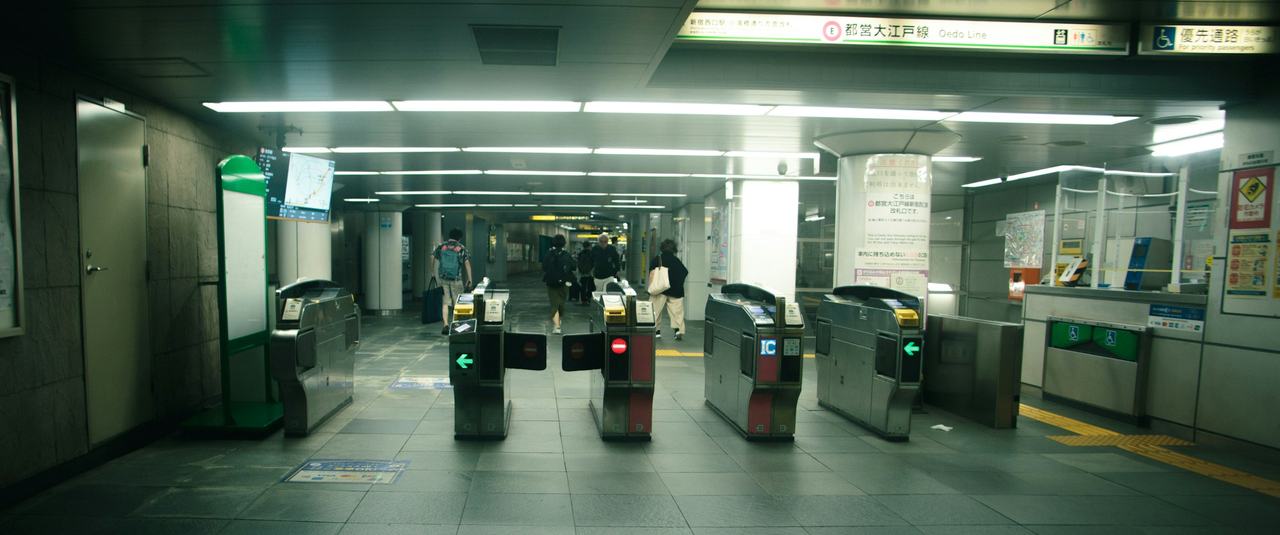
Opening photograph: Ticket gates at Shinjuku station in Tokyo. Photograph by Thiago Yonamine on Unsplash. Blog photo credits.