How to Ask for Directions in Japanese and Follow Them
To ask for directions in Japanese, start with すみません, excuse me, then name the place and add doko desu ka: すみません、神保町駅はどこですか? (excuse me, where is Jimbocho Station?). Swap in the station you need. The harder half is the answer, which in the course comes in three pieces: go straight, turn at a landmark, and how many minutes it takes. Check what you heard with まっすぐですね (straight ahead, right?) and finish with 分かりました。ありがとうございます (got it, thank you). Most lines below are from Koe’s getting-around unit, where you come out of a bookstore in Jimbocho with no idea which way the station is and ask a woman waiting at the crossing.
Stopping someone: excuse me comes first
Before any question, get the person’s attention. The word for that is the one Tokyo uses all day:
You say
すみません。
Sumimasen.
Excuse me.
Also sorry. Tokyo uses it all day: to get someone’s attention, to apologize, and even to thank someone who went to some trouble for you.
Then ask your question. Here it is with a real station name:
You ask
すみません、神保町駅はどこですか?
Sumimasen, Jinbōchō eki wa doko desu ka?
Excuse me, where is Jimbocho Station?
すみません first, to a stranger. 駅 is the station, and its name goes in front.
The note gives you the pattern. 駅 is the station, and its name goes in front: Jimbocho Station is 神保町駅. Replace the name with any station on your route and the sentence still works. Doko desu ka is where is, and it attaches to almost any place: the course also uses it for the restroom, the ATM and the fitting room.
Asking which way, and how far
Sometimes you do not need the name at all. You just want to know which direction to walk in:
You ask
駅はどちらですか?
Eki wa dochira desu ka?
Which way is the station?
どちら is the polite which way. どっち is everyday speech, and fine with strangers too.
The course explains that どちら is the polite which way, and that どっち is everyday speech and fine with strangers too.
The second question worth asking is distance. A station that is three minutes away is worth walking to. One that is twenty minutes away might mean a different plan:
You ask
歩いて何分ぐらいですか?
Aruite nanpun gurai desu ka?
About how many minutes on foot?
ぐらい is about. くらい is the same word.
歩いて is on foot, and ぐらい is about. The note adds that くらい is the same word, so you will hear both.
The three answers you will really hear
This is where directions can fall apart. You asked a clear question, and the answer comes back fast, in a sentence you have never heard. In Koe’s scene the woman at the crossing gives you three lines:
A passerby says
まっすぐ行ってください。
Massugu itte kudasai.
Go straight ahead.
A passerby says
あそこの信号を右に曲がってください。
Asoko no shingō o migi ni magatte kudasai.
Turn right at that traffic light.
A passerby says
歩いて3分ぐらいですよ。
Aruite sanpun gurai desu yo.
It’s about three minutes on foot.
Here is how to take them apart.
- Go straight ahead. まっすぐ is straight, and the sentence ends in ください, please.
- Turn right at that traffic light. The course explains the whole sentence: あそこの信号を右に曲がってください. 信号 is the traffic light, 右 is right, and あそこの信号 is that traffic light.
- About three minutes on foot. The same 歩いて and ぐらい from your question come back to you, with a number in the middle.
You do not need to catch every word. Catch the landmark (the light), the direction (right) and the number (three minutes), and you can find the station.
Checking that you heard it right
Repeating a direction back is the simplest way to be sure. The course teaches this line for it:
You say
まっすぐですね。
Massugu desu ne.
Straight ahead, right?
Checking what you heard, with ね.
ね at the end turns it into a check, the way “right?” does in English. If she nods, you are set. If she says something else, you have caught the mistake before you walked a block the wrong way.
If the answer went by too fast, ask for it again, or ask her to slow down:
You say
すみません、もう一度お願いします。
Sumimasen, mō ichido onegai shimasu.
Sorry, could you say that again?
もう一回 is a little more casual, and fine too.
You say
もう少しゆっくりお願いします。
Mō sukoshi yukkuri onegai shimasu.
A little more slowly, please.
When you have it, close the exchange. This is the line the course gives you to end it:
You say
分かりました。ありがとうございます。
Wakarimashita. Arigatō gozaimasu.
Got it. Thank you.
分かりました is got it, and the thank-you follows straight after. It is the same pair you will use with station staff, shop clerks and anyone else who helps you.
Asking for a konbini or the right exit
The same patterns work for anything you need on the street. In the course, the konbini has an answer for many small problems, from water to an ATM to an umbrella:
You ask
この近くにコンビニはありますか?
Kono chikaku ni konbini wa arimasu ka?
Is there a konbini near here?
この近くに is near here, and arimasu ka is is there. You can swap in other places from the course, like a pharmacy.
Big stations bring a different direction problem: which exit. The course notes that exits are named by compass point, and that Shinjuku has more than a dozen:
You ask
東口はどちらですか?
Higashiguchi wa dochira desu ka?
Which way is the East Exit?
Big stations have many exits, named by compass point: 東口 is the East Exit. Shinjuku has more than a dozen.
The answer you are likely to hear is short. Station staff in the course answer like this:
Murakami-san, the station attendant, says
東口はあちらです。
Higashiguchi wa achira desu.
The East Exit is that way.
あちら is that way. Like the woman at the crossing, the attendant is giving you a direction, not a map, so look where she looks.
Practicing the listening half
Asking for directions takes three or four short lines from you. What makes it hard is the reply, because a stranger answers at full speed with a landmark you have not spotted yet. The fix is to know the shape of the answer before you ask. In the course it comes as a direction, a landmark with a turn, and a time, and that is a good order to listen for.
Every line on this page is a recording from Koe’s course, and in the app you hear each line, say it out loud, and see what it heard. A good way to prepare is to play the three answers from the woman at the crossing in random order and say what each one means before the recording ends. Once “turn right at that light” sounds like words instead of noise, you are ready to ask. For the next step underground, see our posts on changing trains at Shinjuku and what to say when the ticket gate won’t open.
Every line on this page
The 14 lines above, in order, for one last listen before you go. Each one is the recording from the Koe course.
すみません。Sumimasen.Excuse me.
すみません、神保町駅はどこですか?Sumimasen, Jinbōchō eki wa doko desu ka?Excuse me, where is Jimbocho Station?
駅はどちらですか?Eki wa dochira desu ka?Which way is the station?
歩いて何分ぐらいですか?Aruite nanpun gurai desu ka?About how many minutes on foot?
まっすぐ行ってください。Massugu itte kudasai.Go straight ahead.
あそこの信号を右に曲がってください。Asoko no shingō o migi ni magatte kudasai.Turn right at that traffic light.
歩いて3分ぐらいですよ。Aruite sanpun gurai desu yo.It’s about three minutes on foot.
まっすぐですね。Massugu desu ne.Straight ahead, right?
すみません、もう一度お願いします。Sumimasen, mō ichido onegai shimasu.Sorry, could you say that again?
もう少しゆっくりお願いします。Mō sukoshi yukkuri onegai shimasu.A little more slowly, please.
分かりました。ありがとうございます。Wakarimashita. Arigatō gozaimasu.Got it. Thank you.
この近くにコンビニはありますか?Kono chikaku ni konbini wa arimasu ka?Is there a konbini near here?
東口はどちらですか?Higashiguchi wa dochira desu ka?Which way is the East Exit?
東口はあちらです。Higashiguchi wa achira desu.The East Exit is that way.
Common questions
How do you say “where is” in Japanese?
Name the place, then add wa doko desu ka. For a station: すみません、神保町駅はどこですか?. Start with すみません when you are asking a stranger.
How do you ask “which way” in Japanese?
Say the place and dochira desu ka: 駅はどちらですか?, which way is the station. The course notes that どっち is the everyday version and fine with strangers too.
How do you say “turn right” in Japanese?
You will mostly hear it rather than say it. The course’s line is あそこの信号を右に曲がってください, turn right at that traffic light. 右 is right and 信号 is the traffic light.
How do you ask how far something is in Japanese?
Ask in minutes on foot: 歩いて何分ぐらいですか?, about how many minutes on foot. The answer comes back the same way, as in 歩いて3分ぐらいですよ, about three minutes on foot.
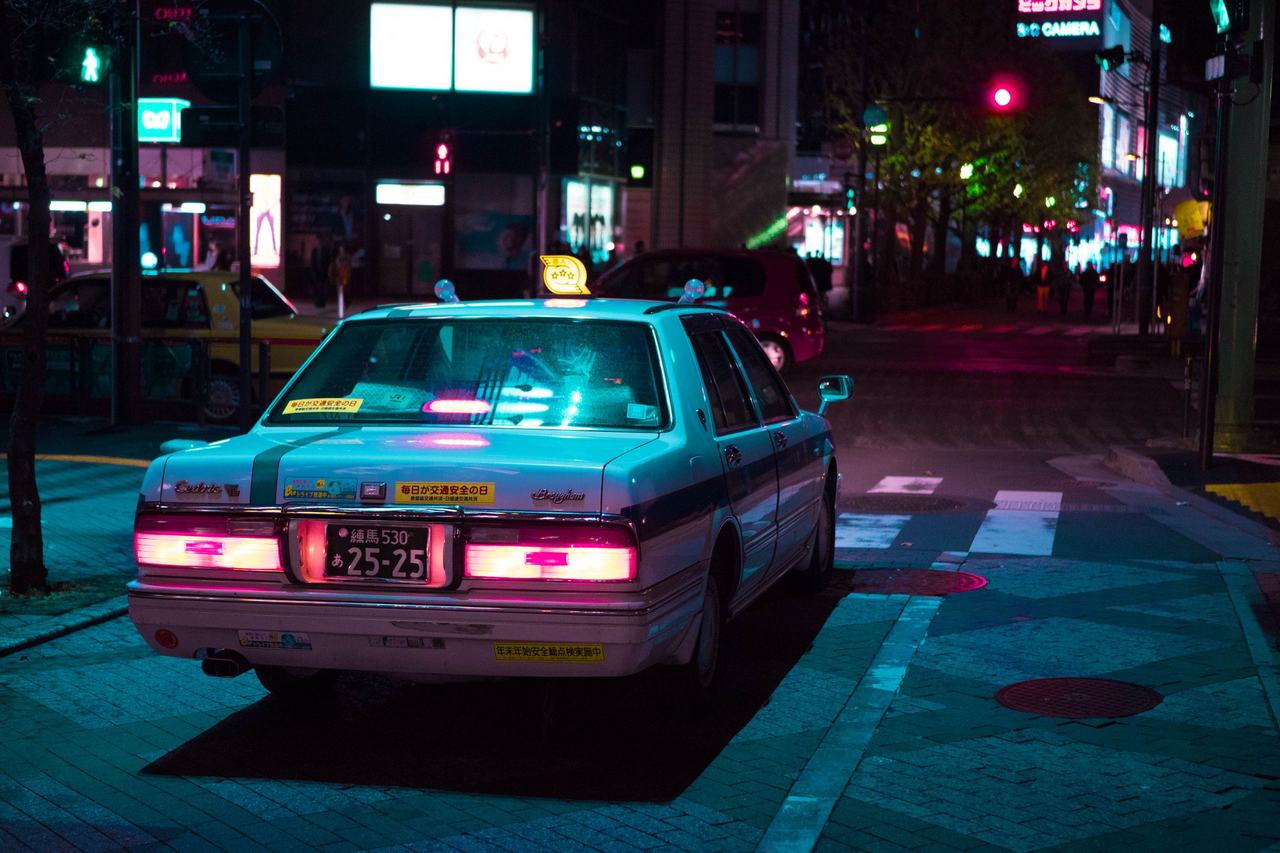
Opening photograph: A taxi with glowing tail lights waits at a corner on a neon-lit Tokyo street at night. Photograph by Alan W on Pexels. Blog photo credits.