Receipts and Point Cards: What to Say at the Register
In Japanese, the everyday receipt from the register is a reshīto, and a formal receipt for expenses is a ryōshūsho. Ask for them with レシートをください (the receipt, please) or 領収書をお願いします (a formal receipt, please). At a konbini register you will also hear two set questions: ポイントカードはお持ちですか? (do you have a point card?), which you answer with ポイントカードはないです (I don’t have a point card), and a question about the receipt, which has a trap where hai means no. Below are both questions and every answer, with real recordings from the konbini unit of Koe’s course.
Do you have a point card?
In the course, the point card question comes after the bag. The course notes put it plainly: every chain has one, and every clerk asks.
Tamura-san, the night clerk, asks
ポイントカードはお持ちですか?
Pointokādo wa omochi desu ka?
Do you have a point card?
You say
ポイントカードはないです。
Pointokādo wa nai desu.
I don’t have a point card.
Every chain has one, and every clerk asks: ポイントカードはお持ちですか?
Omochi desu ka is the clerk’s polite “do you have,” and pointokādo is easy to catch: it is “point card” in Japanese sound. Your answer is the same at every chain: pointokādo wa nai desu. It is plain, polite and complete. There is nothing more to explain, and in the course the payment comes next.
Would you like the receipt?
Once you have paid, the last question is about the receipt. Here is Tamura-san, the night clerk in the course:
Tamura-san, the night clerk, asks
レシートはいかがなさいますか?
Reshīto wa ikaga nasaimasu ka?
Would you like the receipt?
You say
レシートは大丈夫です。
Reshīto wa daijōbu desu.
I don’t need the receipt.
A trap: to レシートはよろしいですか?, はい means no receipt. Answer with 大丈夫です or ください and you can’t go wrong.
You say
レシートをください。
Reshīto o kudasai.
The receipt, please.
Reshīto wa ikaga nasaimasu ka asks what you would like to do with the receipt. Ikaga is the same word a clothing store clerk uses in ikaga desu ka, how is it, so it is worth knowing by ear. If you do not want it, reshīto wa daijōbu desu. If you do, reshīto o kudasai. As at the rest of the register, daijōbu desu does the job of a polite no.
The trap: when hai means no
The receipt question has a second form, and this is where it is easy to get the opposite of what you wanted. In the course’s role play, the clerk asks it this way:
Tamura-san, the night clerk, asks
レシートはよろしいですか?
Reshīto wa yoroshii desu ka?
You don’t need the receipt?
The course translates it as “you don’t need the receipt?” The clerk is checking that you do not want it. So if you answer with a simple yes, you are agreeing: no receipt. The course notes spell this out on the answer line: to reshīto wa yoroshii desu ka, hai means no receipt.
Here is how it plays out. The clerk asks reshīto wa yoroshii desu ka. You say hai, meaning yes, please. The clerk hears yes, I don’t need it, and you leave without a receipt. Had you said reshīto o kudasai, there would have been no doubt either way.
The safest habit is to avoid hai and iie for this question altogether. Answer with daijōbu desu if you do not want it, or kudasai if you do, and, in the course’s words, you can’t go wrong. For reference, here is what hai covers in the course’s notes:
You say
はい。
Hai.
Yes.
Also okay, or I’m listening. A small nod goes with it.
Because hai can mean yes, okay or simply I’m listening, it is a poor answer to a question that is already phrased as a negative. A full answer leaves no doubt.
Reshīto or ryōshūsho: which receipt you need
Most of the time, the register slip is all you need. But if you are traveling for work and need to claim expenses, ask for the other kind:
You say
領収書をお願いします。
Ryōshūsho o onegai shimasu.
A formal receipt, please.
For expenses. A 領収書 has a line for the payer’s name, where a レシート is the register’s slip.
The course notes explain the difference. A ryōshūsho has a line for the payer’s name, where a reshīto is the register’s slip. So if your company asks for a receipt with your name or company on it, ryōshūsho is the word. Ask for it when you pay, so the clerk can prepare it.
Leaving the register
When everything is done, the clerk sees you off with the standard closing line:
Tamura-san, the night clerk, says
ありがとうございました。またお越しくださいませ。
Arigatō gozaimashita. Mata okoshi kudasaimase.
Thank you. Please come again.
Arigatō gozaimashita is thank you, and mata okoshi kudasaimase asks you to come again. With the point card and receipt questions handled, that is the end of the purchase.
The end of a purchase, in order
- The clerk asks about a point card. Say ポイントカードはないです.
- You pay, by cash, card or transit card.
- The clerk asks about the receipt, in either form. Say レシートは大丈夫です or レシートをください, and never a bare hai.
- For expenses, ask for 領収書をお願いします instead.
- The clerk thanks you and asks you to come again.
For the earlier questions at the register, the bento, the chopsticks and the bag, see the guide to what konbini staff ask. If you are paying in cash, the guide to what cashiers say covers the change.
Every line on this page is a recording from Koe’s course. The receipt question comes in two forms, and the difference between them is small and fast, so it is worth hearing both until you can tell them apart. In the app you hear each line, answer out loud, and see what it heard.
Every line on this page
The 9 lines above, in order, for one last listen before you go. Each one is the recording from the Koe course.
ポイントカードはお持ちですか?Pointokādo wa omochi desu ka?Do you have a point card?
ポイントカードはないです。Pointokādo wa nai desu.I don’t have a point card.
レシートはいかがなさいますか?Reshīto wa ikaga nasaimasu ka?Would you like the receipt?
レシートは大丈夫です。Reshīto wa daijōbu desu.I don’t need the receipt.
レシートをください。Reshīto o kudasai.The receipt, please.
レシートはよろしいですか?Reshīto wa yoroshii desu ka?You don’t need the receipt?
はい。Hai.Yes.
領収書をお願いします。Ryōshūsho o onegai shimasu.A formal receipt, please.
ありがとうございました。またお越しくださいませ。Arigatō gozaimashita. Mata okoshi kudasaimase.Thank you. Please come again.
Common questions
How do you say “receipt” in Japanese?
The register slip is a reshīto: ask for it with レシートをください. A formal receipt for expenses is a ryōshūsho: 領収書をお願いします.
What is the difference between reshīto and ryōshūsho?
The course notes explain that a ryōshūsho has a line for the payer’s name, where a reshīto is the register’s slip. Ask for a ryōshūsho when you need to claim expenses.
What does “reshīto wa yoroshii desu ka” mean?
It means “you don’t need the receipt?” Answering hai agrees with it, so you get no receipt. Answer レシートは大丈夫です if you do not want it, or レシートをください if you do.
What should you say when asked for a point card?
Say ポイントカードはないです, I don’t have a point card. The course notes say every chain has one, and every clerk asks.
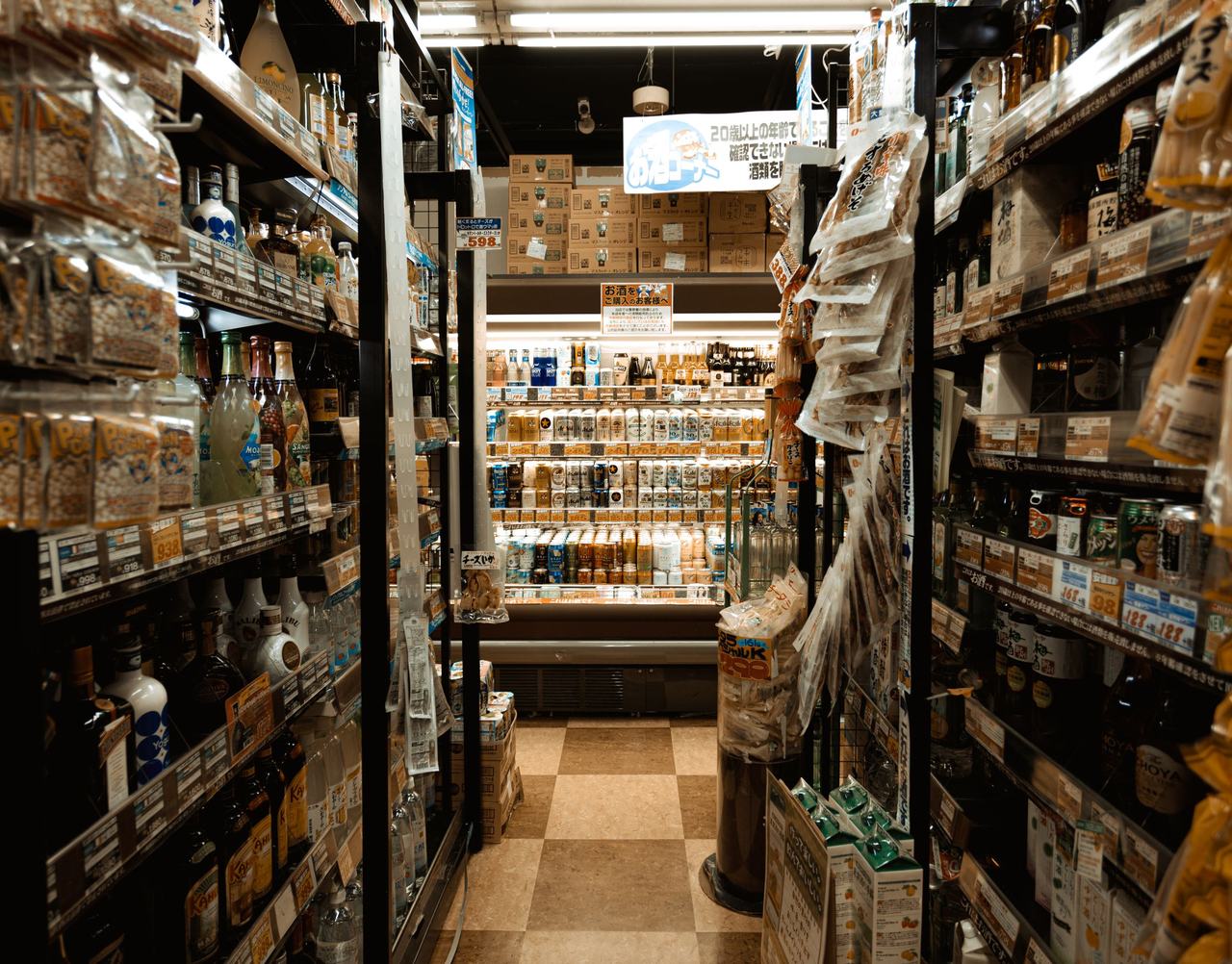
Opening photograph: A narrow convenience store aisle in Tokyo lined with packed shelves and a glowing drinks fridge at the back. Photograph by Aleksandar Pasaric on Pexels. Blog photo credits.