What Konbini Staff Ask You and How to Answer
At a Tokyo konbini, the clerk asks up to six quick questions at the register: shall I heat it up, would you like chopsticks, a bag, do you have a point card, how will you pay, and do you want the receipt. You can answer almost all of them with one of two lines. For no, use daijōbu desu, as in 袋は大丈夫です (I don’t need a bag). For yes, はい、お願いします (yes, please). Below is each question in the order it comes, at real speed, with the short answer, plus the sticker and touch-the-screen prompts. Every line is from the late-night konbini unit of Koe’s course, with Tamura-san, the night clerk.
The one answer that works almost every time
Most konbini questions are offers, and the course gives one rule for turning them down: daijōbu desu is the polite no at a konbini. Put the thing you are refusing in front of it, and you have a complete answer: fukuro wa daijōbu desu, no bag; ohashi wa daijōbu desu, no chopsticks.
The course notes also explain why not to say ii desu. On its own, it can mean yes or no, so clerks often ask again. Say daijōbu desu for no and onegai shimasu for yes, and the clerk will know exactly what you mean. The same two answers carry you through the heating, chopsticks, bag and receipt questions below.
Heating and chopsticks
If you buy a bento, pasta or a rice bowl, the first question comes before anything is scanned. The course notes say these are heated at the counter, and the clerk asks first:
Tamura-san, the night clerk, asks
お弁当、温めますか?
Obentō, atatamemasu ka?
Shall I heat up your bento?
You say
温めてください。
Atatamete kudasai.
Please heat it up.
Bentos, pasta and rice bowls are heated at the counter, and the clerk asks first: お弁当、温めますか?
Next comes the chopsticks question:
Tamura-san, the night clerk, asks
お箸はお付けしますか?
Ohashi wa otsuke shimasu ka?
Would you like chopsticks?
You say
お箸は大丈夫です。
Ohashi wa daijōbu desu.
No chopsticks, thank you.
いらないです is understood, but it’s blunt. 大丈夫です does the same job softly.
The note on the chopsticks line is worth reading: いらないです is understood, but it’s blunt, and daijōbu desu does the same job softly. For everything else about the food counter, including how many pairs and asking for a spoon, see the guide to bento, heating and chopsticks.
The bag, and the sticker
The bag question comes to everyone. The course notes explain why: since 2020, plastic bags cost a few yen, so clerks ask and many people carry their own.
Tamura-san, the night clerk, asks
袋はご利用ですか?
Fukuro wa goriyō desu ka?
Would you like a bag?
You say
袋は大丈夫です。
Fukuro wa daijōbu desu.
I don’t need a bag.
Since 2020, plastic bags cost a few yen, so clerks ask and many people carry their own.
Tamura-san, the night clerk, asks
シールでよろしいですか?
Shīru de yoroshii desu ka?
Is a sticker all right?
The third line is the one phrase lists leave out. Shīru de yoroshii desu ka asks if a sticker is all right. The course explains it: with no bag, the clerk tapes the store’s sticker on the item to show it’s paid for. A nod or hai is all you need. The guide to the bag question has the other answers, including “I have my own bag.”
The point card
Next comes a question you can answer the same way every time, as a visitor:
Tamura-san, the night clerk, asks
ポイントカードはお持ちですか?
Pointokādo wa omochi desu ka?
Do you have a point card?
You say
ポイントカードはないです。
Pointokādo wa nai desu.
I don’t have a point card.
Every chain has one, and every clerk asks: ポイントカードはお持ちですか?
The course notes say every chain has one, and every clerk asks. Pointokādo wa nai desu is the plain, polite answer, and it is the one you will give at every chain you visit. There is nothing more to explain, and in the course the payment comes next.
Paying, and touching the screen
Then the clerk asks how you will pay, or points you to a small screen facing you. At some chains you choose there; at others you tell the clerk. With a transit card such as Suica, which also works as electronic money in shops, especially convenience stores, the course’s line is:
Tamura-san, the night clerk, asks
お支払い方法はいかがなさいますか?
Oshiharai hōhō wa ikaga nasaimasu ka?
How would you like to pay?
You say
交通系でお願いします。
Kōtsūkei de onegai shimasu.
With my transit card, please.
At some chains you pick the payment on a small screen facing you and feed cash into the machine yourself; at others you tell the clerk, and this is the line. 交通系 is the word for transit cards, Suica, PASMO and the rest. Saying the card’s name, スイカで, is fine too.
Sometimes the clerk asks you to touch the screen for another reason:
Tamura-san, the night clerk, says
画面のタッチをお願いします。
Gamen no tatchi o onegai shimasu.
Please touch the screen.
The course explains this one too: when there is alcohol in the basket, that touch confirms your age. Touch the screen as the clerk asks, and the sale carries on. It is about the alcohol, not a problem with your payment.
The receipt
The last question is about the receipt, and it hides the one real trap at the register:
Tamura-san, the night clerk, asks
レシートはいかがなさいますか?
Reshīto wa ikaga nasaimasu ka?
Would you like the receipt?
You say
レシートは大丈夫です。
Reshīto wa daijōbu desu.
I don’t need the receipt.
A trap: to レシートはよろしいですか?, はい means no receipt. Answer with 大丈夫です or ください and you can’t go wrong.
The note explains the trap. If the clerk asks reshīto wa yoroshii desu ka, which means “you don’t need the receipt?”, then hai means no receipt. Answer with daijōbu desu or kudasai and you can’t go wrong. The guide to receipts and point cards covers that and the formal receipt for expenses.
As you leave, you will hear the clerk’s closing line:
Tamura-san, the night clerk, says
ありがとうございました。またお越しくださいませ。
Arigatō gozaimashita. Mata okoshi kudasaimase.
Thank you. Please come again.
The whole register sequence
Here is how a late-night bento run sounds, start to finish, with your answers:
- Heat it up? 温めてください, or daijōbu desu.
- Chopsticks? はい、お願いします, or お箸は大丈夫です.
- A bag? 袋は大丈夫です, and a nod for the sticker.
- A point card? ポイントカードはないです.
- How will you pay? 交通系でお願いします, or touch the screen.
- The receipt? レシートは大丈夫です.
Every line on this page is a recording from Koe’s course. These are listening questions more than speaking ones: the clerk says them fast, and the answers are short. In the app you hear each question, answer out loud, and see what it heard.
Every line on this page
The 15 lines above, in order, for one last listen before you go. Each one is the recording from the Koe course.
お弁当、温めますか?Obentō, atatamemasu ka?Shall I heat up your bento?
温めてください。Atatamete kudasai.Please heat it up.
お箸はお付けしますか?Ohashi wa otsuke shimasu ka?Would you like chopsticks?
お箸は大丈夫です。Ohashi wa daijōbu desu.No chopsticks, thank you.
袋はご利用ですか?Fukuro wa goriyō desu ka?Would you like a bag?
袋は大丈夫です。Fukuro wa daijōbu desu.I don’t need a bag.
シールでよろしいですか?Shīru de yoroshii desu ka?Is a sticker all right?
ポイントカードはお持ちですか?Pointokādo wa omochi desu ka?Do you have a point card?
ポイントカードはないです。Pointokādo wa nai desu.I don’t have a point card.
お支払い方法はいかがなさいますか?Oshiharai hōhō wa ikaga nasaimasu ka?How would you like to pay?
交通系でお願いします。Kōtsūkei de onegai shimasu.With my transit card, please.
画面のタッチをお願いします。Gamen no tatchi o onegai shimasu.Please touch the screen.
レシートはいかがなさいますか?Reshīto wa ikaga nasaimasu ka?Would you like the receipt?
レシートは大丈夫です。Reshīto wa daijōbu desu.I don’t need the receipt.
ありがとうございました。またお越しくださいませ。Arigatō gozaimashita. Mata okoshi kudasaimase.Thank you. Please come again.
Common questions
How do you say “no, thank you” at a Japanese convenience store?
Say daijōbu desu, with the thing in front of it: 袋は大丈夫です for no bag, お箸は大丈夫です for no chopsticks. The course notes say ii desu on its own can mean yes or no, so avoid it.
Why does the konbini clerk put a sticker on my item?
If you do not take a bag, the clerk tapes the store’s sticker on the item to show it is paid for. The clerk asks first with shīru de yoroshii desu ka, is a sticker all right.
Do you need a point card at a konbini?
No. The course notes say every chain has one and every clerk asks. Answer ポイントカードはないです, I don’t have a point card.
Why does the konbini screen ask me to touch it?
When there is alcohol in the basket, touching the screen confirms your age. The clerk says gamen no tatchi o onegai shimasu, please touch the screen.
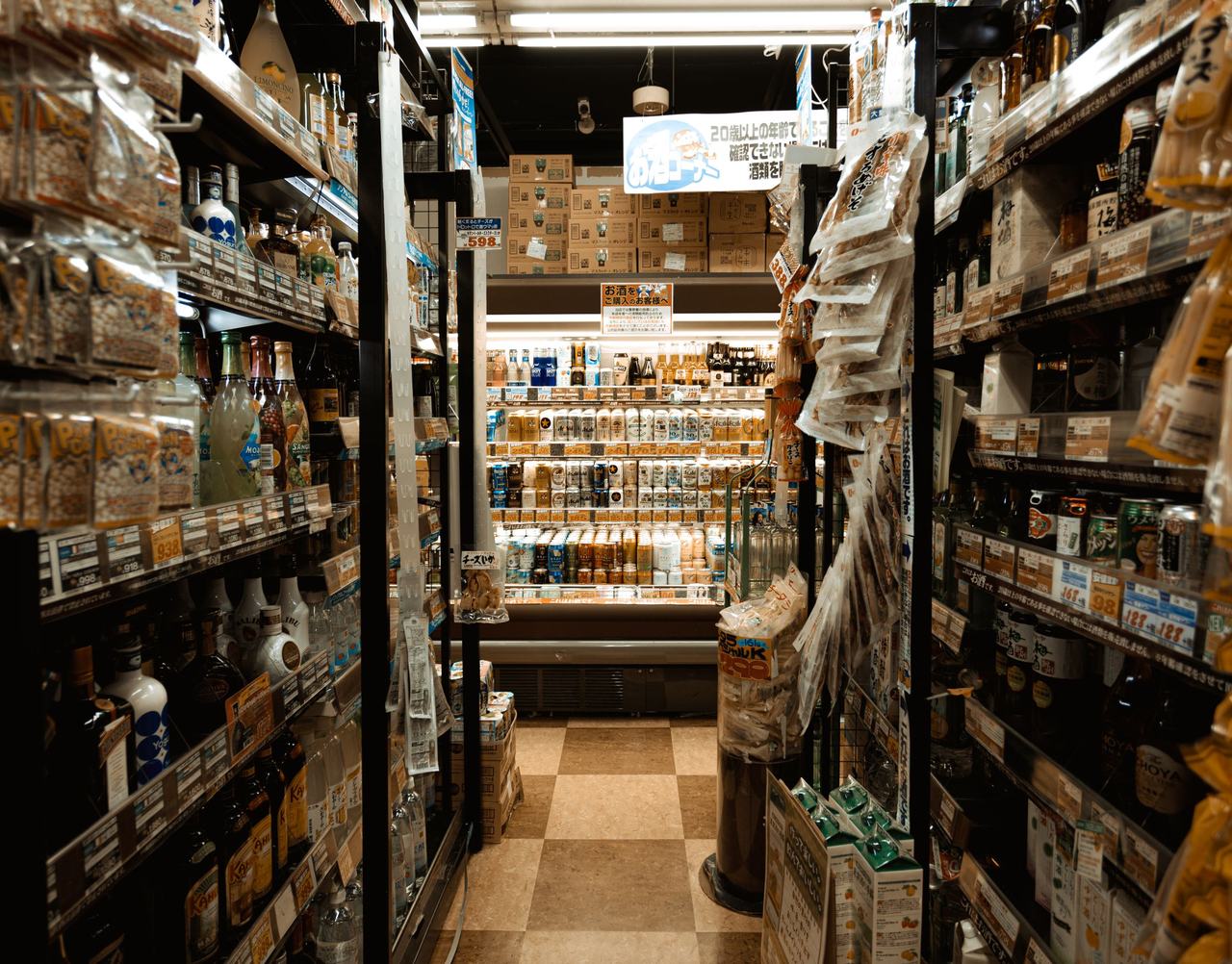
Opening photograph: A narrow convenience store aisle in Tokyo lined with packed shelves and a glowing drinks fridge at the back. Photograph by Aleksandar Pasaric on Pexels. Blog photo credits.