Can You Use Konbini Toilets in Tokyo and How to Ask
Often, yes. The course notes that many konbini let you use the restroom, but that around busy stations a lot can’t. Rules vary by store: some let customers walk in freely, others ask you to tell the staff first, and asking is the usual courtesy when it is not urgent. The polite way to ask is トイレを借りてもいいですか? (may I use the restroom?). You will hear one of two answers: トイレは奥にございます。どうぞ (the restroom is at the back, go ahead) or 申し訳ございません、トイレはご利用いただけません (I’m sorry, the restroom isn’t available). Below is that exchange with recordings from Koe’s convenience store unit, plus the café version.
Can you use a konbini toilet?
The short answer depends on the store. The course says it plainly in the note on the key line: many konbini say yes, and around busy stations a lot can’t. Its late-night scene even ends with another store’s refusal, because not every konbini can lend you its restroom.
Practice varies inside the yes, too. Some stores let customers walk in freely. Others ask you to tell the staff first. When you are not in a rush, asking is the usual courtesy, and it also tells you straight away whether this store is a yes or a no.
The polite ask
Catch the clerk’s attention, then ask:
You say
すみません。
Sumimasen.
Excuse me.
Also sorry. Tokyo uses it all day: to get someone’s attention, to apologize, and even to thank someone who went to some trouble for you.
You ask
トイレを借りてもいいですか?
Toire o karitemo ii desu ka?
May I use the restroom?
Literally, may I borrow the restroom. Many konbini say yes; around busy stations a lot can’t: ご利用いただけません.
The note gives the literal meaning: may I borrow the restroom. トイレ is the restroom, and 借りてもいいですか asks permission to borrow it. It is one sentence, and it is all you need to say.
You do not need to explain why or add anything else. The clerk knows what you are asking.
Yes: at the back, go ahead
If the store lets customers use it, the clerk tells you where it is and lets you go ahead. In Koe’s scene, Tamura-san, the night clerk, says:
Tamura-san, the night clerk, says
トイレは奥にございます。どうぞ。
Toire wa oku ni gozaimasu. Dōzo.
The restroom is at the back. Go ahead.
The course explains the key word: 奥 is the back, where the restroom is. ございます is the clerk’s formal way of saying it is there, and どうぞ is go ahead. Head for the back of the store.
When you come out, a thank-you on the way past the counter closes it nicely. For a kindness like this, the course notes, Tokyo often says sorry and thank you in one breath:
You say
ありがとうございます。
Arigatō gozaimasu.
Thank you.
For a kindness, Tokyo often says sorry and thank you in one breath: すみません、ありがとうございます.
The same konbini lesson covers the store’s other late-night help, much of it asked with wa doko desu ka, where is. ATMはどこですか? finds the ATM, which the course notes takes foreign cards around the clock. And one more is worth knowing in a city with few public bins:
You ask
ゴミ箱はどこですか?
Gomibako wa doko desu ka?
Where’s the trash can?
Tokyo streets have almost no trash cans. The konbini’s, by the door or inside, is for what you bought there.
So the konbini is a place to ask for more than the restroom, as long as you keep to what the note says about the trash can.
No: the restroom isn’t available
In the course, the other answer starts with an apology, and that is the clue. When the first words are 申し訳ございません, the answer is no:
Tamura-san, the night clerk, says
申し訳ございません、トイレはご利用いただけません。
Mōshiwake gozaimasen, toire wa goriyō itadakemasen.
I’m sorry, the restroom isn’t available.
申し訳ございません is a formal I’m sorry, and ご利用いただけません means it isn’t available. The course explains that some stores have to say this. It is not about you, and there is nothing to argue with. Thank the clerk and move on to the next store.
To find one quickly, ask the same clerk, or anyone nearby:
You ask
この近くにコンビニはありますか?
Kono chikaku ni konbini wa arimasu ka?
Is there a konbini near here?
この近くに is near here, and arimasu ka is is there. The directions you get back come in the same shapes as any other: straight ahead, turn at a landmark, a few minutes on foot. Our post on asking for directions in Japanese covers how to follow them. When you have them, close with:
You say
分かりました。ありがとうございます。
Wakarimashita. Arigatō gozaimasu.
Got it. Thank you.
Two words for restroom, and asking in a café
Japanese has two everyday words for the restroom, and you will hear both. The course note on the café line explains which is which:
You ask
トイレはどこですか?
Toire wa doko desu ka?
Where’s the restroom?
お手洗い is the more polite word, and トイレ is fine too.
お手洗い is the more polite word, and トイレ is fine too. In the course, the café owner uses お手洗い. You can use either. どこですか is where is.
In a café where you are a customer, the course has you ask where it is rather than whether you may use it. In Koe’s kissaten scene in Jimbocho, the owner, Haruka, answers like this:
Haruka, the café owner, says
お手洗いは奥の右です。
Otearai wa oku no migi desu.
The restroom is at the back, on the right.
The restroom is at the back, on the right. The same 奥, the back, appears again, followed by 右, right. Listen for those two words and you will know where to walk. If the answer goes by too fast, a quick すみません、もう一度お願いします, could you say that again, works here too.
The whole thing in order
- At a konbini, catch the clerk’s eye with すみません.
- Ask トイレを借りてもいいですか?.
- If you hear 奥 and どうぞ, it is a yes: head to the back.
- If you hear 申し訳ございません, it is a no: ask この近くにコンビニはありますか? and try the next store.
- On the way out, thank the clerk.
- In a café, ask トイレはどこですか? instead, and listen for the direction.
Every line on this page is a recording from Koe’s course, and the app has you hear each one, say it out loud, and then shows you what it heard. The two clerk answers are the ones to practice, because you need to know in a second which one you heard.
Every line on this page
The 10 lines above, in order, for one last listen before you go. Each one is the recording from the Koe course.
すみません。Sumimasen.Excuse me.
トイレを借りてもいいですか?Toire o karitemo ii desu ka?May I use the restroom?
トイレは奥にございます。どうぞ。Toire wa oku ni gozaimasu. Dōzo.The restroom is at the back. Go ahead.
ありがとうございます。Arigatō gozaimasu.Thank you.
ゴミ箱はどこですか?Gomibako wa doko desu ka?Where’s the trash can?
申し訳ございません、トイレはご利用いただけません。Mōshiwake gozaimasen, toire wa goriyō itadakemasen.I’m sorry, the restroom isn’t available.
この近くにコンビニはありますか?Kono chikaku ni konbini wa arimasu ka?Is there a konbini near here?
分かりました。ありがとうございます。Wakarimashita. Arigatō gozaimasu.Got it. Thank you.
トイレはどこですか?Toire wa doko desu ka?Where’s the restroom?
お手洗いは奥の右です。Otearai wa oku no migi desu.The restroom is at the back, on the right.
Common questions
Can you use convenience store toilets in Japan?
Often, yes. The course notes that many konbini say yes, but around busy stations a lot can’t. Some stores let customers walk in freely, others ask you to tell the staff first, and asking is the usual courtesy.
How do you ask to use the bathroom in Japanese?
At a konbini, say トイレを借りてもいいですか?, may I use the restroom. Literally, it asks to borrow the restroom. In a café, ask トイレはどこですか?, where’s the restroom.
What does “goriyō itadakemasen” mean?
ご利用いただけません means it isn’t available, in formal Japanese. At a konbini, you hear it in 申し訳ございません、トイレはご利用いただけません, I’m sorry, the restroom isn’t available.
What is the polite word for toilet in Japanese?
お手洗い (otearai) is the more polite word. The course notes that トイレ is fine too, so you can use either.
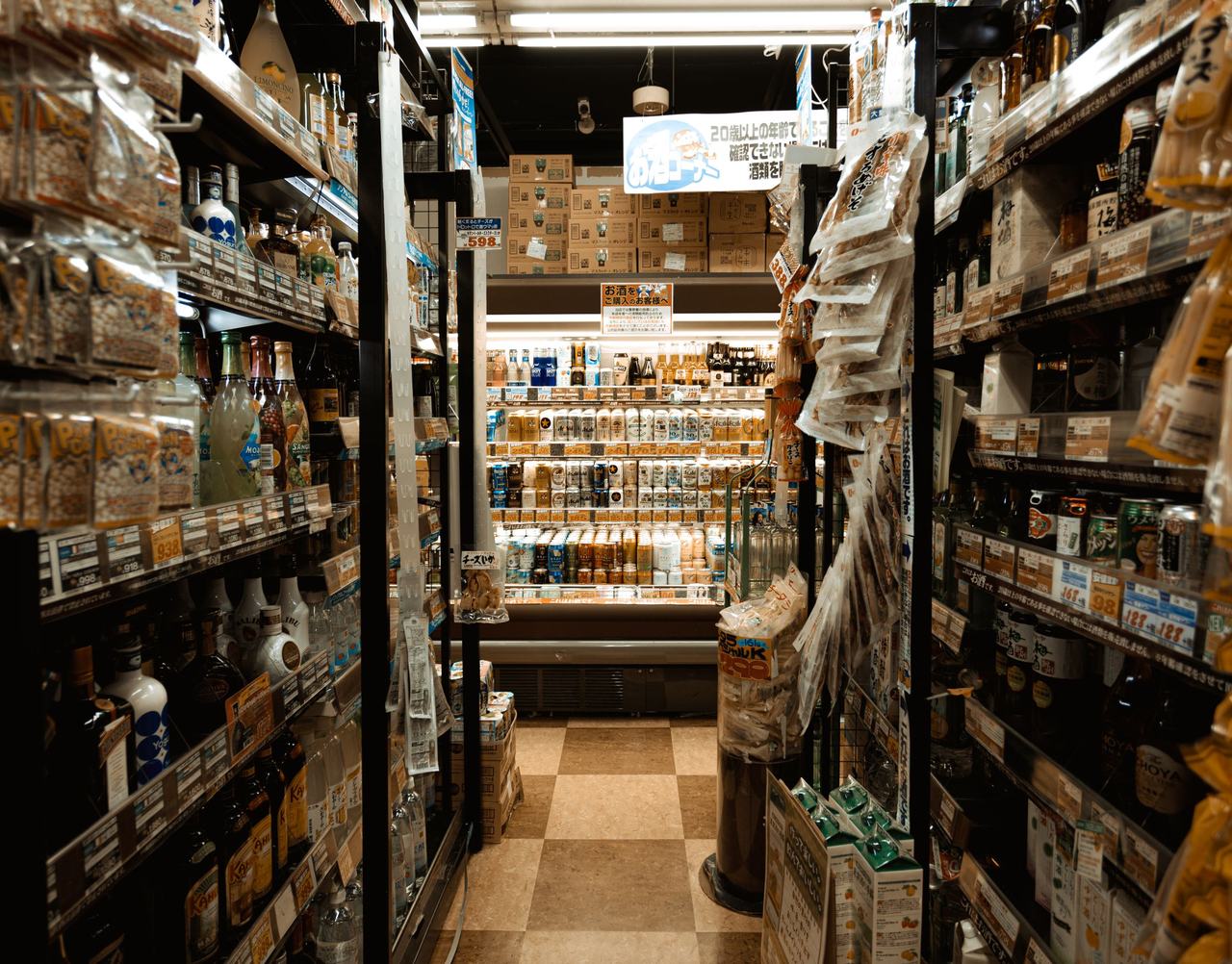
Opening photograph: A narrow convenience store aisle in Tokyo lined with packed shelves and a glowing drinks fridge at the back. Photograph by Aleksandar Pasaric on Pexels. Blog photo credits.