How to Ask for Another Size or Color in Japanese
To ask for a different size in Japanese, hold up the piece and say もう少し大きいのはありますか? (do you have a slightly bigger one?) or もう少し小さいのはありますか? (a slightly smaller one?). For a different color, ask ほかの色はありますか?. Then listen for one of three answers: yes, here it is; no, it is the only one; or a suggestion, such as the same item in another color. Every line below comes from Koe’s shopping unit, set in Nomura-san’s small vintage clothing store in Shimokitazawa, with the recording of each.
Asking for a bigger or smaller size
The two size questions are the same sentence with one word swapped. Learn one and you have both.
You ask
もう少し大きいのはありますか?
Mō sukoshi ōkii no wa arimasu ka?
Do you have a slightly bigger one?
の stands for the thing itself: a bigger one. もう少し is a little more.
You ask
もう少し小さいのはありますか?
Mō sukoshi chiisai no wa arimasu ka?
Do you have a slightly smaller one?
The course explains the two pieces that make them work. もう少し is a little more, so you are asking for a size just up or just down, not a different garment. And the small word の stands for the thing itself: a bigger one, a smaller one. You do not need to know the Japanese word for shirt or jacket. The の points at whatever you are holding.
Both questions end in arimasu ka, do you have. You will hear the same ending in the color questions below, so once it sits in your mouth, every question in this post comes easily.
Asking for another color, or a specific one
If you like the cut but not the color, this is the line:
You ask
ほかの色はありますか?
Hoka no iro wa arimasu ka?
Do you have it in other colors?
ほかの is other. In a vintage store the answer is often no: each piece is 一点もの, one of a kind.
The course note on it is worth reading twice. ほかの means other. But in a vintage store, the note adds, the answer is often no, because each piece is 一点もの, one of a kind. Ask anyway: the next answer may be a suggestion.
When you know the color you want, name it. Colors work as nouns here, so the color goes where the thing would go, followed by the same arimasu ka:
You ask
黒はありますか?
Kuro wa arimasu ka?
Do you have it in black?
Colors as nouns: 黒 black, 白 white, 青 blue, 赤 red.
The note gives you four to start with: black, white, blue and red. Swap the color word into the sentence and nothing else changes.
If the clerk brings out something you do like, say so. It is a small line, and it tells the clerk they are on the right track:
You say
この色、いいですね。
Kono iro, ii desu ne.
I like this color.
When there is only one: ask for something similar
This is the question that saves a vintage trip. The piece you love is the wrong size, and there is no other one. So you ask for something with the same feel:
You ask
似た感じのはありますか?
Nita kanji no wa arimasu ka?
Do you have anything like this?
似た感じ is a similar feel. The question to ask when the one you like isn’t your size.
似た感じ, the course says, is a similar feel. The note calls it the question to ask when the one you like isn’t your size. It also works when the color is wrong and the store has nothing else in that piece. The clerk knows the stock, and a question like this gives them room to suggest something you have not found yet.
What the clerk says back
Asking is the easy half. The answers come fast, in polite Japanese, and they are where it is easy to lose the thread. In Koe’s scene, you like a shirt but not its color, and Nomura-san explains how a vintage store works. These are her three lines:
Nomura-san, the store clerk, says
古着なので、一点ものなんです。
Furugi nanode, ittenmono nan desu.
It’s vintage, so it’s one of a kind.
Nomura-san, the store clerk, says
こちらの色違いならありますよ。
Kochira no irochigai nara arimasu yo.
We do have this one in another color.
Nomura-san, the store clerk, says
サイズは大きめですね。
Saizu wa ōkime desu ne.
It runs large.
The first is the one the clerk repeats most in the course. 古着 is vintage clothing, and 一点もの is a one-of-a-kind piece: there is no other size and no other color, because there was only ever one. In the course’s role play it comes with an apology in front, which sounds like this:
Nomura-san, the store clerk, says
すみません、一点ものなんです。
Sumimasen, ittenmono nan desu.
Sorry, it’s one of a kind.
The second is good news. With 色違い, Nomura-san is telling you they have this one in another color. So even when the exact piece is a no, the clerk may be offering you its sibling.
The third is about fit, not stock. サイズは大きめですね, in the course’s translation, means it runs large. If you usually need a size up, this might be the one that fits as it is.
When the answer is yes, the clerk may simply go and get it, and the next thing you hear may be an invitation to try it on. What happens behind the fitting room curtain, shoes and all, is in our guide to trying on clothes in Japan.
Price and tag questions on the same rack
Size and color questions rarely come alone. On the same rack you will want to ask what something costs, and sometimes there is no tag to read. Two lines cover both:
You ask
このジャケット、いくらですか?
Kono jaketto, ikura desu ka?
How much is this jacket?
The pause after the thing, このジャケット、, stands in for は. Everyday speech.
You say
値札がないんですが。
Nefuda ga nain desu ga.
There’s no price tag on this one.
んですが turns a problem into a soft question, and leaves the clerk room to fix it.
The first uses a pause in place of a particle, which the course calls everyday speech. Swap in any item you can name, or point and use kore. The second is a polite way to raise a problem. The course explains that んですが turns a problem into a soft question and leaves the clerk room to fix it.
A clerk may also tell you where a piece came from. In the course, Nomura-san says this about the jacket Kenta finds:
Nomura-san, the store clerk, says
こちらは70年代のアメリカのものです。
Kochira wa nanajūnendai no Amerika no mono desu.
This one is from 1970s America.
You do not have to answer it. A nod, or a line like この色、いいですね, is plenty.
Putting it together on one rack
Here is how the exchange might run. You find a shirt you like and hold it up. You ask もう少し大きいのはありますか?. The clerk says it is one of a kind. You ask 似た感じのはありますか?, and the clerk brings you two others. One is the right size in a color you do not like, so you ask ほかの色はありますか?, and you hear that they have it in another color. You say この色、いいですね and take it to try on.
None of this needs grammar you have to build on the spot. Every question is a noun plus arimasu ka. What makes it hard is the reply, which comes at native speed with a polite ending you did not expect. Every line on this page is a recording from Koe’s course, and the app has you hear each one, say it out loud, and then shows you what it heard. Play the clerk’s answers here a few times before your trip, until “one of a kind” and “another color” stop sounding like one long word.
Every line on this page
The 13 lines above, in order, for one last listen before you go. Each one is the recording from the Koe course.
もう少し大きいのはありますか?Mō sukoshi ōkii no wa arimasu ka?Do you have a slightly bigger one?
もう少し小さいのはありますか?Mō sukoshi chiisai no wa arimasu ka?Do you have a slightly smaller one?
ほかの色はありますか?Hoka no iro wa arimasu ka?Do you have it in other colors?
黒はありますか?Kuro wa arimasu ka?Do you have it in black?
この色、いいですね。Kono iro, ii desu ne.I like this color.
似た感じのはありますか?Nita kanji no wa arimasu ka?Do you have anything like this?
古着なので、一点ものなんです。Furugi nanode, ittenmono nan desu.It’s vintage, so it’s one of a kind.
こちらの色違いならありますよ。Kochira no irochigai nara arimasu yo.We do have this one in another color.
サイズは大きめですね。Saizu wa ōkime desu ne.It runs large.
すみません、一点ものなんです。Sumimasen, ittenmono nan desu.Sorry, it’s one of a kind.
このジャケット、いくらですか?Kono jaketto, ikura desu ka?How much is this jacket?
値札がないんですが。Nefuda ga nain desu ga.There’s no price tag on this one.
こちらは70年代のアメリカのものです。Kochira wa nanajūnendai no Amerika no mono desu.This one is from 1970s America.
Common questions
How do you say “do you have this in a different size” in Japanese?
Ask for the direction you need: もう少し大きいのはありますか? for a slightly bigger one, or もう少し小さいのはありますか? for a slightly smaller one. The の stands for the item, so the same two questions work for any piece of clothing.
What does ittenmono mean in a Japanese store?
一点もの (ittenmono) means a one-of-a-kind piece. In a vintage store it is the usual reason the answer to “do you have another size” is no: there is only one. A good follow-up is 似た感じのはありますか?, do you have anything like this.
How do I ask for a specific color in Japanese?
Put the color first and add arimasu ka. The course’s example is 黒はありますか?, do you have it in black. Its note also gives white, blue and red. To ask more generally, say ほかの色はありますか?.
How do I say something is too big or too tight in Japanese?
After trying it on, ちょっと大きいですね means it’s a little big, and ちょっときついです means it’s a little tight. The word ちょっと, a little, is in both.
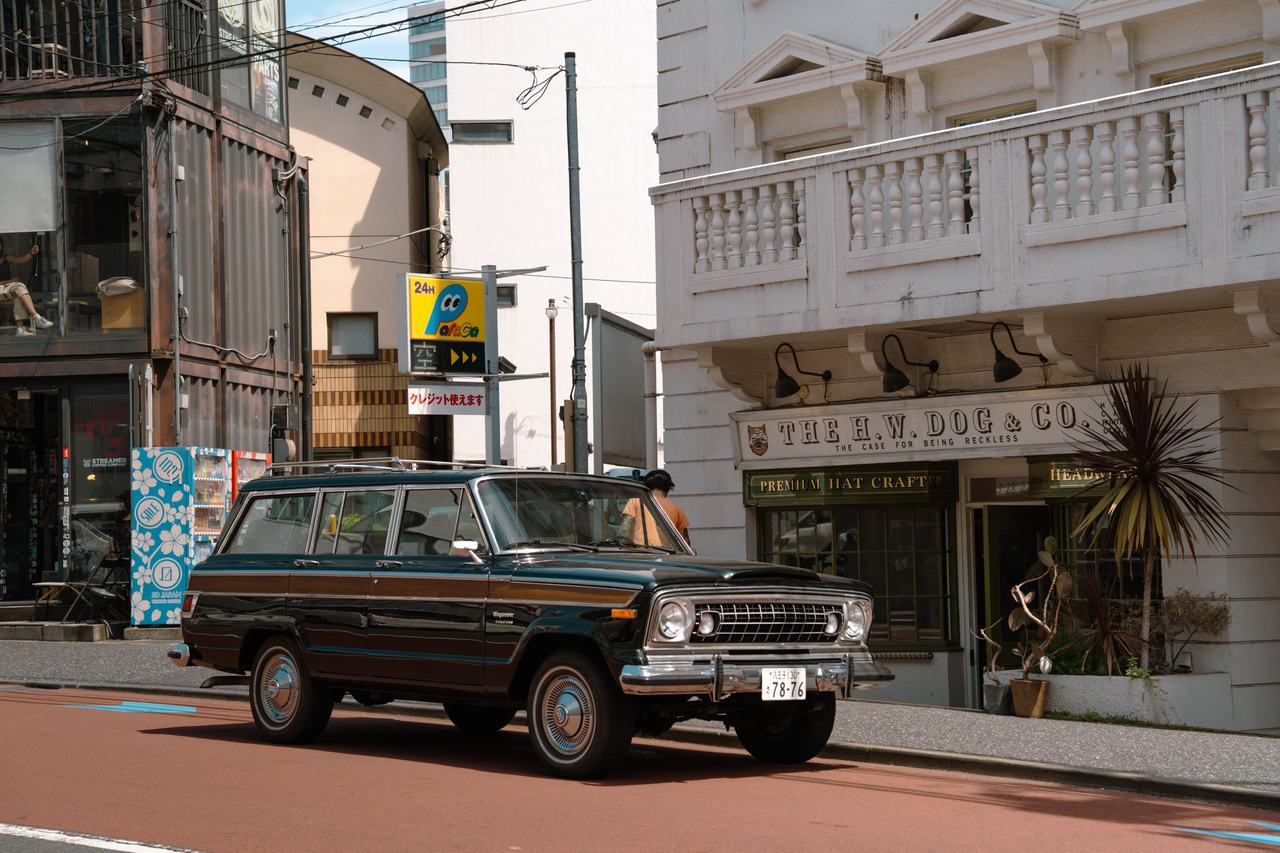
Opening photograph: A vintage wood-paneled SUV is parked outside a retro hat shop on a sunny Tokyo street. Photograph by Iban Lopez Luna on Pexels. Blog photo credits.